
Opinion
BRICS+ Summit: Geopolitical Challenges, Strategies and Expectations, by Kestér Kenn Klomegâh

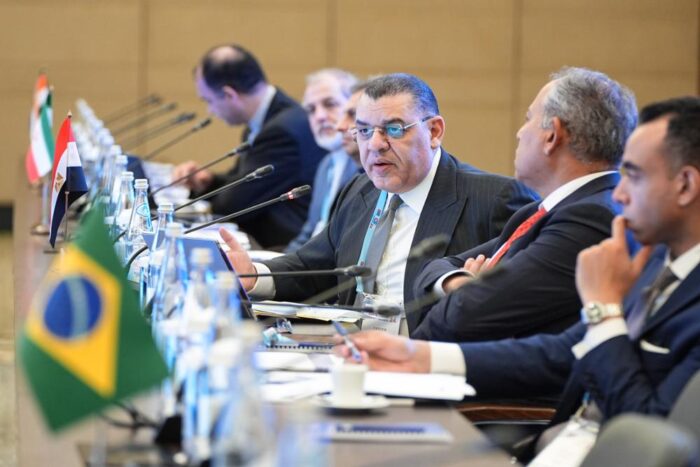
Under Russia’s presidency 2024, BRICS+ (Brazil, Russia, India, China and South Africa) has been building momentum for accelerating the association’s enlargement, steadily weakening Western influence in Global South, and continuing to maximize financial capabilities of the New Development Bank. Noticeably this year under Russia, BRICS has been reinforcing its economic and investment links, particularly in Asian and Africa regions, while at the same time, advocating vehemently for de-dollarization across the world.
Largely dissatisfied with the unipolar system and the world dominated by the United States, China and Russia are leading BRICS association to gradually dismantle the perceived invincibility of Western imperialism, tectonic promise of embarking on necessary reforms focusing on economic governance within the context of South-South cooperation. The scope of emerging tasks for newly expanded BRICS is potentially high for the New Development Bank which was established in 2015. Its founding capital stands at $100 billion.
In the Global South, BRICS+ has the possibility to raise its influence particularly in the economic sphere rather than mere greater and louder pledges. The New Development Bank has the same level of global scope to consolidate and increase its lending weight in the Global South. Compared to other multinational financial institutions, New Development Bank has the power to set off its own pace of supporting countries in the “partner group” who are put together by BRICS+ and their regional partners. The New Development Bank is therefore in reliable position to portray its reliability and predictability in raising the economic profile of members and those in the “partner group” as, essentially perhaps, those who oppose the status quo. This position has positive implications among them is the the rise of fairer possibilities for widening investment, a fairer interest-free conditions for obtaining investment loans from the BRICS Bank, and interactive multipolar order for the Global South.
With the heightening of geopolitics, Russia has to be congratulated for organizing more than 300 events under BRICS presidency. It has accomplished, through arranging partnerships with countries, the expected enlargement of the association which now stands extremely powerful on many significant questions including global security, food security for countries in the Global South, particularly Africa. Due to these issues of security and food security, and further the promise of investment support, many African States have dramatically considered BRICS as their long-term saviour. Majority of them are potential new members through “the partner category” as designated.
Research shows countries of the Shanghai Cooperation Organization (SCO), and those from the Commonwealth of Independent States (CIS) are interested in cooperation with BRICS+ and the forthcoming summit will definitely able to work out modalities of the partner category. Questions about the future of BRICS+ are bound to be there, especially when new world order is being discussed. Whether Russia, China and India and a number of countries, there are arguable variations in political, economic and cultural capabilities. More than sixty countries have currently taken an interest either in full membership of BRICS+ or some form of cooperation with BRICS+ association. This implies the end of “non-aligment” concept which appeared after the Cold War.
According reports, BRICS countries are the powerhouse of the global economic growth and their economies are expected to grow at 4.4% per annum in average during 2024-2025. This explicitly implies that development is increasingly becoming more dynamic, and the share of BRICS countries in the global economy is growing and stands at 36.7% at present, despite western calculated pressure. Nevertheless, BRICS+ continues shaping its status, and most importantly to maintain reliability within the framework of geopolitics and foreign policy.
The overarching reality highlighted by Russian President Vladimir Putin in January when Russia took over the rotating presidency, there have been in-depth analysis and insights into the fact that BRICS is open for political dialogue on building a new world order with “like-minded” friendly countries. Reiterating Kremlin’s position on expanding multifaceted cooperation and partnership among BRICS+ and continues making a significant contribution to maintaining peace and stability in the regions of Asia, Africa and Latin America.
Notable Achievements
On January 1, 2024, Russia’s BRICS chairmanship of the association began which, according to the decision adopted by the 15th BRICS Summit in August 2022, now includes 10 countries. Egypt, Ethiopia, Iran, Saudi Arabia, and the United Arab Emirates joined BRICS as new full members which is a strong indication of the growing authority of the association and its role in international affairs. At this point, the necessity to be reminded of BRICS underlying principles have been sovereign equality, respect for the chosen path of development, mutual consideration of interests, openness, consensus, the aspiration to form a multipolar international order and a fair global financial and trade system, and pursuit of collective solutions to top challenges of changing times.
Russia has operated under the motto “Strengthening Multilateralism for Just Global Development and Security” and, in collaboration with other BRICS+ members, acted precisely in that manner, and the main focus could be described as constructive cooperation with all countries concerned with its multidimensional agenda. Guided by the experience, Russia shared its tremendous strength to ensure this global security and promoted development, facilitated the harmonious integration of new participants in all formats of its activities. In general, Russia has continued to promote all aspects of the BRICS partnership in three key areas: politics and security, economy and finance, and cultural and humanitarian contacts.
Naturally, enhancing foreign policy coordination among the member countries has been the main role, and therefore designed the practical implementation of the Strategy for BRICS Economic Partnership 2025 and the Action Plan for BRICS Innovation Cooperation 2021–2024 for ensuring energy and food security, enhancing the role of BRICS in the international monetary system, expanding interbank cooperation and expanding the use of national currencies in mutual trade.
Preparations for Kazan Summit
On October 18, at the BRICS Business Forum in Moscow, Russian President Vladimir Putin will outline a comprehensive economic parameters, road-mapping the coordination for future development strategies, necessary steps on updated mechanisms of cooperation at all levels with BRICS+ and its partner group. Unlocking progressive pathways to promote sustainable business and future economic directions to dismantle the western dominance are highly commendable. In addition to above, China, India and Russia (Asia leaders) have taken full compliance with the important consensus on support other’s security and sovereignty, extend similar efforts to potential ‘friends’ in the Global South.
Both local Russian and foreign media have extensively written about the importance of BRICS+ Summit as a well-established platform and a key venue for constructive dialogue on global issues and businesses, and particularly in 2024 under Russia’s presidency thousands of countries indicate skyline interest to participate in its hundreds of programmes focusing on consolidating and building on the future of geopolitical relationships. The Kremlin website reported mid-October that high-level summit participation includes influential regional associations in Africa, Latin America, in the Middle East and in Southeast Asia as well as the Eurasian Economic Union (EAEU), the Union State of Russia and Belarus and the United Nations. The BRICS leaders have already expressed their collective preparedness to discuss emerging matters at the upcoming summit. On October 22-24, Kazan, the capital city of the Republic of Tatarstan, will be hosting a BRICS summit.


















You must be logged in to post a comment Login