
Forgotten Dairies
Age Is Not Acquittal: Babangida’s Legacy, Nigeria’s Unresolved Past, and Why Sowore Is Right -By Daniel Nduka Okonkwo
South Africa’s Truth and Reconciliation Commission was built on the precise principle that compassion and amnesty could coexist with truth-telling, but only if the truth was told first, fully, and on the record, not offered decades later in a commercially published memoir reviewed by friends. Argentina prosecuted generals well into their eighties, because the passage of time was never treated as a substitute for accountability. These are not foreign standards imported for rhetorical effect. They are the baseline against which any nation claiming to be a functioning democracy measures its own willingness to look at its past honestly.

Age deserves dignity. Every human being nearing the end of life is entitled to basic compassion, and nothing in a serious accounting requires wishing illness or death on an eighty-five-year-old man. But dignity for the person and scrutiny of the record he built are not competing claims. They can and must coexist, because the alternative, a country that quietly retires its history every time the person responsible for it grows old, is not reconciliation. It is the slow, deliberate manufacture of forgetting, and no nation that wants to be taken seriously by the standards of global accountability journalism can afford to keep choosing it.
I have to re-emphasize that Omoyele Sowore’s response is not out of place. At eighty-five, Ibrahim Badamasi Babangida deserves the compassion owed to any elderly Nigerian—but compassion must never become a burial ground for history. The man who once held Nigeria in the grip of military power cannot now be remembered merely as an ageing statesman whose controversial past should be softened by time. He was the ruler under whose watch June 12 was annulled, a democratic mandate was crushed, journalists and critics faced repression, officers were executed by military tribunals, and billions of dollars in oil revenue became the subject of unresolved national accounting. Time may have changed Babangida’s age; it cannot change the historical record. And if Nigeria is serious about calling itself a democracy, it must confront the question that political convenience has spent three decades trying to silence: Can an ageing former ruler be forgiven by history before history has finished asking its questions?
Every nation that has lived through military or authoritarian rule eventually faces the same test. Chile faced it with Pinochet. South Africa faced it with the architects of apartheid. Argentina faced it with the generals of its Dirty War. The test is simple to state and painful to pass. Can a country hold the men who once commanded its guns and its treasury to the same standard of scrutiny it demands of everyone else, once age, sentiment, or political convenience begin to argue for silence?
Nigeria is facing that test again, and it is failing it in the same way it always has, with nostalgia dressed up as respect.
Omoyele Sowore’s public exchange with Yusuf Datti Baba-Ahmed over remarks made about former military ruler Ibrahim Badamasi Babangida’s eighty-fifth birthday has reopened this test in the most direct terms Nigeria has seen in years. Baba-Ahmed, writing in Daily Trust, accused Sowore of attacking an elderly man and called for compassion. Sowore answered in a lengthy public statement, insisting that his criticism was never about Babangida’s age but about his record in power, and that no Nigerian, however old, should be shielded from that record simply because time has passed. He listed June 12, the killing of journalist Dele Giwa, the execution of military officers over alleged coup plots, and the Structural Adjustment Programme as matters Nigerians retain every right to examine. He also rejected the suggestion that citizens who refuse to defer to former rulers are a danger to Nigeria, arguing instead that the real danger is a political culture that rehabilitates failure and demands silence from anyone who will not participate in the rehabilitation.
I agree with the substance of that argument, though not with every rhetorical flourish attached to it. And having gone back to the documentary record rather than relying on memory or repetition, here is what a serious accounting actually shows, corrected where earlier commentary on this subject got ahead of the facts.
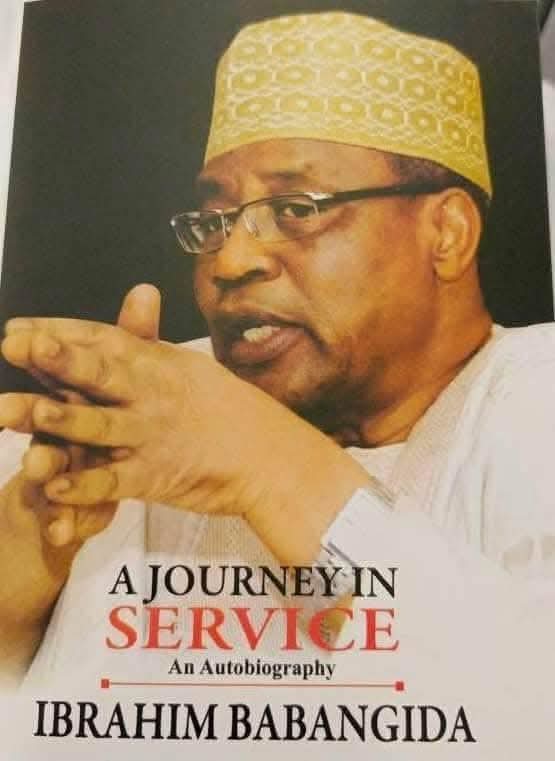
Babangida published his long-delayed autobiography, titled A Journey in Service, in Abuja on the twentieth of February 2025, at an event reviewed publicly by former Vice President Yemi Osinbajo and attended by former heads of state and senior political figures. The four hundred and twenty-page memoir was, by his own framing, an attempt to complete the historical accounting of his years in power with what he called finality and clarity. It did not achieve that. What it achieved instead was the reopening of arguments many Nigerians assumed had calcified into permanent ambiguity.
The most consequential admission in the book is also the simplest to state. For the first time in more than three decades, Babangida acknowledged unambiguously that Moshood Kashimawo Olawale Abiola won the June 12, 1993, presidential election, satisfying both the majority vote and the geographical spread required under the constitutional formula of that transition. This was not a small concession. As recently as 2018 he had declined to make it, saying only that Abiola was on the verge of winning. The admission matters because it closes one argument that consumed Nigerian political discourse for a generation. Who won June 12 is no longer a live question.
But the memoir does something more complicated than simply admitting guilt and accepting punishment, and any serious account of it has to hold two facts side by side rather than choosing the one that is easier to write. Babangida writes that he was away in Katsina attending a funeral when the annulment was announced, and that the announcement was made by an aide to his deputy, Admiral Augustus Aikhomu, on a hastily written statement bearing no presidential seal. He states that he later established the annulment had been driven by forces under his then Chief of Defence Staff, General Sani Abacha, acting without his direct authorization. At the same moment, in the same memoir, he states plainly that as the leader of the administration, he accepts full responsibility for everything done under his watch, and that June 12 happened on his watch regardless of who executed it. The Abacha family has since publicly rejected this account as an attempt to shift blame onto a man no longer alive to contest it.
Both things are true simultaneously. Babangida has placed operational blame on Abacha while accepting command responsibility for himself. A rigorous reading does not have to choose between these two claims to render its own verdict. It has to be noted that an autobiography, however candid in places, remains a single participant’s testimony, produced more than three decades after the events it describes, unverified by cross-examination, and unsupported by any independent judicial finding. It is source material. It is not adjudication. The same standard applied by historians to the memoirs of Pinochet’s generals or the self-justifying accounts of apartheid era security chiefs applies here. Personal testimony from a former commander is evidence to be weighed against the rest of the record, not evidence that gets the final word simply because it was published last.
The rest of the record is well documented and does not require exaggeration to be damning. Journalist Dele Giwa was killed by a parcel bomb in October 1986, during Babangida’s tenure, days after being interrogated by state security operatives. No judicial process has ever produced a definitive resolution of who ordered the killing, and responsible journalism must preserve that distinction rather than convert suspicion into a verdict. But the absence of a conviction is not the same as the absence of a legitimate question, and thirty nine years of unresolved ambiguity around the killing of a journalist under a military government is itself part of the historical record, not a footnote to it.
Major General Mamman Vatsa, a close personal associate of Babangida, was executed in 1986 after conviction by a military tribunal over an alleged coup plot, a case that remains contested among historians as to its fairness and its true motive. Major Gideon Orkar and a group of fellow officers were executed following the failed coup attempt of 1990. These were not obscure episodes. They demonstrated, in the starkest possible terms, the totality of power a military government held over the lives of citizens and soldiers alike, exercised through tribunals that answered to no electorate and to no independent judiciary.
The transition programme itself deserves the same unsentimental treatment. Between 1985 and 1993, Babangida’s government created and dissolved political parties, rewrote transition timetables, and repeatedly postponed the promised return to civilian rule, a pattern that international human rights monitors at the time described as military government extending itself years beyond its own announced deadlines. Whether that pattern reflected a genuine intention to hand over power that kept being derailed by circumstance, or a slower and more deliberate reluctance to relinquish it, is a legitimate historical question, and Sowore’s insistence on asking it is not an act of malice. It is the ordinary work of democratic memory.
On the finances, precision matters more than outrage. The Pius Okigbo Panel, established in 1994 to examine the Central Bank of Nigeria, found that approximately twelve point four billion dollars in oil windfall revenue, generated substantially from the 1990 Gulf War price spike, passed through a set of off budget Dedicated and Special Accounts between 1988 and June 1994, and that the balance remaining in those accounts by the time of the panel’s work had fallen to roughly two hundred million dollars. Babangida has defended this record directly, arguing in his memoir and in subsequent interviews that the funds financed the Ajaokuta steel project, port and bridge construction, and revenue sharing with state and local governments, and that spending twelve point four billion dollars productively across six years was, in his words, a reasonable outcome rather than a scandal. No court has ever convicted him of personally converting these funds. That absence of a criminal conviction is a fact that belongs in any honest account. So does the fact that a federal panel found that public oil revenue was managed through accounts hidden from ordinary budgetary oversight, known only to a handful of officials, a structure that by any international standard of public finance transparency would not survive scrutiny today. Accountability journalism does not need to inflate this into a theft conviction that never happened. It only needs to state, accurately, that the opacity itself was the scandal, and that Nigerians were never given the accounting the Okigbo Panel recommended.
None of this erases what Babangida’s defenders can legitimately point to. Financial liberalization, the expansion of the banking sector, the creation of new states, and elements of his foreign policy record are claims his supporters are entitled to make and have made, and a serious record holds space for them exactly as it holds space for the abuses. The work of journalism, done at a global standard rather than a parochial one, is not to produce a saint or a villain. It is to place competing, sourced claims next to each other and let the documentary weight of each stand or fall on its own evidence.
This is the standard the world has already set for itself, and it is the standard Nigeria keeps declining to apply to its own history. Chile did not wait for Pinochet to die before its courts and its truth commission began assembling the record of his rule, and his frailty in his final years never became a reason to stop the legal process against him. South Africa’s Truth and Reconciliation Commission was built on the precise principle that compassion and amnesty could coexist with truth-telling, but only if the truth was told first, fully, and on the record, not offered decades later in a commercially published memoir reviewed by friends. Argentina prosecuted generals well into their eighties, because the passage of time was never treated as a substitute for accountability. These are not foreign standards imported for rhetorical effect. They are the baseline against which any nation claiming to be a functioning democracy measures its own willingness to look at its past honestly.
Nigeria has instead developed a different pattern, in which former rulers age into affectionate titles, in which anniversaries substitute for accounting, and in which criticism of a former dictator’s record is treated as an attack on an elderly man rather than as the ordinary civic duty of a democracy that wants its present leaders to know they will eventually answer for their decisions too. Sowore’s argument, stripped of the personal edges of his exchange with Baba-Ahmed, is fundamentally a demand that Nigeria apply to itself the standard the rest of the accountable world has already normalized. That demand is correct, and it should not depend on whether one finds Sowore’s tone congenial.
The facts of June 12 are no longer seriously disputed. The facts of Dele Giwa’s killing remain judicially unresolved but historically documented. The facts of Vatsa’s execution, the Orkar executions, the stalled transition programme, and the Okigbo Panel’s findings on oil revenue are all part of the public record, verifiable, sourced, and independent of anyone’s political affiliation. A memoir can add context to that record. It cannot replace it. And a nation that allows an autobiography to function as the final word on a military ruler’s legacy has not practiced compassion. It has practiced amnesia, dressed in better prose than usual.
Daniel Nduka Okonkwo is an investigative journalist, human rights advocate, and policy analyst based in Abuja, Nigeria. He is the publisher of Profiles International Human Rights Advocate, a platform focused on accountability journalism, governance reporting, and the documentation of human rights issues across Africa. His work examines the intersection of political power, institutional accountability, systemic failure, and the human impact of corruption, with particular focus on Nigeria and the wider African continent.
Okonkwo’s reporting and analysis have been published in Sahara Reporters, African Defence Forum, Daily Trust, Vanguard, Daily Intel, Opinion Nigeria, African Angle, Local Newsbreak, and other international media outlets. His work is driven by a commitment to transparency, democratic governance, and justice. He also collaborates with Daniels Entertainment on human rights initiatives, extending his advocacy beyond traditional journalism into broader public engagement.
He is based in Abuja, Nigeria, and can be reached at dan.okonkwo.73@gmail.com.




















You must be logged in to post a comment Login