
Education
Souvenir from the Yobe Spelling Bee 2026 (I) -By Ali Tijjani Hassan
The Yobe Spelling Bee is, without doubt, setting a pace for a future trajectory built around education, confidence, talent and the pursuit of excellence among the younger generation of Yobe State. Let’s come back tomorrow to witness what the next session “knock-out stage” would offer to us. But I believe that many emotional moments would unfold.

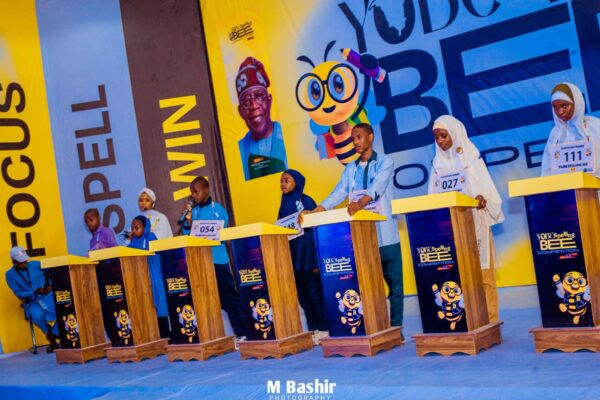
I’m in Damaturu to witness the third edition of the Yobe State Spelling Bee Competition, and to be honest, I might not be doing justice to what I witnessed if I wait for decades before telling my unborn children about how Governor Mai Mala Buni, CON, is gradually refining the educational sector in Yobe State during his tenure.
The programme was declared open by His Excellency, the Deputy Governor of Yobe State, Alhaji Idi Barde Gubana, Wazirin Fune, who encouraged the young participants to give their best and make their respective communities proud. As he said, and I quote: “Forty-five years back, we were at your level, but today we are at the mantle of leadership and about to exit. You are indeed the leaders of tomorrow, and you are on the right track.” The Deputy Governor also appreciated the Secretary to the Yobe State Government, Dr. Mohammed Goje , FRSPH, for initiating, sustaining and continuously improving this remarkable programme. He described it as an epitome of Dr. Goje’s foresighted, selfless and transformative leadership in redefining the future of young people across the state.
It gladdened my heart to see some of the finest young brains among us serving as judges and facilitators. Among them was my friend, Shamsiyya Ibrahim Barde, a recent UN guest and UNOCT champion, who served as the lead judge, while Zara Alim Bakari, as the Master of Ceremony.
Then came the preliminary stage, where every participant was given an opportunity to step onto the podium and demonstrate what they had upstairs. It was one of those experiences you genuinely wish you could record and replay. I saw young and talented teenagers trying to figure out what they could do with their abilities. For me, that is one of the greatest values of the Spelling Bee. Beyond competition, it gives young people a platform to discover, sharpen and showcase their abilities while preparing themselves for a world that will demand excellence from them.
And, of course, the real drama started when a young man who, by all indications, is my Fulani brother, was asked to spell “Maritime.” My brother attempted the spelling three times. There was a disagreement among the judges about his alphabet pronunciation, largely because of mother-tongue interference. For those of us in the audience, it became difficult to determine whether the sound he was producing in the second syllable was either “M” or “N.” As the debate intensified and the young man probably realised that his English-language command was not going to rescue him, he switched to Hausa and asked: Wai ko ba ‘Maritime’ ake nufi ba?”
The entire hall erupted in laughter. That young man single-handedly revived the energy in the room. But beyond the laughter, I admired something about him: confidence. He was not afraid to attempt the word, even when he wasn’t entirely certain of himself. And sometimes, that confidence to stand before people, make an attempt, and keep going despite a barrier is itself a form of education.
Of course, I saw many other vibrant young people who came fully prepared to take the trophy home. Their confidence, composure and command of words were genuinely impressive.
Then came another moment that caught my attention. A young participant with visual impairment appeared on stage and was asked to spell “Senator.” He requested the assistance necessary to participate effectively, explaining how he had been taught to read and interpret words through a system that differed from what most of us were familiar with. That moment made me appreciate something beyond the competition itself, the level of preparation that had gone into making the programme inclusive. It reminded me that education is not truly transformative until it makes room for everyone.
I was equally impressed by the commitment of the organisers and stakeholders. The Secretary to the State Government, Dr. Mohammed Goje, alongside members of his team and associates, including Dr. Sa’id Ali Kori of Thinklab, Dr. Suleiman Dauda of SOLID, Dr. Bulama Maina Yaro of the Yobe State Pilot Livestock Development Programme, Dr. Babagana Muhammad of Nigeria Food Corporation, and Prof. Sheriff Almuhajir of YMFB, who maintained a constant presence throughout the programme despite their various professional and personal commitments. That, to me, speaks of a powerless communication about the importance attached to the initiative.
The Yobe State Spelling Bee Competition is becoming more than an academic competition. It is creating a platform where young people can discover their confidence, test their abilities, compete with their peers and begin to imagine themselves in spaces of excellence.
And perhaps the greatest lesson from the competition is one I have always believed: School was never a scam. Give a child the right environment, expose them to opportunities, challenge them intellectually, and you may be watching the early stages of someone who will one day change your community.
The Yobe Spelling Bee is, without doubt, setting a pace for a future trajectory built around education, confidence, talent and the pursuit of excellence among the younger generation of Yobe State. Let’s come back tomorrow to witness what the next session “knock-out stage” would offer to us. But I believe that many emotional moments would unfold.
Ali Tijjani Hassan, writes from Damaturu.





















You must be logged in to post a comment Login