Africa
Fuel Scooping And Some Nigerians’ “If We Die, We Die” Mindset -By Isaac Asabor
So when another tanker overturns and crowds rush in, the real failure is collective. Government has failed to enforce safety standards and provide economic relief. Regulators have failed to secure transport routes and pipelines. Communities have failed to internalize hard lessons paid for in blood. Individuals have failed to resist a mindset that treats death as an acceptable bargaining chip.

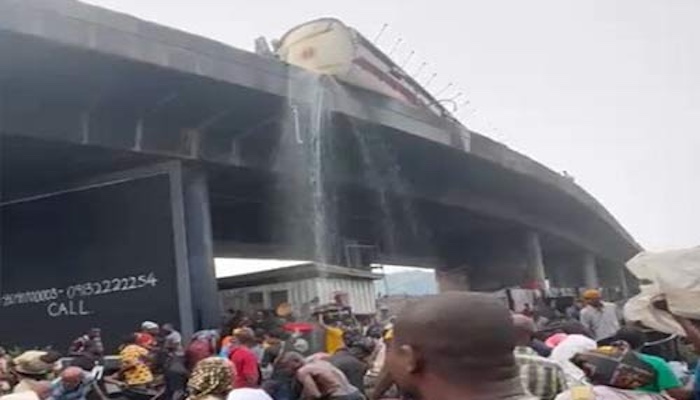
Another tanker overturns. Another crowd gathers. Containers appear from nowhere. Phones are raised, engines idle, cigarettes glow. Warnings are shouted and ignored. Then, as if on cue, fire erupts. Lives are lost. A few statements are issued. The country moves on, until the next spill. This pattern has become so familiar that shock itself feels dishonest. What we are witnessing is not a series of accidents; it is a mindset. A fatalistic creed that says: “if we die, we die”. It is the logic of resignation dressed up as courage, and it is killing Nigerians with depressing regularity.
The recent footage from the Tin Can Bridge area in Lagos, where residents were seen scooping fuel from an overturned tanker, did not introduce anything new. It merely confirmed, again, that years of funerals, warnings, and official campaigns have failed to uproot a dangerous belief: that immediate gain, however small, is worth any risk, however obvious.
Nigeria has rehearsed this tragedy for over two decades. From Jesse in Delta State in July 2000, where more than 1,000 people were killed during fuel scooping, to Abule Egba in 2006, where hundreds died in a single inferno, the lesson has been delivered repeatedly and brutally. Fuel vapour ignites. Sparks trigger explosions. Crowds turn into casualties in seconds. Yet the behaviour persists.
Between July and November 2000 alone, pipeline explosions in Jesse, Ebute Metta, Adeje, and Warri claimed well over 1,300 lives. In the years that followed, Umuahia, Inagbe Beach, Abule Egba, Arepo, Isheri, and parts of Rivers and Delta States all joined a long roll call of avoidable deaths. More recently, the tanker explosions in Jigawa and Niger States between late 2024 and early 2025 reportedly killed over 300 people in just two incidents.
If this were ignorance, it would have ended long ago. Nigerians know what fuel can do. They have seen the images. They have attended the burials. They have heard the warnings from the NNPC, the FRSC, and emergency agencies. What drives people back to the scene of danger is not lack of knowledge; it is a lethal mix of desperation, denial, and fatalism.
The “if we die, we die” mindset did not appear overnight. It is the product of years of economic decline, rising unemployment, inflation, and the steady erosion of hope. When fuel prices rise beyond reach and daily survival becomes a gamble, spilled petrol begins to look like an opportunity rather than a threat. People do not suddenly forget the risks; they convince themselves they can beat them.
This is where the biblical parallel often cited becomes relevant. Like the lepers at the city gate who asked, “Why sit we here until we die?” and reasoned that entering the famine-stricken city meant death while staying put guaranteed the same fate (2 Kings 7:3–4), some Nigerians convince themselves that doing nothing is worse than risking everything. But there is a crucial difference: the lepers made a calculated choice under siege; Nigeria has turned that calculation into a permanent habit.
In fact, given the foregoing backdrop, it is not out of place to opine that fatalism has become normalized. One hears it at accident scenes: “Na God hand e dey.” One hears it after explosions: “Anything wey go happen go happen.” This language is not faith; it is surrender. And when surrender becomes widespread, safety collapses.
Still, hardship alone does not explain this phenomenon. Poverty exists in many countries, yet mass fuel scooping at spill sites is not a routine spectacle everywhere. What distinguishes Nigeria is how weak enforcement, poor infrastructure, and public distrust of institutions combine to reward reckless behaviour.
Tankers routinely travel through densely populated areas with little oversight. Roads are poorly designed and inadequately maintained. Emergency response is often slow. Pipeline vandalism goes largely unpunished. When people see that laws are inconsistently enforced and accountability is rare, they stop believing that restraint has value.
Public enlightenment campaigns, however well-intentioned, cannot compete with lived experience. A radio jingle warning against fuel scooping means little when people have watched others scoop fuel repeatedly without consequences. Information without enforcement becomes background noise.
This does not absolve individuals of responsibility. Knowing the danger and proceeding anyway is a choice. But it is a choice shaped by an environment where short-term survival is prioritized over long-term safety, and where tragedy is so common it no longer deters.
The environmental cost of this mindset is just as devastating. The Niger Delta, already one of the most polluted regions on earth, has suffered decades of oil spills from sabotage, vandalism, and poorly maintained infrastructure. Farmland has been destroyed. Waterways contaminated. Livelihoods lost. Fuel scooping does not only kill instantly; it entrenches environmental damage that condemns communities to future hardship, feeding the same desperation that fuels the next disaster.
Data underscores the scale of the problem. Nigeria loses an estimated 300,000 barrels of oil daily to theft and vandalism, costing billions of dollars annually. Between 2003 and 2015, over 1,600 people reportedly died in pipeline explosions in the Niger Delta. These are not abstract numbers. They represent families wiped out, communities scarred, and a nation repeatedly failing to protect itself.
So when another tanker overturns and crowds rush in, the real failure is collective. Government has failed to enforce safety standards and provide economic relief. Regulators have failed to secure transport routes and pipelines. Communities have failed to internalize hard lessons paid for in blood. Individuals have failed to resist a mindset that treats death as an acceptable bargaining chip.
The uncomfortable truth is this: Nigeria cannot campaign its way out of this crisis alone. Warnings have reached saturation. What is missing is credibility, credible enforcement, credible punishment, and credible alternatives for people who feel they have nothing to lose.
At the same time, Nigerians must confront the cost of fatalism. Saying “if we die, we die” does not make death noble or unavoidable. It makes it predictable. Every time that phrase is acted upon, another name is added to a list that is already far too long.
This is not about blaming the dead. It is about refusing to keep rehearsing the same tragedy. A society that learns nothing from repeated disasters is not unlucky; it is careless with human life.
Until Nigeria decisively rejects the “if we die, we die” mindset, through policy, enforcement, and cultural change, the fires will keep coming. And when they do, the shock will be fake, the mourning brief, and the lessons once again ignored.