Forgotten Dairies
In Condemnation Of APC’s City Boy Movement’s ‘Gift-for-Hand’ Today, ‘Vote-for-Box’ Tomorrow Campaign Strategy -By Isaac Asabor
The Owerri episode should therefore serve as a wake-up call. Nigeria’s democracy cannot continue to thrive on theatrics and transactional politics. It must evolve into a system where citizens demand ideas rather than inducements, and where politicians compete on the strength of their policies rather than the size of their gift packages.

In a democracy that claims fidelity to the ideals of fairness, transparency, and informed participation, electioneering is expected to revolve around ideas. Political actors are supposed to persuade citizens with policies, programs, and demonstrable records of leadership. Voters, on their part, are expected to weigh these offerings and decide who is best suited to manage the affairs of the state. When these democratic norms are respected, elections become meaningful contests of vision rather than festivals of inducement.
Unfortunately, the recent political spectacle associated with the “City Boy Movement” campaign in Owerri presents a disturbing departure from these ideals. What was packaged as youth empowerment and civic engagement looked, to many observers, like a carefully staged display of political patronage, a strategy that can only be described as gift-for-hand today, vote-for-box tomorrow.
The event, linked to the ruling All Progressives Congress (APC) and promoted under the “City Boy Movement,” was ostensibly organized to empower young Nigerians and mobilize grassroots support. High-profile personalities, including Seyi Tinubu, were present, and the gathering attracted large crowds of young people eager to benefit from what was advertised as empowerment opportunities.
Yet beneath the colorful banners, the music, and the rhetoric of youth development lay a troubling pattern that Nigerians have seen too often in the country’s political landscape.
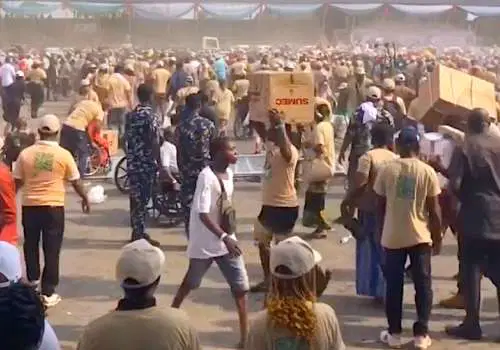
At the rally, various items, including bags of rice, sewing machines, and minibuses, were reportedly distributed to attendees. These were presented as empowerment tools intended to support small-scale entrepreneurs and alleviate economic hardship. However, what unfolded soon after revealed the deeper logic of the exercise.
Crowds surged forward in desperate attempts to grab the distributed items, turning the event into a chaotic scramble. Videos that circulated afterward showed people pushing, shoving, and competing for handouts in scenes that looked less like civic engagement and more like the seasonal charity distribution associated with Father Christmas festivities.
It was a spectacle that inadvertently exposed the true nature of the strategy behind the event.
In a mature democracy, political campaigns are not supposed to resemble gift-distribution carnivals. They are supposed to be forums where candidates present solutions to pressing national problems, economic hardship, unemployment, insecurity, infrastructure deficits, and institutional decay.
Instead, what Nigerians witnessed in Owerri appeared to be an elaborate attempt to cultivate political loyalty through material inducement.
This approach is not new. It has long been embedded in Nigeria’s political culture. Politicians distribute food items, motorcycles, cash envelopes, and other material benefits in the hope that beneficiaries will feel morally obligated to reciprocate with electoral support.
But dressing up this old tactic in the language of youth empowerment does not make it any less problematic.
The City Boy Movement rally simply modernized a familiar formula: mix celebrity culture with political branding, add a dose of youth mobilization, sprinkle in a generous supply of handouts, and present the entire package as grassroots engagement.
The underlying message, however, remains unmistakable: take these gifts today and remember when the ballot boxes appear tomorrow.
This is precisely why the Owerri event deserves strong condemnation from all who care about the health of Nigeria’s democracy.
First, such tactics undermine the dignity of the electorate. Citizens should not be reduced to passive recipients of political generosity. The act of voting is a sacred civic duty, not a transaction to be negotiated with bags of rice or sewing machines.
When politicians rely on material inducement rather than persuasive ideas, they insult the intelligence and autonomy of the very citizens whose mandate they seek.
Second, the gift-for-vote culture erodes the principle of accountability. When political loyalty is secured through patronage, voters may feel compelled to overlook incompetence, corruption, or policy failure simply because they benefited from earlier handouts.
This creates a vicious cycle in which politicians focus more on distributing temporary benefits than on delivering long-term development.
Third, such practices degrade political discourse. Instead of discussing economic reform, educational transformation, or national security strategy, political engagement becomes a contest over who can distribute the most attractive incentives.
The result is a democracy that operates more like a marketplace of patronage than a forum of ideas.
The troubling aspect of the City Boy Movement campaign strategy is that it specifically targets young people, the demographic group that ideally drive a more enlightened political culture.
Nigeria’s youth population is energetic, creative, and increasingly politically aware. They deserve platforms that respect their intellect and aspirations. They deserve serious conversations about technology, innovation, job creation, and the future of governance.
Reducing youth’s engagement to entertainment rallies and gift distribution risks trivializing their political agency.
Young Nigerians should not be mobilized as crowds to cheer political figures or scramble for empowerment items. They should be mobilized as citizens capable of shaping national conversation.
Moreover, the optics of such events are particularly troubling in the current economic climate.
Many Nigerians are grappling with rising food prices, unemployment, and declining purchasing power. Against this backdrop, political rallies where elites distribute symbolic items while cameras roll can easily appear insensitive.
It sends the message that political leaders are more interested in staging spectacles than addressing structural economic challenges. There is also a deeper institutional concern.
Nigeria is not yet in an official election campaign season. The whistle for the 2027 general elections has not been blown, and the regulatory framework governing campaign activities remains in force.
This raises an important question: at what point does political mobilization cross the line into premature electioneering? Events like the City Boy Movement rally blur that line dangerously.
When political gatherings are structured around building electoral loyalty through material inducements years before an election, they risk undermining the regulatory authority designed to ensure fair competition among political actors.
That is why silence from relevant institutions would be a grave mistake. The Independent National Electoral Commission (INEC) has a constitutional responsibility to safeguard the integrity of Nigeria’s electoral process. While political association and civic engagement are legitimate activities in any democracy, actions that resemble covert campaign mobilization must be scrutinized.
If political actors are allowed to engage in large-scale inducement campaigns under the guise of empowerment programs long before the official campaign period begins, the spirit of electoral regulation will be severely compromised.
The Owerri episode should therefore serve as a wake-up call. Nigeria’s democracy cannot continue to thrive on theatrics and transactional politics. It must evolve into a system where citizens demand ideas rather than inducements, and where politicians compete on the strength of their policies rather than the size of their gift packages.
The “gift-for-hand today, vote-for-box tomorrow” strategy belongs to a political culture that Nigerians should be striving to leave behind.
In conclusion, it is imperative that INEC take note of the troubling precedent represented by the City Boy Movement campaign activities in Owerri. The commission should openly condemn any political mobilization that resembles premature electioneering, particularly when the official whistle for the 2027 election cycle has not yet been blown.
Such a clear stance would send a powerful message that Nigeria’s democracy is governed by rules, not by the theatrics of political Santa Claus campaigns disguised as empowerment programs.
Only by drawing firm boundaries now can the country hope to preserve the integrity of its electoral process in the years ahead.