National Issues
Insecurity in Nigeria: A Deep Look at Current Challenges, Root Causes, and the Way Forward -By Alfred Esther Oghenebrume
When crime is no longer profitable and the system of paying ransoms is replaced by swift, strict judicial prosecution, the incentive to pick up arms will disappear. Only by establishing a transparent rule of law and protecting rural livelihoods can Nigeria finally restore its sovereignty and guarantee peace for its citizens.

In 2026, the issue of insecurity remains the biggest challenge facing the Nigerian nation. Over the last decade, when people talked about insecurity in Nigeria, they usually meant the Boko Haram terrorism in the North-East or the oil-related militancy in the Niger Delta. However, the situation has completely changed today. Insecurity is no longer a localized problem confined to just one or two regions. Instead, it has grown into a massive, decentralized network of criminal activities that affects every single geopolitical zone in the country. From organized mass kidnappings to violent land disputes, criminal operations have become highly commercialized, turning insecurity into a blooming business that threatens the daily survival, economic stability, and basic peace of millions of everyday citizens.
One of the most alarming shifts observed in the first half of 2026 is the rapid spread of high-profile kidnappings into the South-West geopolitical zone, an area that was previously considered relatively safe compared to other regions. In recent months, daring armed gangs have carried out coordinated ambushes along major highways, boldly attacking interstate travelers and invading rural boarding schools in states like Oyo and Ondo. These are not random, isolated events; they are highly planned operations where criminals track targets, extract victims quickly, and retreat into deep forest reserves. This expanding wave of criminality shows that kidnapping networks have increased their logistical strength and are successfully setting up operational bases in areas that used to enjoy peace.
Furthermore, this geographic expansion has deeply affected quiet rural and mining communities, particularly along the borders of Osun East. In these remote areas, illegal artisanal gold mining has become directly tied to the security crisis. Foreign and local criminal syndicates have taken over these informal mining sites, using them to achieve two main goals. First, the unregulated gold trade provides these gangs with massive, completely untraceable cash reserves that they use to fund their operations and buy black-market weapons. Second, the thick forests and rough terrains surrounding these mining sites give the criminals a physical shield, making it incredibly difficult for conventional local police detachments to track them down or launch successful raids.
While the South-West deals with this new wave of kidnappings, the nature of security challenges in Northern Nigeria has also gone through a massive transformation. The problem has largely shifted from a purely religious or ideological insurgency into aggressive, profit-driven economic crime. It is true that major military operations over the past few years have successfully pushed large terrorist groups out of major towns and local government capitals. However, smaller, highly mobile factions of groups like Jama’atu Ahlis Sunna Lidda’awati wal-Jihad (Boko Haram) have adapted by breaking into decentralized cells. Instead of trying to hold large territories, these cells now focus on carrying out quick hit-and-run attacks on soft targets, such as rural markets, transport vehicles, and isolated military outposts before disappearing back into hiding.
A major reason these northern criminal cells remain so resilient is their ability to exploit the porous, unguarded borders of the Sahel and the Lake Chad basin. Nigeria shares thousands of kilometers of land borders with neighboring countries, and many of these border stretches run through thick forests, vast plains, and unmanned desert paths. Criminal syndicates and terrorists move back and forth across these international lines with total ease. When the Nigerian military launches a heavy offensive in a particular state, these groups simply cross the border into neighboring nations to rest, gather new supplies, and recruit members. Once the military pressure cools down, they cross back into Nigerian territory to launch fresh attacks, exploiting the lack of synchronized, cross-border policing among regional governments.
To truly understand why insecurity is so hard to wipe out, we must look past daily political headlines and examine the deep-seated environmental and economic root causes. At the top of this list is severe climate change, specifically the rapid desertification of the far northern belt and the steady shrinking of the Lake Chad water basin. For decades, these areas supported millions of pastoral herders and farmers. Now, as the land dries up and turns to desert, these herders are structurally forced to migrate southward in massive numbers to find green pastures and fresh water for their livestock. As these migrating groups move into the Middle Belt and Southern regions, they inevitably run into established farming communities. Because land is a limited resource, these encounters quickly turn into fierce competition over water and soil, frequently escalating into bloody communal clashes.
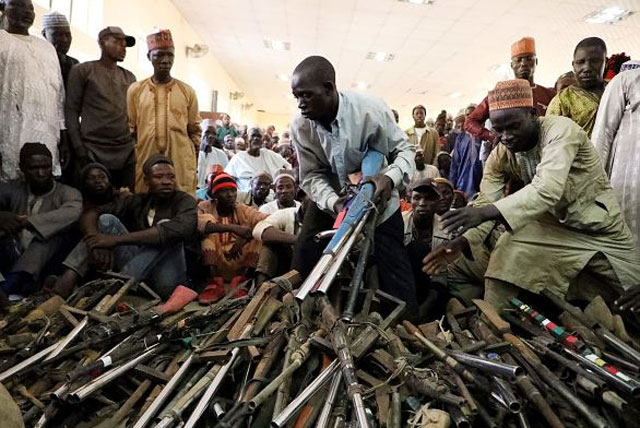
This environmental crisis is made much worse by the massive influx of cheap, illegal small arms and light weapons flowing into the country. Due to civil unrest and weak governance across the wider Sahel region, weapons from old conflict zones flow south through smuggling routes directly into the hands of Nigerian bandits and local militias. Because these military-grade firearms are so cheap and easy to get, localized criminal gangs are often better armed than the rural police stations assigned to protect small communities. When a local gang possesses automatic rifles and rocket-propelled grenades while the local police only have basic firearms, it creates a severe security imbalance that leaves rural populations entirely defenseless.
On top of environmental and weapon problems, the government’s approach to handling these crises has inadvertently created an environment of impunity. For a long time, the dominant strategy for dealing with mass abductions has been a reactive model focused on back-channel financial negotiations and paying ransoms to secure the release of victims. While saving lives is completely understandable, this approach has accidentally turned kidnapping into the most profitable business venture in the country. When criminal gangs realize they can make millions of naira in a single week with very little risk of being prosecuted in a court of law, crime becomes an attractive option. The massive ransom capital they collect is rarely kept idle; it is systematically reinvested into buying heavier weapons and paying informants, allowing the gangs to grow bigger than local security forces.
The human and economic cost of this ongoing cycle of violence is absolutely devastating, particularly for rural agriculture and national food security. Agriculture is the backbone of Nigeria’s rural economy, but today, millions of farmers across the major food-producing belts are terrified to visit their fields. Bandits routinely raid farming villages, burn food barns, and abduct laborers directly from the fields. In many areas, local warlords have established a system of extortion, forcing farmers to pay heavy illegal taxes just for permission to plant or harvest their crops. Many families cannot afford these bribes, leaving them with no choice but to abandon their lands and flee to overcrowded displacement camps. This widespread disruption has caused massive food shortages, driving historic food inflation that makes basic food items unaffordable for ordinary citizens in urban markets.
Alongside the agricultural crisis, the educational sector is bearing a massive, heartbreaking burden that threatens the future of an entire generation. Because rural boarding schools and outlying university campuses are isolated, they have become prime targets for mass kidnappings. In response to this constant threat, state governments and school authorities have been forced to implement proactive, defensive closures of hundreds of educational institutions across vulnerable areas. Shutting down these schools may protect children from immediate danger, but it completely disrupts their learning and expands the national literacy gap. Even worse, keeping thousands of young people out of classrooms leaves them idle, impoverished, and highly vulnerable to being targeted, manipulated, or recruited by the very criminal networks that shut down their schools in the first place.
Fixing Nigeria’s current security crisis requires an immediate and total shift away from relying solely on reactive military force. While strong military action is necessary to dislodge armed groups, permanent peace cannot be achieved through bullets alone. The government must transition toward a community-centered, intelligence-led prevention framework. This means national security policies must focus on establishing a permanent, visible, and helpful civic authority inside ungoverned spaces, deep forests, and abandoned border regions. Security cannot be effectively managed from comfortable, distant urban military commands; law enforcement must live within and protect the rural spaces where these criminal networks currently rule.
Finally, the government must take aggressive action to smash the financial heart of the entire security crisis. Bandits and kidnappers rely completely on the informal financial system to move, clean, and use their ransom money. By strictly monitoring informal cash transfers, regulating mobile money platforms, and aggressively prosecuting the high-profile individuals who act as financial facilitators, the state can choke off the money flowing into these networks. When crime is no longer profitable and the system of paying ransoms is replaced by swift, strict judicial prosecution, the incentive to pick up arms will disappear. Only by establishing a transparent rule of law and protecting rural livelihoods can Nigeria finally restore its sovereignty and guarantee peace for its citizens.