Politics
It Is High Time Wike And His Acolytes Allowed Fubara To Drink Water And Drop The Cup -By Isaac Asabor
The choice before Rivers political actors is clear. They can respect the mandate freely given by the people; allow the governor the peace of mind to work, and reserve impeachment for genuine constitutional breaches. Or they can persist in political suffocation, turning every disagreement into a crisis and every tenure into a battlefield.

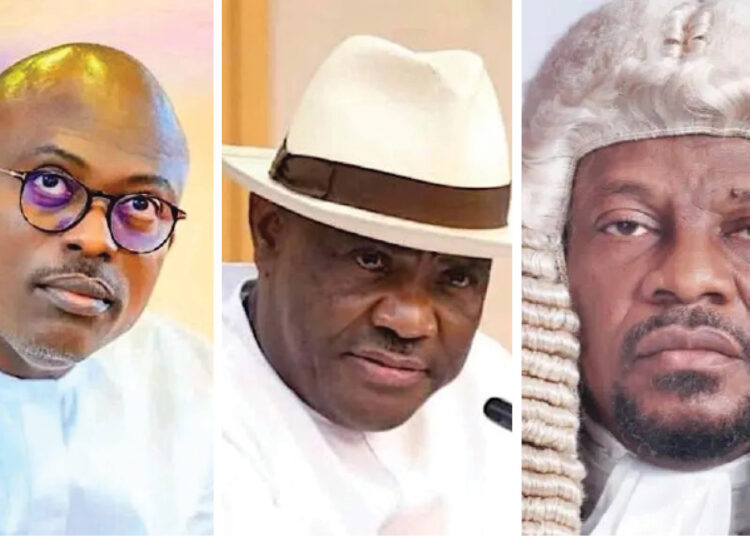
There comes a point in every political crisis when euphemisms must give way to plain talk. Rivers State has reached that point. It is high time Nyesom Wike and his acolytes allowed Governor Siminalayi Fubara to drink water and drop the cup. Anything short of that is not politics; it is the deliberate suffocation of democracy.
In local parlance, to allow a man drink water and drop the cup is to give him breathing space, to let him settle, and to judge him fairly after providing the minimum conditions required to function. Since assuming office, Fubara has been denied even that modest courtesy. From the first impeachment attempt in October 2023, it has been clear that Wike and the political machinery loyal to him resolved not to give the governor peace of mind, autonomy, or legitimacy.
In fact, what should have been a period of transition quickly has since 2023 in Rivers State become a season of siege. This is as impeachment; a grave constitutional mechanism meant for exceptional circumstances, was introduced into Rivers politics with alarming haste. Barely months into his tenure, Governor Fubara was confronted with impeachment proceedings. There was no patience, no benefit of doubt, no allowance for a learning curve. The speed alone betrayed the motive. That the process collapsed following presidential intervention only reinforced the suspicion that impeachment was being deployed as leverage, not justice. That first episode should have imposed restraint. Instead, it opened the floodgates.
By March 2025, Rivers State sank deeper into constitutional turmoil. Another impeachment process emerged, this time targeting both the governor and his deputy. Allegations multiplied, governance stalled, and political tempers flared. Matters deteriorated so badly that the Federal Government imposed a state of emergency, suspending elected institutions and freezing democratic governance in one of Nigeria’s most strategically important states.
That development was not a victory for any camp; it was a collective indictment. When a state’s internal political recklessness invites federal intervention, democracy suffers humiliation. Rivers State paid a heavy price, lost time, stalled development, shaken investor confidence, administrative paralysis, and a citizenry growing increasingly cynical about the value of its votes. Yet, remarkably, even this disruption failed to inspire moderation.
By January 2026, impeachment resurfaced for the third time. Three impeachment attempts within a single tenure is not legislative vigilance; it is political harassment. It signals a calculated refusal to allow a sitting governor governs. It reflects a political culture where independence is treated as defiance and where loyalty to a former power centre is valued above loyalty to the office of governor.
This siege mentality explains the growing perception that Rivers State is being run as a private estate. Wike and his acolytes have acted less like stakeholders in a democratic system and more like proprietors unwilling to release control. That mindset is incompatible with constitutional governance.
Even more troubling is the hypocrisy now embedded in the narrative. The same forces that have kept Governor Fubara under constant political pressure are also accusing him of non-performance. That accusation demands an honest question: has he been given the peace of mind to work?
Even the allegations now being leveled against Governor Fubara must be viewed within the poisoned political environment deliberately created around him. From the outset, he was never afforded a convivial or business-friendly atmosphere to relate with the Rivers State House of Assembly. Long before disagreements escalated, an acrimonious wedge had already been driven between the governor and the lawmakers by Nyesom Wike and his political acolytes, turning what should have been a cooperative relationship into a hostile standoff.
In such a climate, governance becomes transactional and confrontational, not collaborative. More importantly, even if the allegations, ranging from the demolition of the Assembly complex, authorization of expenditures outside the approved budget, withholding of statutory funds due to the Assembly Service Commission, to alleged refusal to implement Supreme Court judgments on legislative financial autonomy, are assumed to be true, they are fundamentally administrative and political disputes that lend themselves to dialogue, negotiation, and institutional engagement.
These are issues that could and should have been resolved through structured interaction between the executive and the legislature, not weaponized as grounds for impeachment. To elevate such disputes to the level of impeachable offences, especially in an environment already rigged for confrontation, only reinforces the argument that impeachment in Rivers State is being pursued not as a constitutional remedy, but as a political instrument of coercion.
Governance does not thrive in an atmosphere of intimidation. No governor can concentrate on policy execution, infrastructure delivery, or economic planning while perpetually defending his mandate. You cannot destabilize the executive arm repeatedly and then complain about slow performance. To suffocate a man politically and then fault him for not delivering miracles is not accountability; it is bad faith.
The persistent hostility toward Governor Fubara reveals a deeper problem: refusal to accept political succession. Physical exit from office has not translated into psychological withdrawal. Influence is being pursued beyond reasonable limits, and relevance is being enforced through confrontation. Rivers State is paying the price for that unresolved power hangover.
The implications go beyond Fubara as an individual. A democracy where governors operate permanently under impeachment threat is inherently fragile. Executive authority weakens. Policy consistency collapses. Elections lose meaning when mandates can be endlessly destabilized by elite vendettas.
Ironically, since 1999, no Rivers governor has been successfully impeached and removed from office. Yet never has impeachment been so casually threatened. The constitution has not changed; political culture has. What was once a solemn and rare instrument has been reduced to a routine political weapon.
The Rivers State House of Assembly has also suffered reputational damage. A legislature consumed by impeachment politics cannot command public trust. Lawmaking, oversight, and representation become secondary to factional enforcement. The people inevitably lose.
Rivers State is too important, economically, politically, historically, for this level of recklessness. When a state of such strategic significance normalizes political suffocation, it sends the wrong signal nationwide. Bad political habits spread quickly when they go unchecked.
At the heart of this crisis lies the age-old conflict between godfatherism and democracy. Godfatherism demands perpetual control; democracy requires transition and autonomy. You cannot sustain both. Rivers State is now living with the consequences of that contradiction.
This is the caution that must now be sounded, plainly and firmly. It is high time Wike and his acolytes allowed Governor Fubara to drink water and drop the cup. Governance cannot flourish under constant threat. Development cannot occur amid endless political warfare. A governor fighting daily for survival cannot focus on delivering dividends of democracy.
Presidential interventions may impose temporary calm, but they cannot replace political maturity at the state level. Stability cannot be outsourced to Abuja; it must be cultivated at home.
The choice before Rivers political actors is clear. They can respect the mandate freely given by the people; allow the governor the peace of mind to work, and reserve impeachment for genuine constitutional breaches. Or they can persist in political suffocation, turning every disagreement into a crisis and every tenure into a battlefield.
Given the foregoing view, it is not out of place to opine that Rivers State cannot develop while trapped in perpetual conflict. A state constantly at war with itself will always underperform its potential. It is time for restraint, time to let go. Let Governor Fubara drink water.Let him drop the cup.