
Forgotten Dairies
On Kemi Badenoch’s Relentless Bashing Of Nigeria -By Isaac Asabor
Kemi Badenoch’s journey from Lagos to the House of Commons is, by all means, remarkable. But that journey should not come with a license to smear the country that birthed her. Nigeria is not perfect, far from it. But it deserves better than to be the perpetual punching bag of someone who should, at the very least, show some dignity and decorum.

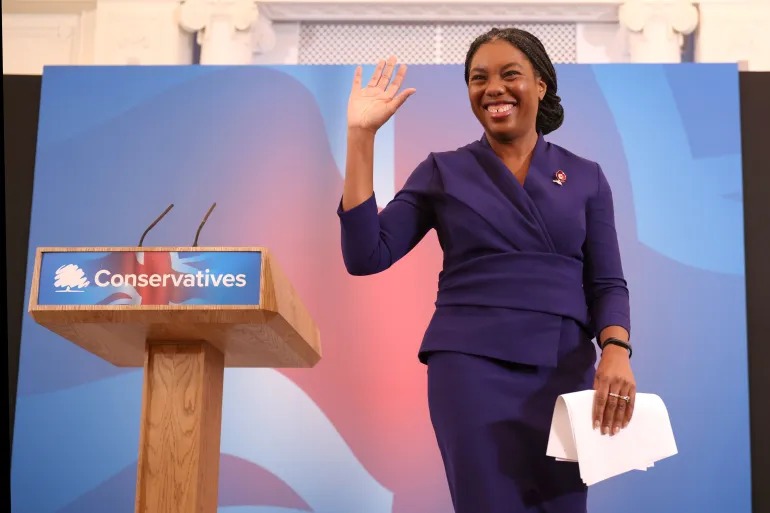
In an era where diasporan voices often serve as bridges between cultures and symbols of national pride, Kemi Badenoch stands out, for all the wrong reasons. The British Conservative politician of Nigerian descent, now holding a significant place in UK politics, has repeatedly found herself in the headlines. Not for celebrating her roots, but for repeatedly disparaging Nigeria, the country of her birth.
While many Nigerians in the diaspora lift their country in positive light, Badenoch has made it a pattern to publicly ridicule, misrepresent, and denounce Nigeria in her commentary. Her most recent misstep, a deeply flawed assertion about Nigerian citizenship laws, drew sharp rebuke from none other than Femi Falana, SAN, one of Nigeria’s foremost legal authorities.
This is not a one-off. It is a pattern. And it is about time we called it out for what it is: a calculated political strategy that throws her own country under the bus to gain credibility in the eyes of a British conservative base.
In a July 2025 interview with CNN’s Fareed Zakaria, Badenoch claimed: “I can’t give [Nigerian citizenship] to my children because I’m a woman… It’s virtually impossible, for example, to get Nigerian citizenship.”
It was a jaw-dropping statement, both legally and ethically. Femi Falana promptly responded, describing her claim as a “display of utter ignorance of the law.” He cited the 1999 Nigerian Constitution, specifically Sections 25 and 42, which unequivocally state that children born abroad to either parent, regardless of gender, are Nigerian citizens by birth. Furthermore, Sections 26 and 27 provide for registration and naturalization pathways to citizenship.
Falana did not mince words. He accused Badenoch of making the comments “to curry favour with the British electorate at the expense of Nigeria.” And he is right. There was no ambiguity in her tone, and certainly no misunderstanding in how her words would be interpreted by millions watching globally.
This is not Badenoch’s first time using Nigeria as a punchline. Back in December 2024, Nigeria’s former Vice President, Kashim Shettima, publicly called her out for what he called “denigrating” Nigeria. In a speech that went viral, Shettima stated: “She is entitled to her own opinions; she has even every right to remove the Kemi from her name, but that does not underscore the fact that the greatest Black nation on earth is the nation called Nigeria.
It was a rare diplomatic clapback, but a necessary one. In contrast to other diasporan leaders like Rishi Sunak who embrace and promote their cultural roots, Badenoch seems committed to distancing herself from Nigeria in a manner that borders on disdain.
In her attempt to describe her identity in racial and ethnic terms, Badenoch once remarked that she identifies more with her Yoruba ethnic group than with Nigeria as a nation, and that she had “nothing in common with people from the North” who she labeled “ethnic enemies.”
That statement was not just careless, it was divisive and dangerous. Nigeria is a country still grappling with the scars of civil war, religious extremism, and ethnic conflict. A public figure, especially one of Nigerian heritage, should be cautious not to inflame those wounds. Instead, Badenoch chose to throw fuel on the fire.
Badenoch’s most controversial views are not limited to Nigeria alone. In a leaked WhatsApp message from 2021, she said: “I don’t care about colonialism because I know what we were doing before colonialism got there… There was never any concept of ‘rights’.”
That statement speaks volumes. It is one thing to question the colonial narrative in nuanced academic terms, but another entirely to dismiss the suffering, theft, subjugation, and cultural erasure that defined colonial rule. For many in Nigeria and other African nations, this sounded like an apology for the British Empire, and a rebuke to the very movements fighting for post-colonial justice.
In several public addresses and interviews, Badenoch has described Nigeria as a country of fear, dysfunction, and disorder. She has recounted personal experiences of being extorted by police in Lagos and described the city in dark, dystopian terms, offering these images as a contrast to Britain’s “functioning society.”
While no one denies the issues Nigeria faces, such as corruption, insecurity, failing infrastructure, it is wholly disingenuous for someone of her stature to frame the country solely through this narrow and negative lens. Moreover, it is hypocritical. Britain, too, has its own share of police violence, systemic inequality, and institutional rot. Badenoch, of all people, should know better than to throw stones from a glass house.
It is clear that Badenoch’s frequent jabs at Nigeria are not accidental. They appear calculated, strategic, crafted to appeal to a conservative British audience that may view African countries as chaotic and corrupt. It is a classic case of “Othering” to win political points.
By distancing herself from Nigeria, and even denigrating it, Badenoch constructs a narrative of success in spite of her origins, not because of them. That narrative sells in the UK. But it comes at a cost: it diminishes her credibility at home, isolates her from the Nigerian diaspora, and exposes a deep insecurity about her identity.
On what must be done, it is expedient to opine that Nigerians everywhere, especially those in the diaspora, must take ownership of their stories. They must hold accountable those who, like Badenoch, use their background as a weapon rather than a bridge.
We must also encourage the Nigerian government and its diplomatic missions abroad to engage in proactive diaspora diplomacy. Public figures who consistently misrepresent the country should be called out and corrected with facts, just as Falana did.
Furthermore, media organizations in Nigeria must stop treating Badenoch’s rants as mere celebrity gossip. These statements carry consequences, especially when they misinform millions and reinforce outdated stereotypes about Nigeria.
Kemi Badenoch’s journey from Lagos to the House of Commons is, by all means, remarkable. But that journey should not come with a license to smear the country that birthed her. Nigeria is not perfect, far from it. But it deserves better than to be the perpetual punching bag of someone who should, at the very least, show some dignity and decorum.
When you constantly use your background as a platform to elevate yourself while stepping on the very soil that raised you, you become the kind of politician whose success comes at the price of truth and identity.
Yes, Kemi Badenoch is always in the news. But sadly, for Nigerians, it is rarely for reasons that inspire pride. Instead, her headlines often sting, because they remind us that not every homegrown star wants to shine for the home they came from. And that is not just disappointing. It is shameful.


























You must be logged in to post a comment Login