
Politics
Oyebamiji: The Man, The Politics And The Aspiration -By Oluseyi Olonade
AMBO’s agenda for youth and technological empowerment similarly moves away from token stipends, focusing instead on technical training, digital skill acquisition, and institutional support for entrepreneurs. The ultimate objective is to transition Osun from a consumption-driven civil service state into a productive economic ecosystem where public infrastructure actively drives growth.

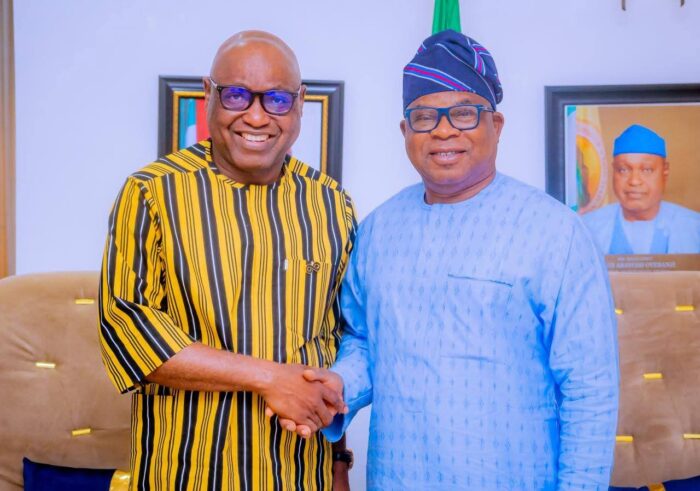
Every political epoch produces individuals whose entry into the arena fundamentally alters a state’s trajectory. For Osun State, currently caught at a critical socioeconomic crossroads, the political landscape is undergoing a necessary realignment. It is within this shifting tide that the emergence of Asiwaju Munirudeen Bola Oyebamiji, popularly known as AMBO, as the governorship candidate of the All Progressives Congress (APC) marks a decisive break from conventional politics.
Oyebamiji is far more than a routine name on an electoral ballot. His candidacy brings together personal integrity, proven technocratic capacity, and a deliberate development strategy – a direct alternative for a state currently drifting under the weight of populist theatre and administrative inertia.
To appreciate what his leadership portends for the future of Osun, his public life must be examined through three distinct dimensions: his character, his political record, and his strategic vision.
As a seasoned player in the corporate world, Oyebamiji’s appeal begins with practical, hands-on experience. Born in Ikire, within the Irewole Local Government Area, his early life was steeped in the foundational values of the state. He spent nearly three decades building a formidable banking career, rising through the ranks at Wema Bank, Trans International Bank, Spring Bank, and Enterprise Bank. This deep grounding in corporate governance, retail finance, and risk management provides the analytical framework he now applies to public administration.
Away from the public glare, his career is anchored by fiscal discipline and accessibility. As a Fellow of the Chartered Institute of Bankers of Nigeria, these professional ethics naturally shape his approach to public service. More importantly, his background is intertwined with community development and an innate capacity to bridge complex social divides. Despite deliberate attempts by detractors to reframe his public image, AMBO’s long-standing history of quiet philanthropy remains central to who he is. He belongs to that distinct tradition where leadership is earned through measurable competence and personal accountability.
Oyebamiji’s political philosophy is anchored on technocratic pragmatism. For him, governance is never a stage for political performance; it is a serious mechanism for structural transformation. His public service career began in earnest in 2012, when the APC administration appointed him to head the then-moribund Osun State Investment Company Limited. Under his management, the comatose organization was thoroughly revamped, recapitalized, and reborn as Omoluabi Holdings Limited—effectively turning a failing state liability into a productive asset. This stellar performance earned him a subsequent appointment as a two-term Commissioner for Finance under successive APC administrations.
During those fiscal years, he navigated complex balance sheets, managed delicate state debt structures, and drove the institutional reforms that kept Osun financially afloat despite severe nationwide economic contractions. His later national service as the Managing Director of the National Inland Waterways Authority (NIWA) further tested and proved this executive capacity on a broader stage. Throughout, his governance model has relied on institutional planning and strategic coalitions, consistently prioritizing long-term sustainability over superficial political fixes.
The urgent necessity of this structured approach becomes stark when measured against the current administration of Governor Ademola Adeleke. While the present government prioritizes public spectacle and populist messaging, the foundational socioeconomic structures of Osun are suffering from severe neglect. Resource allocation routinely favors highly visible, politically driven projects at the expense of critical investments in agricultural value chains, technology hubs, and industrial growth. Operating on a fiscal model heavily dependent on federal allocations, the administration has shown little capacity for expanding the state’s Internally Generated Revenue (IGR) through real economic expansion.
On the social front, current policies favor short-term, unsustainable relief over permanent economic empowerment. Local government autonomy faces constant friction, while the professional standards of the civil service are increasingly compromised by political expediency. Educational institutions and vital state programs are stalled by funding delays, crippling long-term capacity building. By substituting substantive governance with populist applause, the administration has heightened fiscal uncertainty, leaving the state dangerously exposed to broader macroeconomic shocks.
In sharp contrast to these governance deficits, Oyebamiji’s ambition is driven by a comprehensive developmental agenda aimed at pulling Osun toward true economic independence. This means leveraging his financial background to enforce transparent accounting, optimize resource allocation, and eliminate waste in government operations. His blueprint for economic diversification seeks to transform Osun into a viable industrial and agricultural hub, capitalizing on its unique geographic location to attract private capital rather than relying passively on federal hand-outs.
AMBO’s agenda for youth and technological empowerment similarly moves away from token stipends, focusing instead on technical training, digital skill acquisition, and institutional support for entrepreneurs. The ultimate objective is to transition Osun from a consumption-driven civil service state into a productive economic ecosystem where public infrastructure actively drives growth.
The upcoming election in Osun State offers a clear choice between two divergent paths: one anchored on populist massaging, and the other built on institutional capacity and structural development. Through the lenses of political clarity, economic survival, and social progress, Oyebamiji stands out as the definitive alternative. His corporate pedigree, structured public record, and developmental vision position him uniquely to confront the state’s governance challenges.
For an electorate demanding sustainable growth, socioeconomic stability, and institutional advancement, AMBO represents a necessary and purposeful shift in leadership.
Oluseyi Olonade wrote from Ikeja-Lagos

























You must be logged in to post a comment Login