Africa
Procedural Democracy Without Substance: What Can Indonesia Learn From Nigeria? -By Tomy Michael
These two countries reflect a broader phenomenon: procedural democracy without substance. This form of democracy retains elections, political parties, and a constitution, but empties their normative foundations. Executive power is strengthened through legal and institutional channels; coalition political parties are weakened; and civil society faces increasing regulatory pressure.

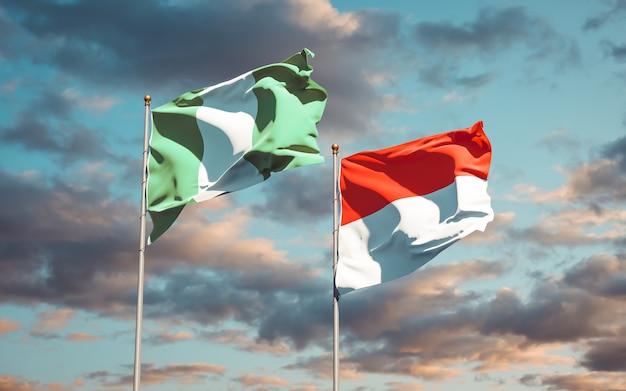
In the discourse on democratic decline, comparisons between countries are a rational fear because they reveal the true side of the state. Democracy is synonymous with a perfect form of government, leading to a distortion of that meaning. However, in the current era of global democratic decline, such distinctions are increasingly misleading. Indonesia and Nigeria share similarities, such as a multi-ethnic population, a strengthened constitution, and abundant natural resources. Regarding democracy, the experience of authoritarianism faces similar challenges: regular elections with weakened accountability, declining public trust, and a growing concentration of executive power. If Indonesia wants to address its own democratic stagnation, important lessons can be learned not from the established democracies of European philosophers, but from the Nigerian experience.
Indonesia is often praised for its ability to maintain electoral stability following the 1998 democratic transition. Competitive elections, a relatively peaceful transfer of power, and constitutional continuity have bolstered Indonesia’s democratic reputation. However, these procedural successes mask more fundamental problems. Over time, the substance of democracy—such as an effective opposition, independent institutions, and meaningful civic participation—has declined. Elections increasingly serve as instruments of legitimizing power, rather than as mechanisms of checks on it. Even today, the Constitution lacks a definition of democracy, only including the phrase “economic democracy,” whose interpretation varies according to the global economic situation.
Nigeria’s experience provides an important cautionary tale. Like Indonesia, Nigeria emerged from an authoritarian regime with high hopes for democracy. The country subsequently institutionalized regular elections and a civilian government. However, Nigeria demonstrates what happens when procedural democracy loses its ability to build public trust. Although national elections were held, voter turnout declined sharply. In Nigeria’s 2023 general election, voter turnout fell to around 27%, one of the lowest in the country’s democratic history. These figures are not merely technical statistics, but rather a reflection of widespread public disillusionment with democratic institutions and doubts that elections truly influence the direction of government.
Indonesia hasn’t reached such a point, but it experienced chaos after the 2024 presidential and vice-presidential elections. When elections fail to translate into policy accountability and effective limits on power, citizens gradually view democracy as a ritual rather than a representational one. Nigeria demonstrates that procedural continuity alone is insufficient to prevent democratic burnout. Once public trust has eroded, restoring democratic legitimacy becomes much more difficult.
These two countries reflect a broader phenomenon: procedural democracy without substance. This form of democracy retains elections, political parties, and a constitution, but empties their normative foundations. Executive power is strengthened through legal and institutional channels; coalition political parties are weakened; and civil society faces increasing regulatory pressure.
Citing Freedom House and the V-Dem Institute, which consistently show a decline in the quality of democracy in various countries, including Indonesia and Nigeria, this assessment confirms that contemporary democratic decline is rarely marked by coups or the cancellation of elections, but by the weakening of institutions. Nigeria’s experience provides a lesson for Indonesia: electoral legitimacy is neither automatic nor sustainable. When political competition lacks real alternatives and executive power fails to limit power, elections gradually lose their corrective function. The low voter turnout in Nigeria reflects the long-term consequences of this dynamic. Citizens do not withdraw because elections are eliminated, but because they no longer believe in the essence of voting.
Another lesson lies in the relationship between law and democratic decline. In Nigeria, as in Indonesia, democratic fatigue often occurs through legal mechanisms—such as changing election regulations, security laws, or the practice of judicial power that favors certain groups. Modern democracies collapse more often through institutional hollowing out than through overt authoritarian collapse. For Indonesia, learning from Nigeria means realizing that democracy cannot be measured solely by procedural implementation. High voter turnout or peaceful elections do not guarantee the resilience of democracy. What is more crucial is whether democratic institutions retain the capacity to limit power, protect dissent, and translate public participation into accountable governance.
Nigeria’s experience also underscores the significant political costs of disregarding civic trust. When citizens withdraw from the democratic process, power is transferred to the people. Indonesia still has room for opportunity, where public participation remains relatively secure, and democratic institutions remain formally independent. However, without substantive reforms—strengthening checks and balances, protecting civic space, and establishing genuine political competition—the early stages of reform in Indonesia are at risk.
Ultimately, Nigeria represents a series of democratic success stories for Indonesia. Democracy demands continued institutional vigilance and the maintenance of public trust. Democracy can survive procedurally but fail normatively, and once the substance of democracy is lost, restoring it is far more difficult than maintaining it in the first place. Democracy will emerge in all aspects, even in the abstract.
Tomy Michael is the Head of the Undergraduate Law Program at Universitas 17 Agustus 1945 Surabaya, Indonesia. He holds a doctorate in law from Brawijaya University and is interested in state studies and legal hermeneutics.