
Forgotten Dairies
The Devil Stranger: From Sanity To Madness -By Ismail Misbahu
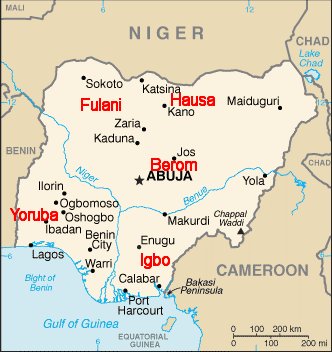
On the issue of genealogical origin, there was hardly anything genealogical about the historical ancestry (I talk of ancestry) of a people perceived to be “Hausa-Fulani”. Bala and other scholars already demystified legendary traditions of genealogical origins, associating the Hausa with Bayajidda, Yoruba with Oduduwa, etc., in the same way he contested claims of a common Fulani genealogical ancestor. Genealogical origins are hard to ascertain even among (Fulbe) clans and lineages.

I was motivated to write this reminder by the recent social media crowdsourcing of panellists on the “Hausa Zalla” podcast. Prof Kperogi, the host of the live podcast, deliberately posted the upcoming August Diaspora Dialogues podcast, knowing well that people who met his criteria may decline his invitation.
They have their reason to decline. But one thing is clear. It’s that the term “Hausa-Fulani” was never a language. It was never a people. It was never a culture.
It was neither Afro-Asiatic nor Niger-Congo family of languages. It was not found in the list of global languages. It was not found in the list of Nigerian languages.
Danfodio did not coin it. His Jihad flag bearers did not coin it. Fulani themselves did not coin it; they hardly accept it anyway! Hausa did not coin it; they’re clearly rejecting it.
Before the heightened tension and insecurity in which the Fulani are seen as the perpetrators, no one seemed to bother about this term, “Hausa-Fulani”.
The Sanity
The term “Hausa-Fulani” was a post-Jihad coinage, a social construct. It was neither a Hausa self-acclaimed identity nor a Fulani one. It was a ‘stranger-imposed’ definition of people living in ‘Northern Nigeria’. People who, by common sense, were believed to have bonded together by a shared history of Islam, culture and social values. That was simply a ‘stranger’s safer assumption. There is nothing sensitive in it.
Fortunately, the Hausa answered the name. The Fulani answered the name. Yet this does not mean acceptance. It means tolerance. It’s a post-Jihad social construct, partly to promote peaceful co-existence, partly reinforced by ordinary labelling, which, of course, no one seemed to have rejected hitherto. We grew up hearing and kind-heartedly responding to people who called us “Hausa-Fulani”. We have heard nothing wrong in it. Our fathers were Hausa, our mothers Fulani; uncles in Ruga, stepmother in ƙauye, etc. Nothing to bother about. We have answered the name with pride, respect and harmony.
Yet we filled our school entry/admission forms as ‘Hausa’ (where it matters!). Certainly not as “Hausa-Fulani” because there’d never been such an option! No such tribe. No such language. And no one cares.
The term “Hausa-Fulani” remained, until now, a safer definition of the living reality of our parents — the social identity — the social setting. The peace and understanding bound this. Everything was safe. The consciousness was healthy. The fact of being a Hausa or Fulani was clear. The reality of marriages was clear. Father a Fulani, mother a Hausa. We were told, saw, knew and lived the reality. The Jihad of Danfodio did not impose such intermarriages.
That’s an identity, a social construct. Blood does not erase it. Language, and clearly there’s no common language called “Hausa-Fulani”, does not erase it. Religion does not erase it. It’s simply a social reality: cohabit, copulate, co-exist and construct a new identity.
This has been the reality in northern Nigeria for centuries. The Fulanin Gida (the sedentary Fulani or what Dr Aliyu Tilde called “domesticus”) have been territorially integrated in the birane (urban cities) of Kano, Kaduna, Zaria, Katsina, Ilorin, Benue, etc. They were held by a common elitist urban identity more than their linguistic or cultural characteristics.
The Fulani living in the forest zone (“the F. Naturalists” in the words of Dr Tilde) shared the same kinship (communitarian) values with the Hausa living in ƙauyuka (villages). This bond kept redefining the nature of social relationships and social identity between the two distinct ethnic groups.
Now came a new social order under colonialism, reinforcing the stranger’s definition of the term “Hausa-Fulani” to mean “Muslims living in northern Nigeria” distinct from ‘others.’ A religious identity was labelled above all-and-sundry and was traced to the Jihad of Danfodio. That’s the stranger’s major blunder, similar to the assumption that Nigerian history begins from its amalgamation in 1914!
This religious identity ascribed to “Hausa-Fulani” has enforced what Prof. Abdallah Uba Adamu called a “cancel culture” or a “status enforcement” on both the non-Muslim Hausa and Fulani populations living in mostly rural communities. They came to be known as “Maguzawa”, not Hausa, not Fulani, not the stranger’s binary of “Hausa-Fulani”. It was not the Bature’s fault. It was neither the stranger’s harmless definition. It was not the fault of Danfodio either. It was the failure to recognise and accept “Maguzanci” as the religion of a non-Muslim “Hausa-Fulani.”
It is this same perception that still enforced another Maguzanci status on Hausa and Fulani (“Hausa-Fulani”) minority Christian populations in the north. This enforced status has stigmatised their image within the larger non-Hausa-Fulani Christian population in the region. They faced discrimination in Churches, inferiority in dress, in their composed hymns, etc. Consequently, Hausa-Fulani Christians found themselves between the devil and the deep-blue sea.
The madness
Out of this complex social reality, a new monster emerged. It is the urban elite composed of both Fulani and Hausa ruling classes. While it is widely believed that the Fulani have occupied more space at the leadership level, they certainly did not see themselves as “Fulani”, but the ruling class! Little wonder they completely ignored their kinsmen, the F. Naturalists (or the cattle-Fulani living in the forest zones). This category of population became the country’s subject of exploitation, extortion, selective justice, bullying by ‘city boys,’ cruel insubordination by the Police, etc.
Their “Fulani Domesticus” did not care much about their social conditions. Unlike colonialism, which protected and improved their pastoral (faunal and floral) lands as well as guaranteed their right to grazing, the current monster has imposed bans on open grazing, sanctions, and criminal codes against their socio-economic potentials.
Tensions started with extortion and corruption by the local Police and courts. Herder-farmer clashes intensified. Killings were rare because this type of conflict was still normative. However, continued marginalisation amidst unresolved cases in courts has reawakened the sleeping dogs. Hungry cattle-bearers ignorant of the social order started organising. The spirit of past injustice reawakens. The cow led all the emotions. Buried facts were reckoned. This set the beginning of rural criminality that has transformed into the present social and moral abyss: killings, kidnapping, burning and seizure of farmlands, brutal extinction of villages, etc.
This social mess has gained the attention of intellectuals, and more and more access to digital social media spaces. Debates that were governed by ethical principles in academic settings have now flooded over social media without control. Different narratives- good, bad, confused, and weird popped up wrestling with each other.
Fortunately for us, the learned men privileged with the advantage of living up to their time, as well as ours, took these issues back to the books. They combed their old archives, refreshed existing knowledge and came up with more convincing perspectives. I am referring to prominent scholars like Professor Abdalla Uba Adamu. Unfortunately, they’ve found themselves in the quagmire of a digital culture that’s left unchecked by the ruling elite.
Understanding the fact that “ethnicity is a fluid socio-cultural construct based on language, history, geographic lineage, and shared identity, not a biological sum that automatically resets to zero” is as simple as Prof. Abdalla illustrates it:
He pointed out that people of North African and Middle Eastern origins — Lebanese, Syrians, Sudanese, Yemeni, etc. took root in Kano. If they could intermarry with both Fulani and Hausa, as is the case in Abdalla’s Kano, what would the offspring be? Should it be Arabo-Hausa-Fulani? Arab-Hausa? Arab-Fulani? And then some married Yoruba women or men. What would you call these? He challenged that when this social construct is stretched beyond the primary identity, things become ridiculous. He concludes that “intermarriages between [Hausa and Fulani] do not cancel or erase either underlying ethnicity.
Abdalla’s compelling perspective that ethnicity is a fluid socio-cultural construct based on language, history, geographic lineage, and shared identity might have updated the already compelling historical views of the eminent Nigerian historian, Yusufu Bala Usman. These were days when healthy debates were the rule and were restricted to academic knowledge and ideas. They were never a social media bruhaha.
Similar to Abdalla’s up-to-date illustration, Bala also queried the enforced status, “Hausa-Fulani”, challenging ‘a distinct ethnic impression’ underlying it. If this were to be anything more than a simple social identity construct, Bala illustrated the possibility of the existence of more and more Fulani-ethnic-dualities: “Yoruba-Fulani”, “Igbo-Fulani”, “Nupe-Fulani” because, he observed, there is Fulani blood in all these cultures, especially in the rural areas of Ilorin, Oyo, Enugu, Imo, etc.
Bala’s attempt to distinguish social and ethnic identity first appeared in his critiques of M.G. Smith, challenging his racial analysis of the “Hausa-Fulani” genealogy, occupations and shared values. M.G. Smith was trying to show that the Fulani living in Ƙauyuka shared more in common with their kinsmen in the birane (the ‘domesticus’ in the urban cities) than the Hausa, with whom they lived together in Ƙauyuka. The same was the case when the Hausa still looked up to their ƴan’uwa (kinsmen) in the birni (city). Bala challenged the view, showing instead that shared social identity has existed among the Hausa and Fulani in both the Ƙauye (village) and birni (city).
In either case, context, rather than just assumption, informed the substance. Bala was emphatic about the social realities of the two groups: co-habiting, co-existing and sharing different but related cultural traits, while Smith was hard on the very racial anthropology of the two groups. Bala did not in any way erase the fact that ethnic groups have their own distinct features and history. He, however, speculated in most of his masterpieces that claims of ethnic genealogy are in most cases associated with unproven traditions and mythologies surrounding a genealogical ancestor.
Here comes his distinction of what he regarded as “territorial identity” and “genealogical identity”. The first best defined the social identity of Hausa and Fulani (the “Hausa-Fulani”) living in the territories of Kano as Fulanin Kano (the Fulani of Kano) or Kanawa (the people of Kano) as a whole. You can name more as Fulanin Jahun of Jahun, Fulanin Ruma of Ruma, Fulanin Ilorin (or the “Ilori Fulani”), etc. Their common identity with the Hausa is their integration into these territories, in the same way their social identity with Yoruba and Igbo was constructed.
On the issue of genealogical origin, there was hardly anything genealogical about the historical ancestry (I talk of ancestry) of a people perceived to be “Hausa-Fulani”. Bala and other scholars already demystified legendary traditions of genealogical origins, associating the Hausa with Bayajidda, Yoruba with Oduduwa, etc., in the same way he contested claims of a common Fulani genealogical ancestor. Genealogical origins are hard to ascertain even among (Fulbe) clans and lineages.
All these were but more scholarly illustrations of the mosaic plurality of Nigerian peoples, not mere grounds for unhealthy, hypothetical and cultural debates about which and what existed and mattered the most.
I closed this lengthy personal reflection on Hausa-Zalla wahala with Abdallah’s powerful charge:
“Hausa Zalla, Fulani Zalla, Hausa-Fulani Zalla are identities. You fit yourself into what you believe and self-identity. No problem. No issues. No fight. No wahala.”
Researcher, History and Social Transformation| Kaduna State, Nigeria| Non-Resident Visiting Research Fellow, PACES Project, International Institute of Social Studies (ISS), Erasmus University, Netherlands | m.ismail@iss.nl |
Read and share my latest articles:
Ismail, Misbahu (2025). “Nasser’s Islamic Propaganda and British Decolonization Policy in Northern Nigeria”, The Journal of Imperial and Commonwealth History, p-ISSN 3117-5686, e-ISSN 3117-5856.
Polinder, S., Nyarangi, M., Misbahu, I., Krah, E.F.M., De Graaf, B.A. (2025). Harnessing religious Leadership to Counter Violent Extremism and Build Religious Tolerance in Nigeria and Kenya. The Religious Leaders & Violent Extremism Policy Brief, No. 1. Utrecht, the Netherlands, Faculty of Humanities, Department of History and Art History, Utrecht University and Mensen met een Missie. p-ISSN 3117-5686, e-ISSN 3117-5856|NB: Religious Leaders & Violent Extremism Policy Briefs are a collaborative product of Utrecht University, Mensen met een Missie (MM) and Joint Initiative for Strategic Religious Action (JISRA), with funding from the Dutch Ministry of Foreign Affairs.)





















You must be logged in to post a comment Login