
Africa
The Final Hours Before Tuesday: The Senate Must Seek Emergency Clarification, Not Threats, as Natasha Akpoti-Uduaghan Prepares to Represent Her People -By John Egbeazien Oshodi
Chief Justice Kudirat Kekere-Ekun must step forward. As the head of the judiciary and Chairperson of the National Judicial Council, she is duty-bound to clarify the scope and strength of Justice Nyako’s ruling. In the past, the judiciary has taken bold stances—even reversing administrative overreach in the Nnamdi Kanu case. Why the silence now? A failure to act decisively will reinforce public suspicion that the courts bend when the political winds blow too hard.

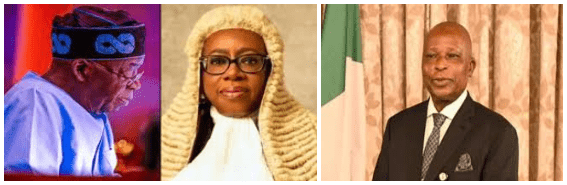
As the clock nears Monday, July 21, 2025, and with Tuesday, July 22, just hours away, Nigeria faces a grave constitutional moment that will test the moral will of its leadership, the courage of its judiciary, and the soul of its democracy. The standoff over Senator Natasha Akpoti-Uduaghan’s rightful place in the Senate chamber has now evolved beyond legal semantics and political defiance. It is now a question of national identity: are we governed by the rule of law or by the rule of man?
Judicial Pronouncements vs Legislative Defiance
On July 4, 2025, Justice Binta Nyako of the Federal High Court delivered a nuanced yet firm judgment. She ruled that the suspension of Senator Natasha for six months was excessive, overreaching, and incompatible with the intended purpose of the Senate Rules and the Nigerian Constitution. She declared: “I believe the Senate has the power to and I believe should recall the plaintiff and allow her to same-time represent the people who sent her there to represent them.” Though framed in advisory language, the judgment begins with the commanding phrase: “It is hereby ordered…”—language that underscores its judicial authority. This is the portion many now forget.
Weaponizing Linguistic Nuance to Avoid Compliance
Rather than honor the spirit of the court, the Senate, led by Godswill Akpabio and represented by Senator Yemi Adaramodu, has fixated on select words—“should,” “believe,” “opinion”—to argue that the ruling is not enforceable. This is intellectual gamesmanship, not governance. The Senate claims the ruling is merely “advisory,” conveniently ignoring its opening phrase: “It is hereby ordered.” The truth is simple: if these same words came from a man in uniform or a ruling in their favor, they would not ask whether it was advisory or binding.
Psychological Implications of a Disputed Mandate
As a clinical and forensic psychologist, I understand the psychological toll of injustice and gaslighting. For Senator Natasha, the refusal to honor her court-affirmed rights is not merely procedural—it is psychological warfare. It sends a message to all Nigerians, especially women and the youth: that courage is punishable, that independent-mindedness will be resisted, and that institutional might can override truth. The trauma of exclusion under false legal pretenses lingers far deeper than any courtroom ruling.
The Judiciary’s Quiet Crisis: The CJN Must Speak Now
Chief Justice Kudirat Kekere-Ekun must step forward. As the head of the judiciary and Chairperson of the National Judicial Council, she is duty-bound to clarify the scope and strength of Justice Nyako’s ruling. In the past, the judiciary has taken bold stances—even reversing administrative overreach in the Nnamdi Kanu case. Why the silence now? A failure to act decisively will reinforce public suspicion that the courts bend when the political winds blow too hard.
The President’s Role: Prudence, Not Interference
President Tinubu is not a judge, but he is the symbolic head of the Nigerian state. He must not remain mute in a time of such institutional tension. While he must not interfere in judicial matters, he can urge the Attorney General to file for an expedited interpretation and clarification of the court’s decision. This is not interference—it is executive prudence to avoid an institutional breakdown.
The AGF’s Silence: Legal Duty or Political Posture?
Attorney General Lateef Fagbemi has a constitutional role to clarify, interpret, and defend the constitution and rule of law. His silence so far is not neutral—it is a choice, and it is one that contributes to growing instability. If the AGF can defend executive actions in public statements, he can also defend court rulings that protect fundamental rights. Let him lead an urgent request to the court for declarative clarity.
The Senate’s Responsibility: Seek Emergency Clarification, Not Threats
The Nigerian Senate, rather than threaten the judiciary or delay compliance, should file for an emergency judicial clarification. If they are uncertain about the binding force of Justice Nyako’s ruling, the lawful path is not to defy it—but to seek clarification through the same judicial system they are bound to obey. Delay and defiance only reinforce public distrust in the Senate’s integrity and deepen institutional crisis.
Gender Bias and the ‘Natasha Exception’
Let us be blunt. In a Senate of 109 members, only four are women. Of those, three generally conform to the traditional expectations of silence, loyalty, and caution. Natasha, the youngest and boldest, is the only one punished so severely. This reeks of gender-based marginalization. In previous cases, male lawmakers who flouted decorum or violated rules received minimal reprimand. But Natasha, who dared to speak, is told not to come back. We must ask: is this about ethics—or is this about silencing a woman who refuses to bow?
Precedents Ignored: Selective Justice in the Legislature’s Treatment of Senator Natasha
Other lawmakers from both chambers have been suspended and later returned—some with court orders. We know that in the past, legislators and senators went to court and were reinstated. These individuals resumed their seats with no defiance from the Senate. These rulings were respected without the current level of semantic resistance or political theatre. No one questioned whether those judgments were “opinions” or “recommendations.”
These precedents, when juxtaposed with Senator Natasha’s ordeal, underscore a troubling inconsistency in institutional response—one that appears to hinge not on legal principle, but on personality and gender. No man was told that a judicial “opinion” was not binding. No man was advised to “stay away” from the chambers. This selective treatment makes Senator Natasha’s ordeal more than a procedural controversy—it makes it a case study in gendered suppression and judicial manipulation.
Let’s break down how to approach the visuals and voiceover for each message, keeping in mind the distinct characteristics of Facebook and YouTube’s short-form video formats (vertical video, quick cuts, trending audio potential).
The Global Optics: Who Watches Nigeria Now?
Make no mistake—Nigeria’s democratic integrity is now under a global lens. The case of Senator Natasha Akpoti-Uduaghan is no longer a domestic procedural debate. It has become a test of Nigeria’s commitment to the rule of law, gender equality, and institutional accountability. International observers—ranging from the African Union to ECOWAS monitors, from U.S. and EU embassies to global human rights watchdogs—are paying close attention. What they see is a democratically elected female senator facing strategic obstruction, not based on any fresh misconduct, but on interpretations designed to dilute judicial authority. This has implications not just for justice at home but for Nigeria’s international standing. A country that pleads for foreign investment, development aid, and diplomatic respect cannot afford to publicly undermine its own judiciary. Respect for judicial orders is a minimum threshold for democratic legitimacy. If this precedent is allowed to stand, Nigeria risks being viewed not as a maturing democracy, but as a state where legality bends to political survival.
Weaponizing Linguistic Nuance to Avoid Compliance
Rather than honor the spirit of the court, the Senate, led by Godswill Akpabio and represented by Senator Yemi Adaramodu, has fixated on select words—“should,” “believe,” “opinion”—to argue that the ruling is not enforceable. This is intellectual gamesmanship, not governance. The Senate claims the ruling is merely “advisory,” conveniently ignoring its opening phrase: “It is hereby ordered.” The truth is simple: if these same words came from a man in uniform or a ruling in their favor, they would not ask whether it was advisory or binding. They also conveniently overlook the fact that the Court’s penalty for contempt—namely, the ₦5 million fine and the mandatory public apology—was a separate response to a Facebook post. That penalty has no bearing on the directive to recall the senator. The Senate cannot collapse two issues into one as an escape hatch. Justice Nyako drew a clear line: penalty for contempt and restoration of legislative function are different matters.
What Must Be Done—Immediately
It is now nearly Monday. There is no time to waste. Senator Natasha’s legal team must urgently file for an emergency hearing by July 21 to seek direct judicial clarification—preferably before the close of Monday’s court schedule. The aim is not to escalate but to interpret and affirm. Justice Nyako’s language may contain phrases like “I believe” or “the Senate should,” but her ruling also begins with, “It is hereby ordered.” That is not advisory—it is declarative. Let the courts confirm this clearly, swiftly, and publicly. At the same time, the Senate must stop issuing warnings and instead file its own motion for urgent clarification if it believes there is ambiguity. The principle is simple: resolve legal disagreements in court, not in press releases. Let the gavel, not the megaphone, be the final arbiter.
Tuesday: Civil Disobedience with Dignity
If the Senate remains defiant and refuses to admit her, then Senator Natasha must not retreat. She should act with discipline and moral clarity—not through confrontation but through visible, peaceful presence. Let her arrive early Tuesday morning, dressed in her senatorial attire, and take her seat in front of the National Assembly complex. Let her bring a chair, table, and laptop—and conduct her legislative duties in the open. Let her constituents see that she has not abandoned them. Let Nigerians witness a modern example of civil resistance, grounded in law and dignity. Let the world see a woman fighting not for ego, but for electoral representation.
Security Threats and the Use of Force
Any attempt to remove her—whether by DSS, police, or National Assembly security operatives—would be a tragedy. It would send a chilling message: that even peaceful compliance with court judgments invites state retaliation. It would confirm that fear, not law, governs public space. Tanks, barricades, or forced removals should have no place in the resolution of a constitutional dispute. This is not a matter of national security; it is a matter of national dignity.
Let the Law Speak Louder Than Power
Justice Nyako’s judgment was careful, considered, and constitutionally grounded. It must not be read selectively or weaponized into ambiguity. The Chief Justice of Nigeria must issue a public clarification to stabilize this moment. The Attorney General must guide both the Senate and the executive toward compliance through lawful means. President Tinubu, as head of state, must discreetly encourage institutional harmony, not public silence. Each has a duty to help the law—not political brinkmanship—prevail.
Final Reflection: I Stand With Justice, Not Sides
Let me be clear from the start: I take no sides. I do not write for any politician, nor do I speak for any party. I write as a clinical and forensic psychologist. I write as someone born on Nigerian soil, shaped by its spirit, and still deeply connected to its struggle for fairness. I write as someone who believes that justice must not depend on who holds the microphone—but on what is right.
This is no longer about one woman or one seat. What is unfolding before us touches the very core of Nigeria’s legal and moral fabric. When a clear court ruling is reduced to a game of semantics, and the powerful begin to debate whether “ordered” means optional, we should all be concerned. Because if the law can be bent this easily today, who will be safe from injustice tomorrow?
Tuesday will not just pass as another day. It will become a message. It will speak to history. It will echo in the hearts of young Nigerians who still want to believe in this country, who still ask if honesty and courage have a place in public life.
Let us not play with what is sacred. Justice is not a tool for delay or debate—it is the soul of any nation that wants to endure. The people know the truth. The world is watching. And history, as always, is listening.
There is a saying: “No matter how long darkness stays, the morning must come.” That morning can begin with us—if we choose to do what is lawful, not what is comfortable.
Again, I take no sides. I stand only with justice. With the rule of law. With the hope that Nigeria still has what it takes to lead itself with dignity.
Let Tuesday speak well of us.
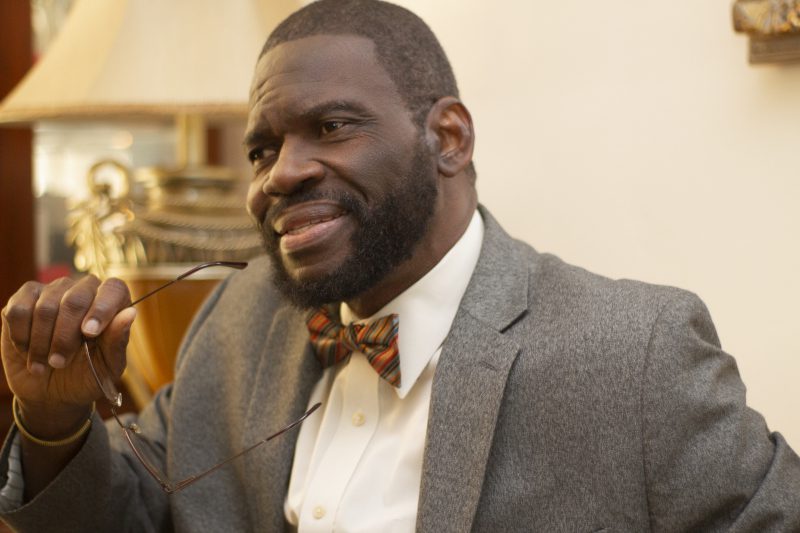
Psychologist John Egbeazien Oshodi
Professor John Egbeazien Oshodi is an American psychologist, educator, and author with deep expertise in forensic, legal, and clinical psychology, cross-cultural psychology, and police and prison science. Born in Uromi, Edo State, Nigeria, and the son of a 37-year veteran of the Nigeria Police Force, his early immersion in law enforcement laid the foundation for a lifelong commitment to justice, institutional transformation, and psychological empowerment.
In 2011, he introduced state-of-the-art forensic psychology to Nigeria through the National Universities Commission and Nasarawa State University, where he served as Associate Professor of Psychology. Over the decades, he has taught at Florida Memorial University, Florida International University, Broward College (as Assistant Professor and Interim Associate Dean), Nova Southeastern University, and Lynn University. He currently teaches at Walden University and holds virtual academic roles with Weldios University and ISCOM University.
In the U.S., Prof. Oshodi serves as a government consultant in forensic-clinical psychology and leads professional and research initiatives through the Oshodi Foundation, the Center for Psychological and Forensic Services. He is the originator of Psychoafricalysis, a culturally anchored psychological model that integrates African sociocultural realities, historical memory, and symbolic-spiritual consciousness—offering a transformative alternative to dominant Western psychological paradigms.
A proud Black Republican, Professor Oshodi is a strong advocate for ethical leadership, institutional accountability, and renewed bonds between Africa and its global diaspora—working across borders to inspire psychological resilience, systemic reform, and forward-looking public dialogue.


























You must be logged in to post a comment Login