
Breaking News
William Ruto and Nana Akufo-Addo Discuss Africa’s Development ChallengesKestér, By Kenn Klomegâh
A bit of reminder that the AU spearheads Africa’s development and integration in close collaboration with all African Union Member States, the Regional Economic Communities and with African citizens at home and abroad. The AU vision is to accelerate progress towards an integrated, prosperous and inclusive Africa, at peace with itself, playing a dynamic role in the continental and global arena, effectively driven by an accountable, efficient and responsive Commission.

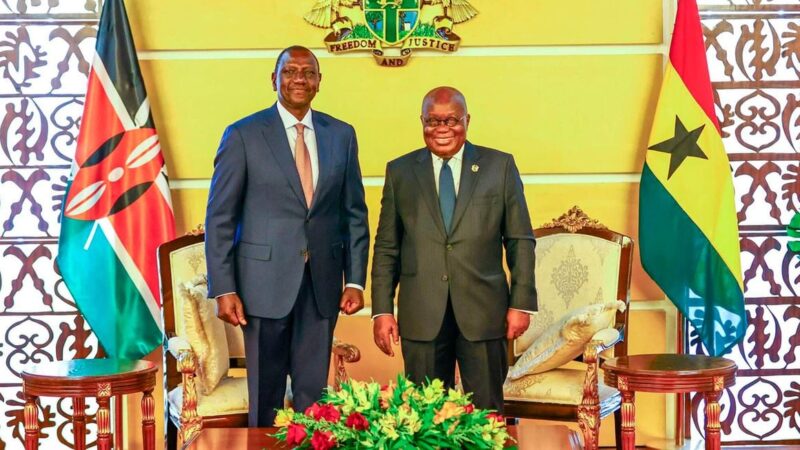
Kenya’s President Dr. William Samoei Ruto, during the first week of April 2024, visited the Republic of Ghana located in West Africa purposefully looking to deepen high-profile diplomatic ties, but beyond that championed very significant questions such as (i) narratives over the neo-colonial exploitation of the continent resources, (ii) African integration and its economic status, (iii) the election of next African Union Commission chairperson, (iv) the integration of technology into the trade strategy of the African Continental Free Trade Area (AfCFTA) and finally (v) women’s empowerment within the context of emerging multipolar developments.
(i) Narratives over neo-colonial exploitation of the continent’s resources.
Largely overlooked in local African and western media, the significant historical rhetoric and narratives exclusively centered on how Africa has been exploited without shifting blames to the close-knitted involvement of African leaders and exploiting partners. The geopolitics, in almost all media, emphasizes the simplistic narrative of how Western and European world exploited and under-developed Africa.
By entering into the business across the continent, it implies that Africans themselves agreed to the long-entrenched practice of and the conditions set by engaging external partners. As noticeable results have shown until today, it was by consensus (agreements) that Africans have been marginal actors in those type of economic relations.
Really Africans established the conditions for economic arrangements (unscrutinized, unchecked and unmonitored) over the years. Without agreeing and cooperating with Africans, Westerners and Europeans could not have done business on the continent. Understandably, this has been the traditional pattern throughout Africa, that African leaders have allowed the continent’s resources to be scrambled through the mechanisms fixed by both. That is why African leaders have to champion reforming first their own state institutions, show more transparency and accountability for actions and performances as cornerstones for integrated economic growth and development.
Perhaps the emerging multipolar will offer the African agency to redefine and refine, in various in ways their system of approach, consider to gear for strength rather than harbour such decades-old sign of weaknesses in bilateral negotiations, especially those related to their huge untapped natural resources. In fact, African leaders have to stand for the opposite, not to be misguided by narratives but sit up well for better negotiations (a comprehensive framework for dealing) with external partners and global players.
(ii) The election of next African Union Commission chairperson. The fact is that the often discussed African integration and its economic status closely relates to the entire leadership of the African Union (AU). While the leadership here has been calling for reforms in international organizations such International Monetary Fund, the World Bank and so forth, the AU has thought of reforming itself to transform the continental organization into an effective instrument for transforming Africa. Bureaucracy, rhetoric and rubber-stamping development questions have characterized its activities over the years. Worse is posing for groups photos at international conferences and summits, these bring little to the continent. AU is now a member of the G20, and what else what next?
A bit of reminder that the AU spearheads Africa’s development and integration in close collaboration with all African Union Member States, the Regional Economic Communities and with African citizens at home and abroad. The AU vision is to accelerate progress towards an integrated, prosperous and inclusive Africa, at peace with itself, playing a dynamic role in the continental and global arena, effectively driven by an accountable, efficient and responsive Commission.
With the above summarized functions, and with renewed and full-fledged continental interest, the AUC chairperson must necessarily have the distinctive professional and management skills, ability to control and direct, especially build bridges in the economic affairs across Africa. Within the context of the emerging multipolar reconfiguration and geopolitical changes, to indiscriminately drive more balanced, equitable and fairly-decent relations for the benefit of the continent.
On Ghana trip in April 2024, President William Ruto made an exceptional case for Raila’s AU bid. Reports monitored by this author indicated that William Ruto secured support for Azimio la Umoja Coalition and veteran opposition leader Raila Odinga’s bid for the chairmanship of the African Union Commission (AUC) from Ghana after President Nana Akufo-Addo pledged his support. It was the first such pitch by President Ruto in West Africa since they had some form of ‘handshake’ with his erstwhile nemesis Odinga whom he has since publicly backed to seek the AU top seat. In fact, East Africans have endorsed the candidate with the assurance that Odinga would play a leading role in enhancing and sustaining the pan African agenda. This is in terms of independence and sovereignty, peace and security, development and future prosperity of Africa.
According to the AU guidelines, it is the explicit turn for East Africa, it means only candidates from Eastern Africa region will be eligible for the AUC chairperson position, part of new rules on rotation. After a rigorous vetting, follows then by debate at a public televised forum with field questions from the public. Preparations are in progress to choose the fifth Chairperson to succeed incumbent AUC Chairperson Moussa Faki whose second term of office ends in February 2025. That new forthcoming era would open a new chapter and, to a large degree, determine the future of Africa, especially taking cognizance of the current global changes.
A media report released on March 03, 2024, titled “Museveni Endorses Raila Odinga’s AU Chairperson Bid” and circulated in the East African region showed the publicity campaign and erratic steps at promoting Kenyan Raila Odinga to take over as Chairman of the AU Commission. Interestingly, Raila Odinga, Kenya’s opposition leader, has readily accepted Ugandan President Yoweri Museveni’s endorsement of his candidacy for African Union Commission chairperson.
Apart from Presidents Ruto and Museveni, other state heads who thrown their invaluable weight behind the former Prime Minister are Samia Suluhu (Tanzania), Cyril Ramaphosa (South Africa), Salva Kiir (South Sudan) and Felix Tshisekedi of the Democratic Republic of Congo. In addition, former Nigerian President Olusegun Obasanjo also endorsed Odinga, saying he is the best candidate to replace the outgoing chair, Moussa Faki. He was re-elected in 2021 for the current second four-year term which ends in 2025. Moussa Faki Mahamat, born on 21 June 1960, was first time elected as the African Union Commission (AUC) Chairperson on 30 January 2017 and assumed office in March 2017. He served previously as State Minister of Foreign Affairs for the Republic of Chad.
(iii) The integration of technology into the trade strategy of the African Continental Free Trade Area (AfCFTA). Worth to note first that the AfCFTA Secretariat, the headquarters is located in Accra, capital of the Republic of Ghana. The striking note in Kenya’s president talk at the important venue was to encourage potential and interested stakeholders to harness the power of innovation to expedite the movement of goods and services across the continent. The simple meaning and implication have to be centered on AfCFTA working closely with the other agencies of the African Union (AU) to fast-track cross-border trade using technology.
Secretary-General of the African Continental Free Trade Area Secretariat, Wamkele Mene, observed: “The next wave of investment in African markets must focus on productive sectors of Africa’s economy in order to drive the continent’s industrial development in the decades to come.” Beyond the African continent, the opening of this world’s largest free trade area in Africa in January 2021, spanning 54 states over the next years has the potential to unite more than 1.4 billion people in a $2.5 trillion in the economic bloc, should be of great interest too to foreign partners around the world.
Highlighting the transformative potential of technology, President Ruto emphasised its ability to streamline trade processes, improve transparency and enhance efficiency. These elements are crucial for the success of AfCFTA’s ambitious agenda to create a single market. That was the main reason why President William Ruto described the continent wide free trade agreement as a milestone in pursuing more integrated and inclusive economic growth, anchored on development of skills, market integration, market diversification, and underpinned by technology transfer within African economies and outside.
The AfCFTA agreement is expected to foster industrialization and regional competitiveness through the creation of regional value chains and improved agro-processing and expanded markets for meaningful intra-Africa trade and jobs for young people. Some major developments at AfCFTA, including the signing of a Memorandum of Understanding (MoU) worth $6billion with Equity Bank and another $7billion agreement with the United Bank of Africa. These funds are earmarked for disbursing to small and medium enterprises, especially those led by young people. To ensure effective implementation, Kenya strongly supports the establishment of regional offices and its scheme to host the East African Regional Office in Nairobi. That AfCFTA represents a promise for Africans to significantly contribute towards the prompt attainment of Agenda 2063.
(iv) It has increasingly become important in discussions mechanisms through which to put women in a new dynamic development paradigm across Africa, aspects of women’s empowerment within the context of emerging multipolar developments. At least, during this contemporary times, the first female president of the United Republic of Tanzania, Samia Suluhu Hassan (SAH-mee-ah Soo-LOO-hoo HA-San)Samia Suluhu (Tanzania), and many others in today’s politics, then Nigerian-born Ngozi Okonjo-Iweala who is the seventh Director-General of the WTO. She took office on 1 March 2021, becoming the first woman and the first African to serve as Director-General. Her term of office will expire on 31 August 2025.
At the joint press conference, Ghana’s Nana Akufo-Addo focused on what was later described as carving an image on the global stage. Of course, citizens from Ghana have performed in many international organizations. “I just sought the support of President William Ruto for the candidature of Ghana’s dynamic Minister for Foreign Affairs and Regional Integration, Hon. Shirley Ayorkor Botchwey, for the position of Commonwealth Secretary-General, at the forthcoming elections to be held during the 2024 Commonwealth head of states’ meeting in Samoa,” Nana Akufo-Addo told the joint media conference after the bilateral diplomatic talks.
So far, Ayorkor Botchwey will compete with Lesotho’s candidate for the post. She was a member of the ECOWAS Parliament from 2013 – 2017. Shirley is currently the Chairperson of ECOWAS Council of Ministers and the Minister for Foreign Affairs and Regional Integration of the Republic of Ghana. Ayorkor Botchwey graduated from the Pitman’s Central College, University of London and University of Westminster both in the United Kingdom (UK). Nana Akufo-Addo will probably be out of office by the time elections at both the AUC and the Commonwealth take place. He is in his last term, and now heading towards next presidential elections due in December 2024. The elections for the next Commonwealth Secretary-General’s position is September 2024.
Nevertheless, women continue playing important roles in Africa’s development. Despite the small number in the political sphere, many are in Africa’s traditional agriculture, and now in business and trade. The expectation is that women generally be engaged in different aspects of employment life both in Africa and around the world. This could lead to closing the gap gender, social inclusion, and generally broadening their roles and further for the next future generations. In fact, that was one question both President Nana Akufo-Addo and President William Ruto underlined during their early April talks.
In a nutshell, Kenyan President Dr. William Samoei Ruto’s trip to West Africa has to be analyzed in the above-mentioned context. In the past, the emphasis was strongly put on political ideology, but now, that has largely changed and African leaders could obviously seek an increased economic cooperation with any external partners. But African leaders have to critically review their foreign relations, this time to make a complete departure away from geopolitical accusations and focus on pragmatic strategies and transparent policies over economic dimensions. Multipolar mechanism simply means adopting all-inclusive and mutual understanding, devoid of diverse confrontation and deepening differences. Anything short of that undoubtedly means a return to (East-West or North-South) sharply divided world.























You must be logged in to post a comment Login