
Africa
A Child Who Keeps Talking—And a Father Who Just Stood Up -By John Egbeazien Oshodi
Back on March 18, 2025, Tinubu shocked Nigerians by invoking a state of emergency in Rivers State. The decision effectively suspended the sitting governor, his deputy, and the state’s entire legislative body. Retired Vice Admiral Ibok-Ete Ibas was appointed interim administrator. It was an extraordinary step—and a deeply controversial one.

The Psychology of a Silent Meeting
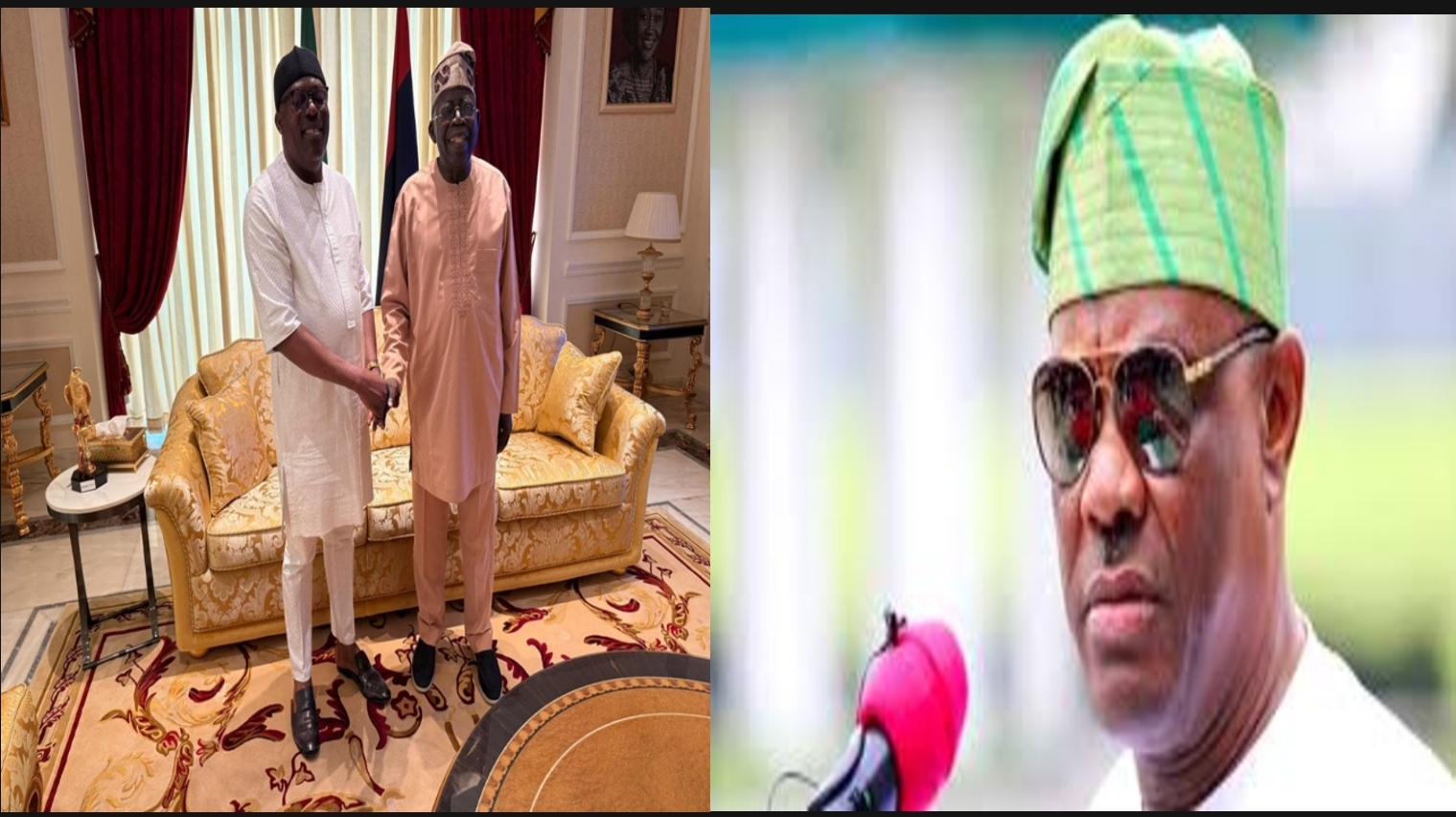
In the psychology of power, silence is often louder than words. On June 3, 2025, President Bola Ahmed Tinubu hosted a quiet, unscheduled meeting in Lagos with Siminalayi Fubara, the suspended Governor of Rivers State. The meeting lacked fanfare, yet its message roared through the political corridors of Nigeria.
This occurred just hours after Nyesom Wike—current Minister of the Federal Capital Territory—went on national television, again treating presidential authority as an afterthought. He declared, with his trademark mix of bluster and ego, that he was not consulted before Tinubu declared a state of emergency in Rivers. In Wike’s eyes, this omission was an affront, a mistake, a decision that could have been corrected if only he had been consulted.
In response, President Tinubu did not raise his voice. He raised his status. He quietly received the very man Wike fought to politically erase. “Governor Sim Fubara of Rivers, now on suspension from office, visited President Bola Tinubu in Lagos on Tuesday,” read a brief update from presidential aide Bayo Onanuga. No statements. No rebuke. Just the optics of quiet authority.
The Emergency Declaration: Tinubu’s Presidential Line in the Sand
Back on March 18, 2025, Tinubu shocked Nigerians by invoking a state of emergency in Rivers State. The decision effectively suspended the sitting governor, his deputy, and the state’s entire legislative body. Retired Vice Admiral Ibok-Ete Ibas was appointed interim administrator. It was an extraordinary step—and a deeply controversial one.
Many believed the move was crafted to protect Wike, not to save democracy. Yet months later, Wike openly criticized the decision, saying: “If I had known about it, I would have advised the President differently.” “I never backed emergency rule in Rivers” – Wike, so what who the hell are you is the president you boy.
That was not advice. That was condescension. Wike cast himself as the thinker behind the throne—the man who should always be consulted. This public correction of the Commander-in-Chief was not a slip of tongue. It was an expression of control, bordering on subtle psychological dominance.
Wike’s Habit of Disrespect: Arrogance as Strategy
The Nigerian public has watched this pattern long enough to see the through-line:
He mocked Rotimi Amaechi, who lifted him into political relevance.
He belittled Peter Odili, a revered elder who once backed his ambition.
He initially circuitously dismissed Tinubu’s direct executive instruction to unseal the PDP headquarters.
Mock Then Praise: A Strategy of Emotional Ambiguity
Then comes what appears to be the most strategic stroke: performative praise. After the jabs and veiled insults, Wike softens the public blow with declarations of loyalty. “I respect President Tinubu… I am loyal… I will deliver Rivers again… I will deliver Abuja,” he says—statements that create the impression of unity and submission. But this does not necessarily reflect genuine loyalty; it more likely suggests careful image management. It allows Wike to maintain what appears to be psychological superiority while outwardly performing subservience. And that’s precisely why this recurring pattern raises concern. It creates public ambiguity—are they aligned or in tension? It subtly erodes the president’s stature without open confrontation. The real damage is not always loud, but it quietly accumulates. The office of the Commander-in-Chief begins to look negotiable. Authority seems diluted—not through protest or failure, but through rhetorical games and selective flattery. For those watching—political actors, citizens, and international observers—the impression is that presidential power in Nigeria can be teased or tested by a minister without repercussion.
Each time, Wike does more than defy. He appears to ridicule. Then, after the dust settles, he circles back with what sounds like praise. This cycle—of striking followed by softening—does not seem accidental. He delivers a psychological blow, then quickly moves to cover it with compliments. But by that point, the perception has already shifted. It is a pattern that seems deliberate. And now, it appears the president has decided—quietly but firmly—that the line must be drawn.
Just recently, Wike reportedly told a journalist: “Who is Tinubu other than me?” The tone did not seem admiring—it came across as self-assertive. He wasn’t elevating the president; he appeared to be elevating himself. This does not resemble a true partnership. It reflects what could be described as psychological projection cloaked in political praise.
The PDP HQ / FCTA Showdown: A Quiet Strain on Presidential Authority
When President Tinubu issued a directive for property owners—including the PDP National Secretariat, the Federal Inland Revenue Service, and others—to settle their ground rent within 14 days or face penalties, the message was unmistakably presidential. Yet the first pushback came not from distant officials, but from the very Minister in charge of the Federal Capital Territory. Wike initially resisted the directive, refusing to unseal the PDP headquarters immediately, signaling a hesitation that rippled far beyond bureaucracy.
Though the properties may have since been reopened, the incident left a visible bruise. It was a quiet but symbolic pause—a moment when a presidential order met internal delay. No dramatic confrontation followed, but the subtle disobedience revealed a deeper strain within the executive ranks. In the architecture of power, such pauses are not just delays; they are signals. And they linger, whispering questions about loyalty, hierarchy, and who truly holds the reins in Abuja.
Fubara’s Return: A Presidential Countermove
In his recent interview, Wike likened Fubara to a disloyal son who had betrayed a father, portraying himself as the injured patriarch in need of deference. But beyond personal pain, his rhetoric exposed a deeper assumption—that he owns Fubara, politically and emotionally. His repeated references to betrayal and disappointment were not just expressions of loss—they were confessions of entitlement. Wike lamented that Fubara had not returned since their last peace meeting, but framed reconciliation not as mutual dialogue, but as a requirement for Fubara to submit to Wike’s legislative loyalists. In other words, peace is permitted only on Wike’s terms. This is not fatherly concern. It is conditional power disguised as elder statesmanship, revealing that Wike still sees himself as the architect—and gatekeeper—of both Fubara’s mandate and the presidential will.
But just hours after these remarks, President Tinubu was photographed with Fubara—without Wike. The symbolism was undeniable. It was a quiet but powerful message: Wike, you are not the throne. You are not the power. The presidency will engage Fubara directly, with or without your blessing.
Amid this backdrop, the President’s quiet audience with Fubara became loaded with meaning. Wike had tried to politically sideline and erase Fubara. Yet here stood the suspended governor—beside the President, not in defiance, but in respectful dialogue. A reappearance not orchestrated by Wike, but by the highest office in the land.
Tinubu didn’t need to raise his voice. He simply reminded Wike of the limits of personal empire. “You questioned my judgment?” the President seemed to convey. “Here is the man you attempted to destroy—now meeting with me.”
This moment was more than political optics. It was a restoration of balance. A deliberate, silent, presidential recalibration of psychological and political power.
The Kingibe Disregard: Another Elected Voice Pushed Aside
Nigerians have quietly observed that Nyesom Wike continues to sideline Senator Ireti Kingibe, the sole elected representative of the Federal Capital Territory in the National Assembly. Despite her constitutional role and electoral mandate, she has been treated by the FCT Minister as if she holds no relevance in Abuja’s governance structure. This persistent disregard mirrors his treatment of Governor Fubara—undermining elected figures in favor of his personal dominance. And just as Wike once sought to erase Fubara from the political map, one wonders what kind of uproar he might stir if President Tinubu were to hold a formal meeting with Senator Kingibe in the future. Would it trigger another round of bluster? Another press display of bruised ego? Many Nigerians already sense the answer.
Wike Talks Like the Boss of Tinubu and Fubara—Even Calls Fubara a Son Who Tried to Shoot Him
Wike’s latest televised tirade deepened public perception that he sees himself as the true boss over both Tinubu and Fubara. His statements—comparing Fubara to a son who came in the night “with guns to shoot his father”—were not only inflammatory but revealing. In Wike’s narrative, Tinubu is portrayed as someone he “cannot disobey” yet must correct. Fubara, meanwhile, is cast as a betrayal of familial and political loyalty. This language, cloaked in paternal metaphors, confirms Wike’s continued refusal to respect office, hierarchy, or constitutional restraint.
He also emphasized that Fubara has not returned to see him since the so-called reconciliation visit, implying that true peace can only occur if Fubara meets and agrees with the pro-Wike lawmakers—further showcasing his belief that no resolution is legitimate unless routed through his authority.
A Yoruba Man’s Patience Has Limits
In Yoruba culture—deeply rooted in hierarchy, decorum, and reverence for elders—there are lines one simply does not cross. Both President Bola Tinubu and Chief Bode George come from this tradition, where public insult to an elder is not merely a personal slight—it is a cultural violation. Yet recently, Nigerians watched as Nyesom Wike, on live television, dismissed Bode George with the words, “sit at home and read newspapers,” reducing a nearly 80-year-old statesman to ridicule. This was no longer political banter—it was public desecration. And for a Yoruba man like Tinubu, the insult likely struck deeper than any partisan disagreement. It was a direct affront to the values that shaped him—a gesture that symbolically disrespected not just George, but the very ethos of Yoruba moral order.
And still, we must ask: Chief of Staff Femi Gbajabiamila, Special Adviser Bayo Onanuga—both sons of Yoruba heritage—why the silence? It is one thing for a minister within this APC-led administration to spar with Bode George politically, given their long-standing PDP rivalry. But to publicly ridicule an elder so openly—what does that say about the cultural backbone of respect and dignity? Do you not feel the tremor? This is no longer about politics. It is about whether Yoruba men in national leadership will defend the traditions they were raised to honor—or stand aside as those values are mocked in full view of the nation.
Final Reflection: Let the Presidency Be Treated as Presidency
This moment marks a subtle but seismic shift. For too long, Wike has operated as if he created Tinubu’s presidency—weaponizing public perception that he “delivered Rivers” and contributed funds.
But Tinubu is no apprentice.
This Lagos meeting with Fubara was more than strategy. It was a boundary. It was the beginning of a course correction.
Because in politics—as in psychology—when a child refuses to respect the parent, the parent must stop indulging the tantrum.
Only if, in the coming days, weeks, or few months, the President issues a direct order affirming Fubara’s return to his elected seat—and that directive cuts past Wike—then the message will be unmistakable: the era of indulgence is over.
Mr. President, you’ve remained calm long enough. Now is the time to match subtlety with firmness. The people are watching. The nation is waiting.
This writer holds no personal affiliation with any of the individuals mentioned; the sole concern lies in the defense of democracy, truth, effective governance, institutional integrity, and justice.
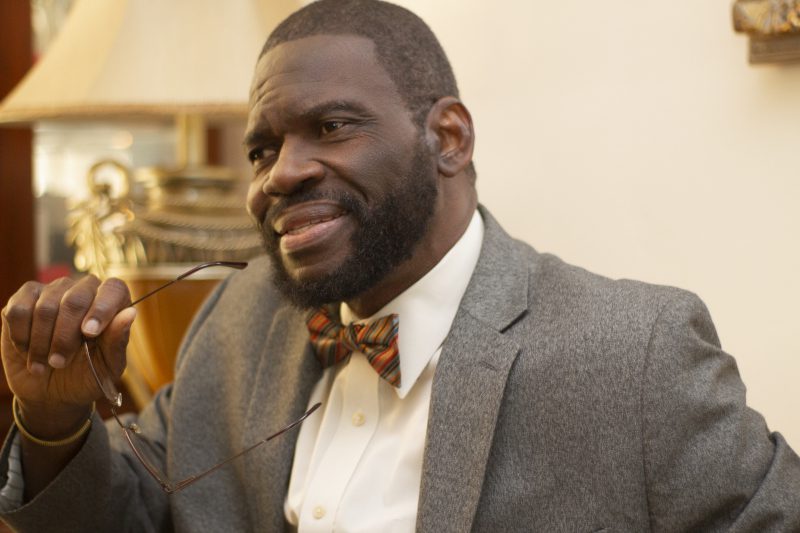
Psychologist John Egbeazien Oshodi
Professor John Egbeazien Oshodi is an American psychologist, educator, and author specializing in forensic, legal, and clinical psychology, cross-cultural psychology, police and prison sciences, and community justice. Born in Uromi, Edo State, Nigeria, he is the son of a 37-year veteran of the Nigeria Police Force—an experience that shaped his enduring commitment to justice, security, and psychological reform.
A pioneer in the field, he introduced state-of-the-art forensic psychology to Nigeria in 2011 through the National Universities Commission and Nasarawa State University, where he served as Associate Professor in the Department of Psychology. His contributions extend beyond academia through the Oshodi Foundation and the Center for Psychological and Forensic Services, advancing mental health, behavioral reform, and institutional transformation.
Professor Oshodi has held faculty positions at Florida Memorial University, Florida International University, Broward College, where he also served as Assistant Professor and Interim Associate Dean, Nova Southeastern University, and Lynn University. He is currently a contributing faculty member at Walden University and a virtual professor with Weldios University and ISCOM University.
In the United States, he serves as a government consultant in forensic-clinical psychology, offering expertise in mental health, behavioral analysis, and institutional evaluation. He is also the founder of Psychoafricalysis, a theoretical framework that integrates African sociocultural dynamics into modern psychology.
A proud Black Republican, Professor Oshodi advocates for individual empowerment, ethical leadership, and institutional integrity. His work focuses on promoting functional governance and sustainable development across Africa.






















You must be logged in to post a comment Login