Global Issues
African Union’s G20 Membership: Effective Collaboration Towards Africa’s Economic Growth, by Kestér Kenn Klomegâh
AU member states need to get their act together and their coalition is already deepening due to the African Continental Free Trade Agreement (AfCFTA). They need capacity building to appreciate and use the benefits of both the AfCFTA and the G20. Together they will be a bigger force to garner concessions from the West, such on debt forgiveness. This issue was raised strongly at the current G20 discussions in Brazil.

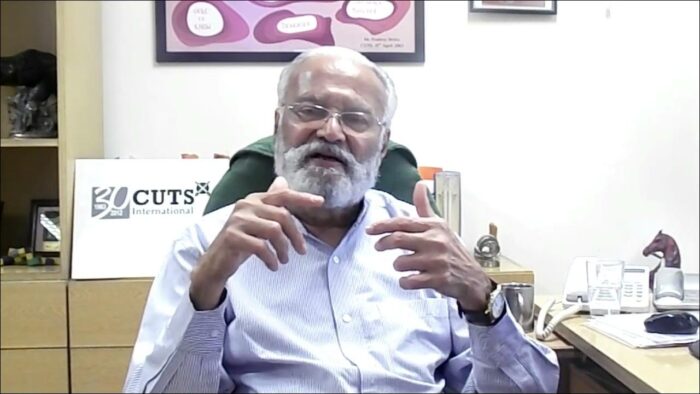
In this interview, Dr. Pradeep S. Mehta, Secretary General of the Jaipur-based Consumer Unity & Trust Society (CUTS) International, with centres in Accra, Nairobi, Lusaka, Geneva, Washington DC, Hanoi and New Delhi, one of the largest public policy research and advocacy groups in India, discusses African continent’s integration into the Group of Twenty (G20) and other global governance systems. While appreciating the fact that the African Union (AU) became a full member of the Group of Twenty (G20) under India’s presidency in September 2023, Pradeep further underlined that Africa has taken strategic steps to explore new opportunities and to shape policies that can drive sustainable development and foster economic growth in the continent.
The African Union, becoming a permanent member of G20, has many implications but there is the necessity for adopting a strategic alignment, capacity building, and stronger collaboration among AU members and with other developing countries. By this particularly for realising the African Continental Free Trade Agreement (AfCFTA), African countries have to attempt exploring opportunities within the context of complexities and contradictions of the emerging multipolar world. Here are the interview excerpts:
Are there any significant differences between European Union and African Union, in terms of, say aspirations and achievements?
Pradeep S. Mehta: European Union (EU) is a legally binding treaty among 27 well-to-do countries in Europe, which was called the Treaty of Rome now amended by the Lisbon Treaty, while The African Union (AU) is also a legal treaty among 55 countries in Africa which are mainly poor or developing under the Constitutive Act of Africa. AU is being guided by the EU’s success, but it is only an aspiration of African countries with little political maturity and/or financial resources. EU is governed by a Council of the 27 heads of state which rotates its Presidency every six months. In the case of AU, the sheer number will not allow short periods of Presidency so it is more of a consensus based approach. The EU is serviced by the well endowed European Commission while the AU is serviced by the moderately endowed AU Commission.
Do you think AU’s membership in G20, for instance, could be of any economic benefits in this emerging multipolar world?
PSM: By joining the G20, it is joining an exclusive club, which goes beyond economics. In Africa, currently South Africa is the only member which is also hosting the next Summit in 2025. Even the EU is a single member though not all its member are members of the G20. The membership is akin to countries seeking membership of the World Trade Organisation (WTO) in spite of the fact that this requires many sacrifices. Staying out is more disadvantageous than staying in.
What are your uptakes as one of the speakers at the high-level round-table titled “Mainstreaming the African Union into the G20”, organised by CUTS International and the Vivekananda International Foundation in New Delhi, India?
PSM: AU member states need to get their act together and their coalition is already deepening due to the African Continental Free Trade Agreement (AfCFTA). They need capacity building to appreciate and use the benefits of both the AfCFTA and the G20. Together they will be a bigger force to garner concessions from the West, such on debt forgiveness. This issue was raised strongly at the current G20 discussions in Brazil.
What role do you suggest India can further play to support Africa’s development within the context of geopolitical rivalries and competition?
PSM: India can play the role of an honest broker providing capacity building and technical assistance to African countries. It has been running such development programmes for few decades, and quite successfully without falling into any ditch where there could be conflicts.
Increasingly, rich countries are tying up with India to provide technical assistance to poor African countries, such as in the sphere of trilateral development projects. These are more cost effective and India can bring in appropriate technology. CUTS International has executed many Trilateral Development Projects in Africa and Asia which has resulted in advancement of local capacities hugely. This has been done consistently in the area of Competition and Consumer Protection regimes in nearly 25 countries in Africa.
And as a staunch member of BRICS, an informal association, how would you comparatively assess India’s current investment and business engagement with Africa?
PSM: These two issues are not related to each other. However, India is providing technical assistance in a big way other than capacity building, medical help and educational opportunities to Africans in a big way. Even armed forces staff from African countries are being trained in India.
How really destructive is the ‘rules-based order’ and western ‘hegemony’ on the continent of Africa? Is this a challenge in pursuit for sustainable development or African leaders have to look at themselves their in the mirror?
PSM: The rules-based order is now changing with say climate change norms is being forced on poor countries who can ill afford the high standards of carbon management. In overall, the attitude of the rich countries continues to be condescending rather be cooperative. The huge funding required to deal with the harms of climate change and biodiversity are no where in sight in spite of hortatory messages. The money has to come from the rich world who are responsible for the mess.