Africa
An Open Message to President Bola Ahmed Tinubu: Retired Police Officers Are Dying—This Is a National Disgrace, Not Just a Police Problem -By John Egbeazien Oshodi
Centralization is choking the system. One federal force cannot carry the entire nation’s policing burden and still guarantee welfare. In functioning democracies, state and local policing allows governments closer to the people to manage recruitment, training, discipline, and retirement benefits.

Mr. President,
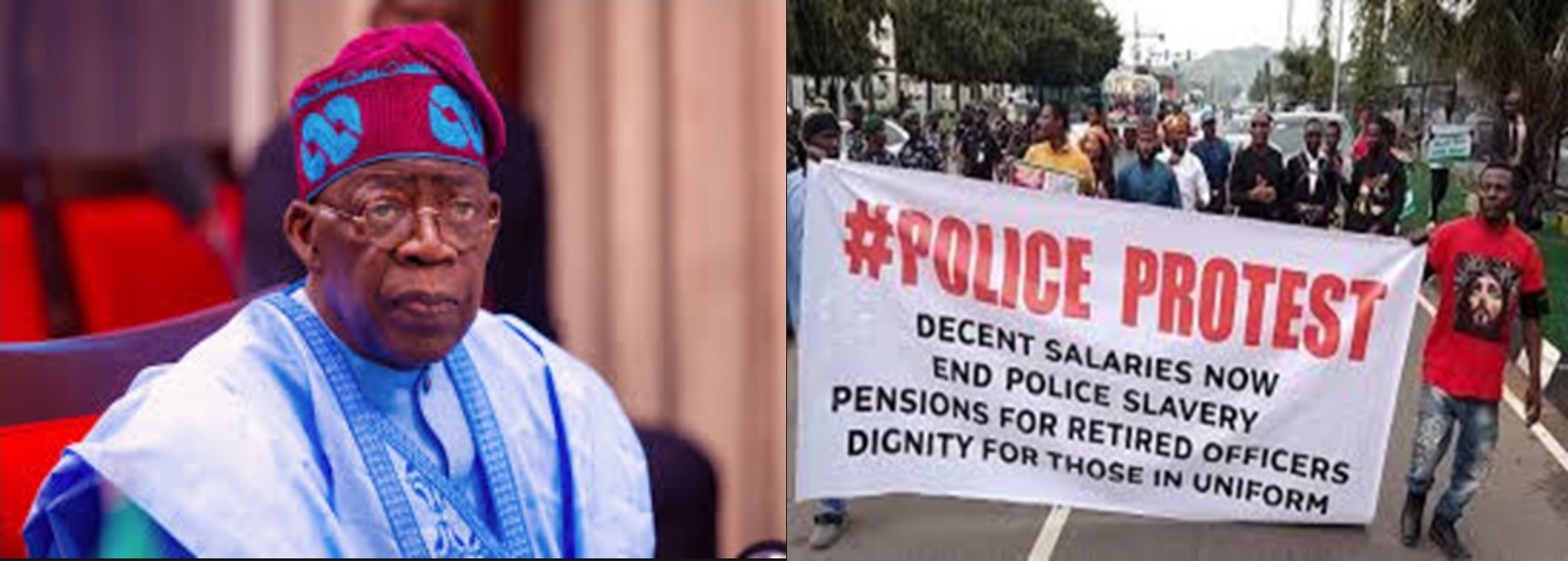
It was a scene that should never have existed. Outside the gates of the National Assembly in Abuja, a group of visibly aged, visibly broken former police officers stood beneath a harsh sun, holding faded placards and crumpled photographs of themselves in uniform. They were not there to chant slogans. They were there to plead. To protest. To mourn the promise they once believed in—and the country that now forgets them.
Their uniform, once a symbol of duty and pride, has become a burden. And their suffering—physical, emotional, institutional—is a collective indictment of the nation’s conscience.
The Uniform They Once Wore Now Feels Like a Burden
In a heartbreaking scene that played out before the world’s eyes, activist Omoyele Sowore walked behind a procession of weary ex-police officers—men who once guarded Nigeria’s streets, now trembling under the weight of their own invisibility. One elderly man, his hands shaking, held up an old photograph of himself in full service uniform. His voice quivered as he spoke:
“I am a nuisance to my family. A nuisance to my neighbours. I barely eat once a day.”
This was not a protest—it was a funeral march for a forgotten class of people. Those who once stood as Nigeria’s shield now shuffle as its beggars.
Sowore’s presence—quiet, deliberate—brought attention. But more than that, it brought dignity. For his solidarity, we thank him. He didn’t just stand with them—he reminded a sleeping nation to open its eyes.
“We Don’t Want This Anymore”: The Pension That Breaks, Not Builds
One retired officer, with clenched fists and misted eyes, spoke for many:
“Help us… remove us from this contributory pension scheme. It is killing us.”
What they seek is not luxury. They are not asking for political appointments or mansions. They are asking for a return to a defined benefit structure—a system that provides security, dignity, and predictability. But instead, the Contributory Pension Scheme (CPS) has become a bureaucratic cage—one that extracts contributions in life and returns only insults in retirement.
To remain in this scheme is to sanction a slow death. A psychological punishment. A financial suffocation. It is a system designed for spreadsheets, not for humans.
The IGP Had No Choice But to Listen
Facing media coverage and rising public outrage, Inspector General Kayode Egbetokun met with the retirees. But his response betrayed a familiar pattern—deflection over direction.
“The protest is not going to give us a solution. It is coming together to dialogue, to talk,” he said.
These are not men who need more meetings. They need medicine. They need food. They need pension arrears. And above all, they need respect. Mr. Egbetokun’s ostensible resistance to state policing—an institutional remedy that would ease both operational and welfare burdens—only reinforces the inertia at the top.
This “Small Case” Protest Has Worked—But It Must Grow
What began as a modest march has cracked open a national conversation. These few brave retirees—some barely able to walk, others trembling from untreated illness—have forced open the sealed vault of public silence. Their defiance lit a moral fire that even the establishment cannot extinguish.
This protest worked not because of its size, but because of its symbolism. It exposed a bitter truth: Nigeria forgets fast. But when the forgotten show up, we remember.
Let the Retired Police Women Speak Too
The next chapter of this protest must include the voices of retired female officers. Women who served doubly: as uniformed defenders and as survivors of a patriarchal force. Their stories—of pension delays, post-service poverty, and institutional neglect—will deepen the moral reckoning. Their suffering has gone unspoken for too long. If they rise, their stories will not echo—they will thunder.
Modern Policing Requires Modern Systems
Mr. President, this is no longer about figures on paper. This is about the soul of national service. Modern policing requires more than weapons and vehicles. It requires:
Fair, livable wage
Post-retirement health and housing care
Psychological support
Humane barracks and living conditions
Structured pension systems backed by independent oversight
If we continue to run policing like a pre-independence relic, we will keep getting post-service tragedies. We must modernize welfare—not as charity, but as an institutional right.
The Global Standard: How Other Nations Protect Their Retirees
Globally, security personnel do not need to protest to live with dignity. In the United States, officers are enrolled in Defined Benefit Plans at city and state levels. These ensure predictable monthly payments for life, health insurance, and family survivor benefits.
In Canada, the RCMP retirees receive indexed monthly payments and psychological transition support. South Africa’s GEPF safeguards police pensions with clarity and housing benefits. The UK’s Police Pension Scheme (PPS) is transparent, structured, and humane.
None of these nations leave their officers unpaid for a year. None delay benefits until death. None force their retirees to choose between rent and medication. Nigeria must stop pretending pension cruelty is normal.
Why State Policing Is the Institutional Key
Centralization is choking the system. One federal force cannot carry the entire nation’s policing burden and still guarantee welfare. In functioning democracies, state and local policing allows governments closer to the people to manage recruitment, training, discipline, and retirement benefits.
State policing would mean:
Faster welfare responsiveness
Regionally tailored pension administration
Public accountability at the state level
Reduced corruption through proximity-based oversight
Mr. President, your Inspector General may resist. But you must not. The Nigeria of today cannot survive on the model of yesterday.
A Cry Not for only Money—But for Honor
Let this be understood clearly: the protest was not only about pensions. It was a plea for memory. A plea for a country to say to its aging protectors, “We see you. We honor you. We will not forget.”
When a nation abandons its defenders, it signals to the youth that service is foolish. That sacrifice ends in shame. That is not a future Nigeria can afford.
A Call to Action, Mr. President
You have said your presidency seeks to rebuild trust. Let that trust begin here. We urge you to:
Immediately establish a Presidential Task Force on Police Pensions
Reform or exit the CPS in favor of a sustainable hybrid pension model
Publicly endorse and accelerate state policing legislation
Launch an emergency pension welfare intervention fund
Receive monthly briefings on pension status from independent auditors
Conclusion: Mr. President, End the Waiting
There is still time to change course. But that window is closing. Will you be the president who restored the honor of our guardians—or the one who watched them die in silence?
Your legacy, Mr. President, will not be measured by conference centers built or roads commissioned. It will be measured by how the most vulnerable—those who gave their lives to protect others—were remembered under your watch.
Fix this. Not for political gain. Not for optics. But because it is right.
Respectfully,

John Egbeazien Oshodi
Professor John Egbeazien Oshodi is an American psychologist, educator, and author with deep expertise in forensic, legal, and clinical psychology, cross-cultural psychology, and police and prison science. Born in Uromi, Edo State, Nigeria, and the son of a 37-year veteran of the Nigeria Police Force, his early immersion in law enforcement laid the foundation for a lifelong commitment to justice, institutional transformation, and psychological empowerment.
In 2011, he introduced state-of-the-art forensic psychology to Nigeria through the National Universities Commission and Nasarawa State University, where he served as Associate Professor of Psychology. Over the decades, he has taught at Florida Memorial University, Florida International University, Broward College (as Assistant Professor and Interim Associate Dean), Nova Southeastern University, and Lynn University. He currently teaches at Walden University and holds virtual academic roles with Weldios University and ISCOM University.
In the U.S., Prof. Oshodi serves as a government consultant in forensic-clinical psychology and leads professional and research initiatives through the Oshodi Foundation, the Center for Psychological and Forensic Services. He is the originator of Psychoafricalysis, a culturally anchored psychological model that integrates African sociocultural realities, historical memory, and symbolic-spiritual consciousness—offering a transformative alternative to dominant Western psychological paradigms.
A proud Black Republican, Professor Oshodi is a strong advocate for ethical leadership, institutional accountability, and renewed bonds between Africa and its global diaspora—working across borders to inspire psychological resilience, systemic reform, and forward-looking public dialogue.