
Global Issues
As A Matter Of Human Rights, The Life Of A War Correspondent Matters -By Isaac Asabor
The Council identified the issue of protection of journalists in armed conflict as urgent and important. It insists on the need to observe the applicable law calling upon parties to conflicts to respect their obligations under international law to protect journalists and civilians. The council singled out impunity for crimes committed against journalists in armed conflict as a significant challenge to their protection.

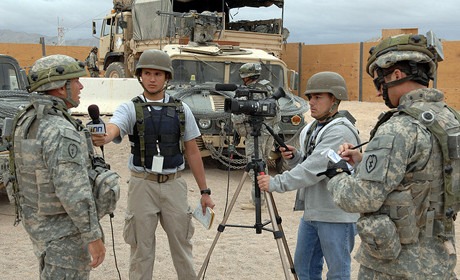
If there is one inimitable role that noticeably separates the Journalism profession from other professions; except the military, police and other security agencies, it is unarguably that of playing the crucial role of plying their trade on the frontlines of war, and in doing so, play the role of nurturing a society based on open discussion of facts and the pursuit of the truth, as opposed to one based on rumor, prejudice, propaganda and the naked exercise of power. Therefore, putting the crucial roles Journalists play when on the frontline, Marie Colvin, a veteran war correspondent killed while covering Syrian Protests in 2012 said, “Covering a war means going to places torn by chaos, destruction and death, and trying to bear witness. It means trying to find the truth in a sandstorm of propaganda when armies, tribes or terrorists clash…Our mission is to report these horrors of war with accuracy and without prejudice.”
Against the foregoing backdrop, it is not exaggerative to opine that Journalists are more often than not at war fronts in the line of fire to gather news despite the risk therein, and that they deserve special protection. In fact, it is not an overstatement to recall that the incidences of deadly attacks on journalists over the last two decades have seemingly not been adequately addressed with applicable legal and policy frameworks that could have provided a higher level of protection as the sanguinary incidents of Journalists been killed in the course of carrying their duties on the frontlines persist.
At this juncture, it is expedient to urge international and local authorities charged with the onus of protecting Journalists that ply their trade on war trenches to be alive to their responsibilities as it is expedient that the life of even one Journalist sourcing stories from war zone matters.
Therefore, it is germane to opine in this context that the inspiration to express this view was spurred by the death of one Journalists, and six others that were injured on Friday in Southern Lebanon when Israel fired artillery into the area they were gathered.
As virally reported today, the affected Journalists were respectively gathering stories from the frontline for news media that cut across Reuters, the Agence France-Presse(AFP) Wire Service and Al Jazeera. The attack against the Journalists has being described as one of the worst press catastrophes that have emerged from Israel’s war against Hamas.
At this point, it is not out of place for some readers of this piece to ask if it is possible to protect the lives of Journalists covering news from war zones. The answer to the foregoing cannot be farfetched as it is possible, since Mr. Robin Geiss, an ICRC legal expert, had in the past talked about the protection of War Journalists as he said as long as they are civilians, and are not taking part in the fighting, they are entitled to be protected under international humanitarian law.
When asked, “What protection do media professionals have under international humanitarian law?”, he said, “At first sight, one could get the impression that international humanitarian law does not provide a whole lot of protection for journalists, given that the Geneva Conventions and their Additional Protocols contain only two explicit references to media personnel (Article 4 A (4) of the Third Geneva Convention and Article 79 of Additional Protocol I). However, if one reads these provisions in conjunction with other humanitarian rules, it is clear that the protection under existing law is quite comprehensive. Most importantly, Article 79 of Additional Protocol I provides that journalists are entitled to all rights and protections granted to civilians in international armed conflicts. The same holds true in non-international armed conflicts by virtue of customary international law (Rule 34 of the ICRC’s Customary Law Study).
“Thus, in order to perceive the full scope of protection granted to journalists under humanitarian law one simply has to substitute the word ” civilian ” as it is used throughout the Geneva Conventions and their Additional Protocols with the word ” journalist.”
From the context of the ongoing crisis between Israel and the Hamas of Palestine, when asked “Do you think enough is being done to ensure better protection for media personnel working in armed-conflict situations?, the answer would be in the negative as experts are at the moment condemning the deadly attacks by Hamas on Israeli civilians and the devastating Israeli airstrikes and blockade of Gaza as they were unanimous in their views that both sides were violating international law.
For instance, a United Nations Commission of Inquiry said it has been “collecting and preserving evidence of war crimes committed by all sides” since the violence started last week. Against the foregoing backdrop, evidence could be added to an investigation by the International Criminal Court into possible war crimes committed by Israel and Hamas in past conflicts.
“Intentional targeting of civilians and civilian objects without a military necessary reason to do so is a war crime, period,” said David Crane, an American international law expert and the founding chief prosecutor of the United Nations’ Special Court for Sierra Leone. “And that’s a standard that both sides are held to under international law.”
On a similar note, under article 79 of Additional Protocol I of the Geneva Conventions, which codifies a customary rule, journalists in war zones must be treated as civilians and protected as such, provided they play no part in the hostilities.
Given that the profession of journalism is not without danger, not a few journalists in the world have resorted to struggling to in their news gathering roles, and doing that put their lives at risk, or find themselves facing threats to their human rights, which basically involves their right to safety. While this is the case particularly in troubled areas, notably zones experiencing war or other forms of upheaval, it is far from being exclusive to such cases.
For instance, at home in Nigeria, local journalists are increasingly facing threats to their lives as they are in all directions threatened in the course of duty, in addition to the challenges encountered by journalists in armed conflict situations.
It is expedient to recall that the main UN organs dealing with human rights showed an increasing concern for the issue of protection of journalists in peace and war times. In December 2006, the Security Council declared that it is deeply concerned by the frequency of acts of violence in many parts of the world against journalists, media professionals and associated personnel in armed conflict, in particular deliberate attacks in violation of international human rights laws.
The Council identified the issue of protection of journalists in armed conflict as urgent and important. It insists on the need to observe the applicable law calling upon parties to conflicts to respect their obligations under international law to protect journalists and civilians. The council singled out impunity for crimes committed against journalists in armed conflict as a significant challenge to their protection.
The resolution also stressed that ensuring accountability for crimes committed against journalists, media professionals, and associated personnel is a key element in preventing future attacks. Amongst the UN specialized organizations, the United Nations Educational, Scientific and Cultural Organization (UNESCO) has been very active in raising awareness on the issue of safety of journalists. UNESCO has spearheaded a group of UN agencies to elaborate a UN Plan of Action on the Safety of Journalists and the Issue of Impunity.
In a similar vein, non-governmental human rights organizations, including organizations dedicated to the protection of journalists such as Reporters Without Borders (RWB), Committee to Protect Journalists (CPJ), and the International Federation of Journalists (IFJ), have been actively advocating for the protection of journalists and raising awareness on the issue of impunity of perpetrators of attacks against journalists.
In fact, the action of some of these organizations played some role in the placement of the issue of protection of journalists on the agenda of UN organs. Some regional organizations, notably the Organization of American States (OAS), the Organization for Security and Cooperation in Europe (OSCE) and the African Union (AU), have also put the issue of protection of journalists on their agenda.
Given the fact that Journalists are in greater danger in conflict zones more than ever before, it is expedient to in this context to urge people and the institutions they represent, particularly as the crises between Israel and Palestine, and between Russia and Ukraine persist, to as a matter of human rights do their works diligently in such a way that they would speak to the fact that the life of a War Correspondent matters.

















You must be logged in to post a comment Login