
Global Issues
Beyond Declarations: When International Law Fails to Confront Systemic Racism -By Fransiscus Nanga Roka
Until international law is prepared to begin the movement from principle and aspiration towards enforcement, obligation — it will continue to be what it far too often has been: a fluent tongue of justice, experientially articulated but selectively enacted.

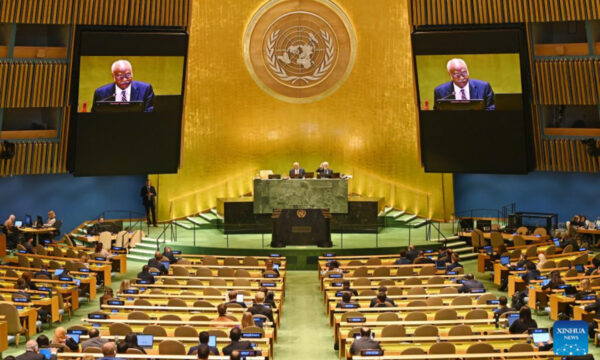
The words of moral commitment have been practiced throughout the world for decades. Declarations are crafted, resolutions adopted and milestones celebrated. The world comes together, talks and pledges. But racism remains not as an aberration, but a structure. Where the system is not an accident.
This is an uncomfortable truth: international law knows how to denounce racism, but not how to abolish it.
Between the Durban Declaration and, of course, the most recent international rallying cries for action there is a strong architecture for anti-racism at an international level. States recommit, pledge reforms and celebrate progress. However, beneath the surface lies a deeper truth: racial inequities are not disappearing; they simply morph. It transforms with each new economic system, builds itself into digital scaffolding and conceals its weapons in neutral terms “security,” “migration control,” “economic efficiency.”
The issue is NOT a lack of law. It is lack of consequence.
Racism International law in its current form is constitutionally allergic to enforcement. It depends on voluntary compliance, diplomatic pressure and reputational incentives tools that fundamentally fall short against entrenched systems of discrimination. You ask states to report on progress. They submit documents. They attend reviews. They receive recommendations. And then too often they come home with unchanged.
This is not accountability. It is choreography.
Think of the exact working or which racism works. It is rarely explicit. It is not declared in laws or policies. It is an exclusion one that reveals itself in outcomes such as excessive rates of incarceration, lack of access to healthcare within these communities and systemic barriers to economic opportunity but also manifests on those scale through algorithmic bias derived from the injustices of history These are not isolated incidents. They are patterns. Whereas systems evidence the patterns.
And yet international law finds it difficult to address this reality. Its devices are for violations laid bare obvious acts, recognizable actors, individual harms. Systemic racism, on the other hand, is diffuse. It is systemic, so it becomes normalized through action, and has no single vector of failure. This allows it to frequently evade the reach of laws altogether.
.
It is for this reason that the law requires evidence of intent. Racism thrives on impact.
Part of this gap is not technical, but political. The thing is States simply do not want to own the systemic racism in their borders, a reform would be needed of policing cost education as well of economic policy. That would mean dealing with histories of colonialism, slavery and exclusion not as historical wrongs but rather contemporary truths. And that makes it a far harder conversation to have than another resolution.
And so the long cycle persists: pronouncements that do not shake; promises unaccompanied by transformation.
What is more worrisome is how international law was getting used of this kind progress by noise-making. Data is collected. Indicators are developed. Reports are published. But measurement is not transformation. Though counting inequality will not remove it, Sometimes, the measurement itself is a proxy for action making an offer to care without redistributing power.
Racism victims can wait. To document. To engage in processes that offer promise of recognition but hardly justice. We talk a good game about reparations, yet few ever take action. While structural reforms are suggested, they rarely come into practice. This produces a chasm between the words of human rights and the experience of those it purports to protect.
The deepest paradox of international law is that it seeks universality yet accepts asymmetry.
Stepping beyond proclamations, the global legal regime needs to ask itself a challenging question: how does accountability manifest when damage is systemic? The answer is not found in the same mechanisms that have failed us for decades. This would entail a transition from non binding gestures to legally binding obligations, from reporting back on commitments made that might not be fulfilled without consequence, to remediating measures where applicable and when breaches occur; more broadly it will also require symbolic action over material action.
The recognition systems, not individuals are responsible for systematic racism and must be seen as a harm focused on the legal basis. But as not just a social issue but a legal transgression that can be quantified. In other words, it means leaving behind intent-based frameworks in favor of impactbased standards: where enduring disparities warrant legal scrutiny irrespective of professed neutrality.
The second is an accountability for inaction. You can name and shame but that is not enough. Those that do not actively combat systemic racism ought to, at the very least by way of conditional access to international funding and trade consequences or a legally binding mechanism tied within human rights bodies.
Third, victims are at the centre not as sources of testimon but as rights holders with a right to remedy. Such access must be substantive, in the form of reparations, institutional reform and participation within decision-making processes that govern their lives.
But at the end of the day, international law has its own limitations. It cannot pretend to voice the moral conscience while evading political reality. Racism is not kept alive with ignorance it is held up by power. And power does not give in to pronouncements.
To the world hungry for knowledge of oppression. That comes off like a will not.
Until international law is prepared to begin the movement from principle and aspiration towards enforcement, obligation — it will continue to be what it far too often has been: a fluent tongue of justice, experientially articulated but selectively enacted.
A system that captures injustice but effectively does nothing to impede it is not merely incomplete.
It sounds simple enough, but it creates a system that normalizes for-profit institutions and thereby legitimizes the same inequality they profess to fight.
Fransiscus Nanga Roka
Faculty of Law, University 17 August 1945 Surabaya Indonesia

























You must be logged in to post a comment Login