
Forgotten Dairies
Ndisgonabi—Tinubu or Tinubu -By Prince Charles Dickson, PhD
That brings me to Ndisgonabi. I first heard it in that playful fatalist exchange between my beloved friend Nima and her sister NG at an amala joint. One would say, Ndisgonabi. The other would answer, gonna be. Then I too started echoing it: Ndisgonabi. Gonna be. It sounded funny, warm, unserious. But like most street philosophy, it was carrying a knife under the wrapper. Ndisgonabi is what people say when they are tired of pretending control. It is our local remix of “what will be, will be.” It is also, in politics, a dangerous narcotic.

Bí ìtàkùn bá pa ẹnu pọ̀, wọn á mú erin so.
If creeping plants could unite, they would easily tie up an elephant.
Politics is full of men who confuse noise for destiny. But destiny, that slippery old masquerade, usually waits for structure. In 1984, New Zealand’s Prime Minister Robert Muldoon staggered into history by calling a snap election in a visibly drunken state, hoping to ambush the opposition. The gamble backfired. He lost. In January 2009, in Nigeria, police in Kwara detained a goat after vigilantes claimed an armed robbery suspect had transformed into the animal to escape arrest. The police kept the goat, but admitted they could not confirm the witchcraft scientifically. One story is about power intoxicated by its own myth. The other is about a society so burdened by superstition that absurdity can wear handcuffs. Together, they say something brutal about politics: sometimes leaders misread reality, and sometimes citizens arrest the wrong animal.
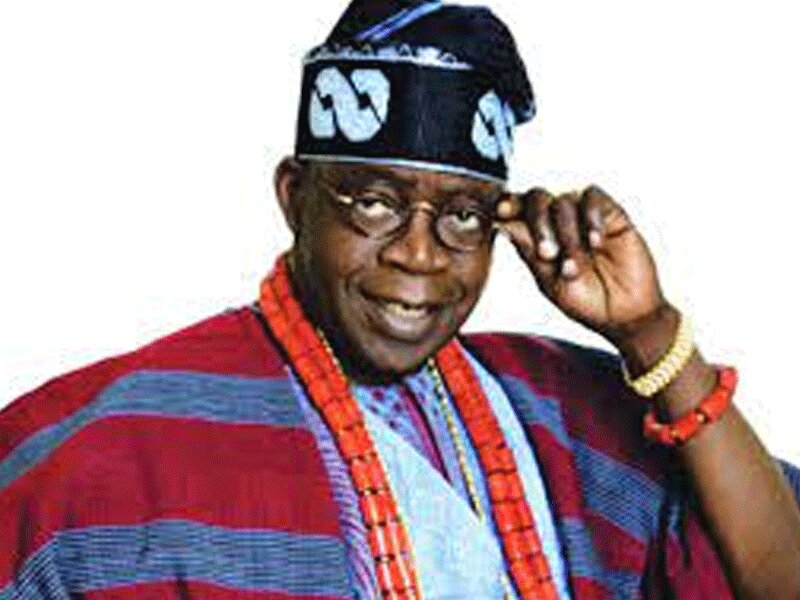
That is where Nigeria is drifting toward 2027. The elephant in the room is Bola Ahmed Tinubu. Not because everybody loves him. Not because his government has solved Nigeria. But because politics, especially Nigerian politics, does not award power to the most complained-about man. It awards it to the man whose enemies cannot agree on which knife to use. INEC has already fixed the presidential and National Assembly election for 20 February 2027, with governorship and state assembly polls on 6 March 2027. The whistle has gone. This is no longer an era of abstract outrage. It is an era of arithmetic.
Now, let us be fair, because fairness is not weakness. Tinubu’s administration is not walking on water. Yet it is not walking on pure failure either. The World Bank said in its April 2026 Nigeria Development Update that macroeconomic fundamentals improved through 2025 and into 2026, with the economy growing at around 4 percent, inflation trending downward though still elevated, and gross FAAC revenues rising from N29.4 trillion in 2024 to N37.4 trillion in 2025. NBS says headline inflation was 15.38% in March 2026, with food inflation at 14.31%. Those are not small numbers. They suggest that some macro-stabilisation is happening. But macros do not hug hungry people. Revenues can rise while despair deepens. A country can look healthier in spreadsheets and sicker in the market.
That is the contradiction haunting Tinubu. The poverty of statistics and the statistics of poverty are not the same thing. Government can point to improving indicators, better revenue capture, tighter monetary conditions, and reform momentum. But the citizen does not live inside a PowerPoint. The citizen lives inside transport fares, school fees, rent, market prices, and the humiliation of constant improvisation. The World Bank’s April 2026 update shows poverty at 63% in 2025, with only a gradual projected decline from 2026 onward. That single figure is the real opposition press conference. It means reform may be economically coherent and politically dangerous at the same time.
Then there is insecurity, the dark editor of every government boast. In just the past weeks and months, Reuters and AP have reported major bandit abductions in Zamfara, deadly retaliatory attacks in Katsina, mass killings in parts of Kwara and Katsina earlier this year, and the abduction of students in Benue. Reuters also noted today, 22 April 2026, that Tinubu’s government is tightening internal security amid economic strain, heightened militant attacks in the north, and political friction. This is the administration’s greatest vulnerability. Citizens may forgive hardship if they feel protected. They rarely forgive hardship and fear in one package.
And yet, here is the wicked truth: Tinubu can still win again.
He can win not because he has conquered suffering, but because the opposition may still be auditioning for tragedy. Key opposition leaders formed a coalition around the ADC precisely because they understood the central lesson of Nigerian electoral history: only a united opposition can seriously threaten an entrenched ruling machine. Unity is not decoration. It is oxygen. An Atiku has signalled his intention to run in 2027. This matters because every opposition conversation still has one stubborn ghost inside it: ambition.
And this is where the North becomes the unslept question in the room. Atiku remains familiar, networked, seasoned, and deeply legible to elite politics. But familiarity can curdle into fatigue. There is a suspicion around him in some quarters, not always ideological, often emotional: the feeling that he is forever arriving at the national bus stop with one more ticket, one more coalition, one more final attempt. That is not a polling number. It is a political mood, and moods matter.
Another deeper question is whether the North is willing to do an Obi, meaning not merely to tolerate Peter Obi as a southern protest vessel, but to actively invest in him as a viable national instrument. That would require a leap from grievance to calculation, from sympathy to strategy. It would require sections of northern politics to decide that electability is now broader than old rotation habits, old patronage circuits, and old distrusts. That leap is possible. It is not yet proven.
As for Obi himself, the argument around him is lazy at both extremes. His admirers often speak as though moral clarity is already a governing blueprint. His critics often speak as though he is made only of emotion and internet incense. Both positions are unserious. Obi’s 2023 rise was real because he converted public anger into a disciplined symbolic movement, and Reuters captured that early when it described his effort to harness Nigerians’ frustration with the status quo. But symbolism is not the same as statecraft. To do better than Tinubu, Obi would need more than clean optics and crowd voltage. He would need a tougher party architecture, stronger northern penetration, better elite bargaining, vote protection capacity, and a clearer answer to the old Nigerian riddle: how do you move from inspiration to enforcement? In other words, he can be more than emotion, but he has not yet fully proved the machine.
That brings me to Ndisgonabi. I first heard it in that playful fatalist exchange between my beloved friend Nima and her sister NG at an amala joint. One would say, Ndisgonabi. The other would answer, gonna be. Then I too started echoing it: Ndisgonabi. Gonna be. It sounded funny, warm, unserious. But like most street philosophy, it was carrying a knife under the wrapper. Ndisgonabi is what people say when they are tired of pretending control. It is our local remix of “what will be, will be.” It is also, in politics, a dangerous narcotic.
Because once citizens start saying Ndisgonabi about power, they have already surrendered the republic.
No, what is going to be is not always going to be. Sometimes what is going to be is what was organised. Tinubu’s fate is not floating in the sky like divine memo. It is being negotiated on the ground by insecurity, inflation, incumbency, elite bargains, northern calculations, opposition ego, media climate, and public exhaustion. If the creeping plants stay scattered, the elephant walks through the farm and calls it democracy. But if they bind themselves, if Atiku stops being a yo-yo of perpetual possibility, if Obi becomes more machine than mood, if the North decides interest is greater than habit, if the opposition learns that arithmetic is holier than vanity, then Tinubu can lose.
Until then, Ndisgonabi may simply mean this: Tinubu or Tinubu—May Nigeria win!

















You must be logged in to post a comment Login