
Africa
Bigger Barns, Empty Souls: The Vanity Of Nigerian Politicians Through The Lens Of Jesus’ Parable -By Isaac Asabor
The answer should sober even the most arrogant leader. Because no matter how large your barns are, no matter how tight your security is, no matter how far your children have been shipped abroad, you will one day leave it all behind. And the only question that will matter is not “what you had”, but “what you gave”.

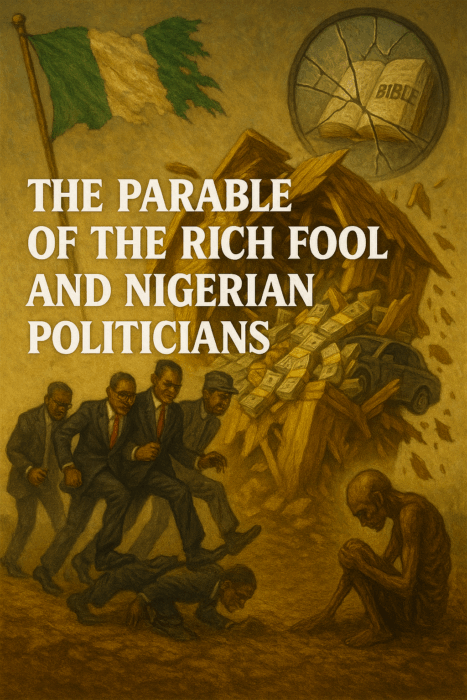
As an opinion writer, there is hardly a year that I don’t use my voice and platform to call on Nigerian politicians to lead with conscience and govern with purpose. Particularly on significant days like June 12, a date that symbolizes our struggle for democracy, I feel morally compelled to speak truth to power. Although I have already penned and published a piece in this regard today, lamenting the state of our democracy, however, I find it necessary to go a step further through this write-up as it is not just another appeal for good governance; it is a deliberate attempt to prick the conscience of our leaders, who continue to display unmatched levels of acquisitiveness and selfishness. Using Jesus’ parable of the rich fool as a mirror, I hold up their actions against eternal truth, not to condemn, but to awaken them to the futility of hoarding wealth in “bigger barns” while the nation rots.
In Luke 12:16–21, Jesus tells the story of a wealthy man whose fields yielded a bountiful harvest. So massive was the yield that he lacked space to store his produce. He decided, “I will pull down my barns and build greater,” and afterward, he would tell his soul to relax, eat, drink, and be merry. But the parable ends abruptly with God’s judgment: *“Fool! This night your soul will be required of you; then whose will those things be which you have provided?
This biblical narrative, no doubt, eerily mirrors the mindset of Nigerian politicians today, a ruling class obsessed with storing wealth in “bigger barns” while the country around them decays. The rich fool in Jesus’ parable is not just an individual; he is a symbol of any leader who trusts in temporal power, amasses wealth, and loses sight of eternal and civic responsibility.
Without a doubt, Nigeria’s political class is building barns of vanity. From Abuja to state capitals across Nigeria, the political elite engage in wealth accumulation at levels that defy logic and justice. Like the rich fool, their concerns are not how to improve the lives of the electorate, build schools, equip hospitals, or reduce unemployment. Instead, their worries center on “Where else can we stash the loot?”
Whether it is offshore accounts, luxury real estate in Dubai and London, or armored convoys that shame struggling citizens, their barns are overflowing. Yet, every four years, they seek re-election with campaigns full of deceit and empty promises, only to return to their old ways once power is secured.
But just like the rich fool, their obsession with material expansion without spiritual or moral direction is setting them up for an inevitable downfall. They may build barns, but they cannot store eternity.
Jesus’ parable did not condemn success or wealth; rather, it condemned misplaced priorities. The rich man had a great harvest, something that should have translated into generosity or community building, but instead, he turned inward. He saw his surplus not as an opportunity to serve, but to indulge.
Nigerian politicians operate with this same flawed logic. Excess oil revenues, foreign investments, and public funds that should have lifted millions out of poverty are routinely misappropriated. When COVID-19 hit and palliatives were meant to ease the burden on citizens, many governors and public officials hoarded them in warehouses, literal barns, while their constituents starved.
Like the man in Jesus’ story, these leaders imagine they are insulated by their power and wealth. They fail to ask the vital question: “Whose will these things be when I am gone?
In fact, the folly thinking that one’s legacy is built solely on possessions has ancient roots. Pharaohs were buried with treasures they believed would serve them in the afterlife. Today, Nigerian politicians are buried with long convoys, luxury caskets, and state-funded funerals, but what do these rituals matter when the roads leading to the cemetery are riddled with potholes and poverty?
Solomon, the wisest man who ever lived, said in Ecclesiastes 2:18-19, “I hated all the things I had toiled for under the sun, because I must leave them to the one who comes after me.” He recognized that wealth, power, and achievements mean nothing when you cannot control who inherits them or how they are used.
So should Nigerian politicians. What legacy do they truly leave? Another flyover in a collapsing economy? Another white elephant project that will be overgrown by weeds in two years? Or bloated pension laws for themselves while civil servants die waiting for gratuities?
Without resorting to sounding toxic in this context, it suffices to opine that the collective foolishness of the political class of today is unprecedented. What makes the Nigerian case more tragic is not the isolated corruption of a few individuals, it is the collective vanity of the entire political ecosystem. Even those who enter politics with good intentions are soon caught up in the cycle of greed, self-preservation, and endless acquisition.
Just like the rich man in the parable who thought his future was secure, many Nigerian leaders believe that political immunity, loyal security details, and a stolen war chest will shield them. But when the hour of reckoning comes, be it death, disgrace, or divine judgment, they discover, too late, that their barns cannot buy them peace.
At this juncture, it is germane to make reference to David’s wisdom to contextually serve as a better example. This is as King David had a more grounded perspective. In Psalm 39:6, he wrote, “Surely every man walks about like a shadow; surely they busy themselves in vain; he heaps up riches, and does not know who will gather them.” David understood what Nigerian politicians fail to grasp, that life is fleeting, and wealth without purpose is vain.
David did not stop at recognizing this vanity. In the very next verse, he redirected his hope: “What, then, can I count on, O Lord? In you my hope lies.” Unlike the rich fool who placed his faith in his harvest, David placed his hope in God and in eternity.
In fact, Jesus warned against laying up treasures on earth, where rust and moth destroy (Matthew 6:19–20). This is not merely about heaven and hell. It is about priorities, purpose, and stewardship. Nigerian politicians, drunk on power, must ask themselves: “What am I building, and for whom?”
Is it a private jet fleet or a healthcare system that works? Is it a sprawling mansion in Banana Island or affordable housing for the masses? Is it a Swiss bank account or a transparent education fund?
Real leadership requires investing in things that endure, justice, infrastructure, education, peace, and above all, human dignity.
All hope is not lost. The parable ends with a warning, not a curse. Jesus says, “This is how it will be with whoever stores up things for themselves but is not rich toward God.” The implication is clear, change is possible. The political class in Nigeria must return to the fundamentals of leadership: service, integrity, accountability.
They must understand that the barns they build will one day rot, the cars they drive will one day rust, and the positions they hold will one day pass on to another. The only thing that endures is how they used their power, for themselves, or for the people.
Nigeria’s politicians must stop chasing shadows and start building substance. Vanity has gotten us nowhere. As it is now, Nigerians look at leadership and see only greed, excess, and detachment from reality.
Let every politician pause and reflect on Jesus’ piercing question: “Then whose will those things be which you have provided?”
The answer should sober even the most arrogant leader. Because no matter how large your barns are, no matter how tight your security is, no matter how far your children have been shipped abroad, you will one day leave it all behind. And the only question that will matter is not “what you had”, but “what you gave”.
Let Nigerian leaders stop building barns, and start building a nation. A word is enough for the wise.

























You must be logged in to post a comment Login