
Opinion
Bisi Akande, Poverty And Ige’s Death -By Festus Adedayo
All the above put together remind me that, in their daily fight for dominance and conquest, a fleeting nature of power and dominance exists among Nigerian politicians. It is the type of desperation found among the lion and a warthog. In Nigerian politics, there is an unending, constant and relentless struggle between preys and predators, with each seeking dominance and conquest. In doing this, politicians deploy worldly cunning to foist false narratives on the populace. Bisi Akande’s interview and a huge chunk of his autobiography are a further reinforcement of this frightening fight in the political wild.

In her biography of Ayo Rosiji, one of the key politicians of Nigeria’s first republic, entitled Man With Vision, Australia-born historian, Nina Mba, citing a Holmes, called biographers “People who knead people.” In other words, biographers knead their subjects from raw flour into edible form. You then wonder what the late lecturer in the History department of the University of Lagos would have called autobiographers. Self-conjurers, perhaps. For, in the process of piecing together bits about themselves, those who write their life histories have been accused of selfishly adding together a mish-mash of two unrelated traditional soup recipes, (lúrú and sápá) falsifying realities and mis-painting the picture of truth. Last week, sidekick of the Nigerian president and former Chairman of the All Progressives Party, (APC) Chief Bisi Akande, chose to conjure the spirit of a dead dog. In a podcast interview with popular broadcaster, Edmund Obilo, which centered around his autobiography, My Paticipations, the 86-year old came under heavy shellacking on allegations of historical revisionism. The specifics were that he kneaded a wrong dough of history and made a wrong portrayal of himself. In that interview, Akande coasted home with a self portraiture as a man who sat by the edge of a smelly sewage but chose not to smell the rank odour of rot.
By the way, I passed Akande’s country-home, Ila-Orangun, Osun State, by about a week ago. I was on my way to the burial of the mother of Oba Adedokun Omoniyi Abolarin, the Orangun of Oke-Ila. You cannot fail to notice Akande’s house. Its arrogance and domineering spirit in the midst of abject poverty are worn on the mansion’s lapel. Architectured to sit imperially among natives’ poor houses, the mansion fittingly tells the story of a countryside-born boy made good. Don’t bother yourself with the architectural gaffe of such a mansion being surrounded with lock-up shops. It still doesn’t diminish the majesty you see in Akande’s home. Its outward finishing struck me as a repeat of same architecture of his house in Oluyole, Ibadan. Both bear similarities with the State Secretariat’s roofing and burnt brick finishing at Abere which I also saw. His government constructed the secretariat. So, when, in the Obilo interview, Akande kept referencing his retirement to his Ila country-home, planting pepper at his backyard and deliberately choosing not to live the posh life of a president’s consort in Abuja, do not be fooled to believe that the old man lives in less splendour.
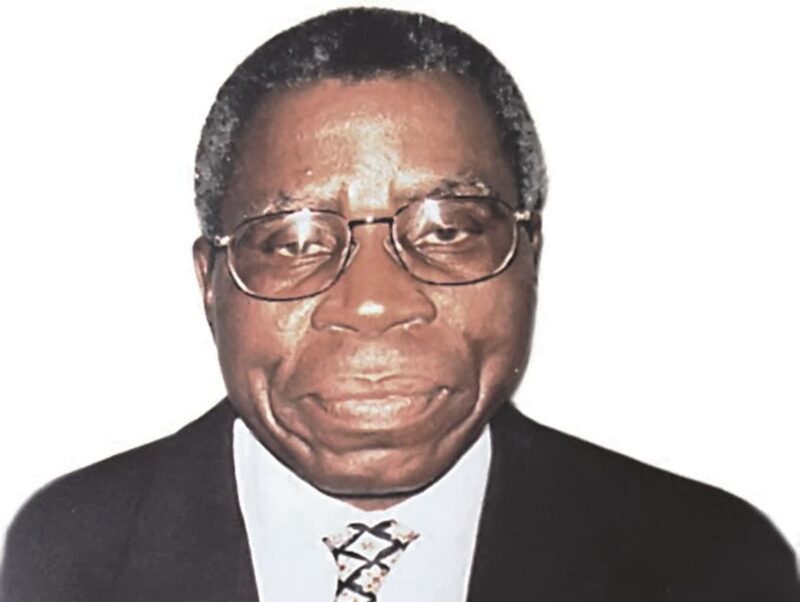
Chief Bola Ige
Sorry, I digressed. Akande made two weighty assertions in his controversy-baiting interview. One is that the presidency under Olusegun Obasanjo allegedly killed Chief Bola Ige. The second was that the pan-Yoruba sociocultural group, Afenifere died with the assassination of the Attorney General of the Federation. As the Yoruba say of words in convoluted circumstances as this, they need to be surgically placed in their contexts (élá l’ọrọ ). In doing this, let me begin from Akande’s assertion on Afenifere’s purported death. There is no denying the fact that Chief Ige was the darling of Southwest Nigeria. At his death, the Yoruba lost its most valuable political leader who was famously referred to as Chief Obafemi Awolowo’s heir apparent. At campaign grounds, the evocative song sang to usher Ige into such arena was “Ige has arrived! Ige has arrived! Awolowo’s heir apparent has arrived!” (Ìgè dé, Ìgè dé o, Aróle Awolowo, Ìgè dé o!).
Ige was proud of his Yoruba heritage. He wasn’t one who prostrated on all fours to a cow for the sake of eating its protein. He never suffered fools gladly and belonged to the school of thought which says that every impulse a man strives to strangle broods in his mind and poisons him. So, he spoke his mind without caring whose ox was gored. A lawyer friend once told me of how Ige beckoned onto him and his friend at a public event and, in his usual lacerating words, tongue-lashed them for putting on other tribe’s cap, rather than the Yoruba’s. Though he spoke Hausa very fluently, having schooled in Kaduna, Ige took great pleasure in his mother tongue.
The truth however remains that the January 1999 D’Rovans hotel presidential primary election of the Alliance for Democracy (AD) which took place in Ibadan marked the beginning of the cracks in the wall of the AD and Afenifere. It has been alleged that Ige sponsored the creation of alternate sociocultural groups to get back at the so-called “Ijebu Mafia” who allegedly worked against his presidential aspiration. To that extent, Akande may be right that Ige saw the fractionalization of the original Afenifere. To however say that Afenifere died with Ige will be excessive hyperbole.
Again, after the death of Ige, there doesn’t seem to exist again, apart from the two factions of the sociocultural group – either Chief Reuben Fasoranti or Ayo Adebanjo’s – who deifies or factors in Yoruba’s recent ancestor, Chief Awolowo, in all they do as the two groups. I am sure the man Chief Akande is his sidekick, Tinubu, in his closet or among his coterie of Yoruba hangers-on, gloats, like Obasanjo did in his autobiography, that the presidency which Awolowo couldn’t attain in his lifetime, was handed him on a platter. Since Tinubu became president, unless I missed it, I am yet to hear him pay tribute to Awolowo’s fabled sagacity in governance. I do not know if Bisi Akande, who is now mouthing Afenifere’s Catholicism, more than the Pope, has ever spoken to the president about this historical memory loss. It was good Obilo asked Akande if the Fasoranti who Tinubu visited in Akure as president wasn’t head of the same Afenifere he claimed was dead or if the members of the group Tinubu hosted in Aso Rock belonged to Ohanaeze Ndigbo. Such selective memory is said to be Akande’s stock-in-trade. When he engages in this kind of revisionism, his opponents remind us of his self-confession he made that he was never an Awoist until Chief SM Afolabi invited him to be a member of Awo’s Committee of Friends.
On the assassination of Ige in 2001, there is also no doubting the fact that the failure of the federal government to find the killers of this highly respected Nigerian is a blot on the Obasanjo government. On the list of assassins who possessed the raison d’être to kill Ige, the fact that the presidency ranks top is an unassailable fact. If you knew the awe with which Ige was held in Yorubaland, his resignation from the Obasanjo government would indeed have dented the Ota farmer’s second term presidential bid. However, with Ige’s obsession for his Yorubaness and the disdain and awe with which the north held an obsessive Yoruba in power at that time, Ige’s presidential aspiration could not have stopped Obasanjo’s second term bid. After all, even when the southwest refused to vote for him in the first term, Obasanjo still became president. If Akande was desirous of Ige’s killers being apprehended, why didn’t he factor in more theories on the assassination? For instance, could some persons, who nursed ambition to be Nigeria’s president someday, have stopped him, knowing that an Ige presidency in 2003 could put paid to their ambition? Yes, the theory of armed robbery has been eliminated due to the clinical planning of the assassination, but, is there any possibility that we cast our nets too narrowly?
It is of great importance for us to drill down further into Bisi Akande’s claim that the government headed by Senator Rashidi Ladoja, as Oyo State governor, demanded and got a nolle prosequi in the trial of alleged Ige murderers. Was it a deliberate attempt to play politics, attempt to even political score or share political banditry? Not only did Ladoja denounce this claim with facts, he went ahead to accuse Akande of a penchant for lying while threatening to drag Akande to court for defamation.
It should also be said that while Akande was enamoured of unraveling the killers of his mentor, Chief Ige, under his leadership and direction as governor of Osun State, his ‘boys’ supervised the impeachment of his deputy governor, Iyiola Omisore, allegedly so that the Ile-Ife-born politician could lose his immunity and be ready to face trial for the same murder. If I were Akande’s interviewer, I would have raised further question for his answer on what his government did to unravel the assassination, a few days before Ige’s murder, of an Osun State legislator, Odunayo Olagbaju. So, what moral right does he have to ask Obasanjo to find Ige’s killers when his own government equally looked the other way when Olagbaju was felled? In the interview, Akande made many other assertions on Ige’s death which should make the police ask him, instead of Ladoja, to come forward for interrogation so that the spirit of Bola Ige could get justice finally. He appeared to know more than he was telling the world, even by his own admission.
Let me go to another issue of importance in the Akande interview. Of recent, the power apparatchik that surrounds the Nigerian president must have discovered that the narrative that all his life, Bola Tinubu had wanted to become president, was flawed. At a meeting with some political operatives immediately after attending a Chatham House engagement in December, 2022, Tinubu was seen on video telling them that “Political power is not going to be served in a restaurant. They don’t serve it a la carte. At all cost, fight for it, grab it and run with it”. The vehemence with which then presidential aspirant Tinubu told these operatives of the cold-bloodedness of power had same cadence and grits with the vehemence with which a leopard pursues an impala. Tinubu sliced the words with his teeth with same clinical finish and precision with which the leopard slices the impala’s throat. So, when, a few weeks ago, some misguided fellows, without the president’s consent, impeached Mudashiru Obasa, erstwhile Lagos House Speaker who the Lagos Landlord installed by himself, they courted the wrath of a man who though shoulders the behemoth hunk of flesh of an elephant, is yet interested in the flesh of a grasshopper. Since 1999, Tinubu has held Lagos as a fief, his incisors tightened round the neck of the politics and economy of the state.
No political juggernaut in the Tinubu political clan had enough cognate sidekick ‘followership’ around the president to dissolve the above narrative in the minds of the world like Bisi Akande. Since they both left office as governors of Osun and Lagos in 2007, Akande has maintained his political ‘follow-follow’ role around Tinubu. He was the most qualified for the task. So, in the Obilo interview, Akande attempted to push a counter-narrative. Tinubu didn’t want to be president, he emphasized. There was a bedlam in the Tinubu camp when he told all the scroungers around him that he would not be contesting for the presidency, Akande said further. Pius Akinyelure attempted to convince him, yet he would not bulge. Akande then had to be enlisted to do the convincing. He then told Tinubu that his being Nigeria’s president was a clarion call which he must yield to. In other words, Tinubu was persuaded against his earlier wish to be Nigeria’s president.
But, as James Hadley Chase volunteered in one of his classics, a liar must have a very good memory. The interviewer then momentarily badged in. But, that same Tinubu told Nigerians it was his lifelong ambition to be Nigeria’s president? Obilo asked. In fact, at the famous but controversial Abeokuta campaign in June 2022 where it was believed he dared Muhammadu Buhari to do his worse, Tinubu actually told the world that he, the godfather, had come to take over a throne that rightly belonged to him. With that Emilokan pronouncement, Tinubu literally said he was tired of playing the second fiddle. When the interviewer confronted Akande with Tinubu’s claim of entitlement to the presidency, the Tinubu sidekick went into an incoherent waffle. With that Abeokuta speech whose summary was akin to “my feet are tired,” many of Tinubu’s followers have compared his audacity and self-entitlement mentality to the seat of Nigeria’s president to that of African-American rights activist, Rosa Parks, who refused to give up her seat on the American Montgomery City Lines on December 1, 1955.
As it is with politicians who play the ostrich with verifiable facts, in the interview, Akande also attempted to muffle the facts of Buhari’s opposition to Tinubu’s presidency. In the Abeokuta declaration, it was obvious that the “they” Tinubu knocked for putting barriers before his ambition were Buhari, Godwin Emefiele and their accomplices. So, why was Akande attempting to potato a glaring fact that is negative to his party, the APC?
The final issue of concern in the Akande interview is his claim that only lazy Nigerians are hungry. While the interviewer squared up with him admirably over this claim, Akande’s fabled gambit of playing the ostrich sprang up here. He couldn’t see hunger in the land, he claimed. To be fair to the ex-APC chairman, he may not see hunger if his impoverished kinsmen in Ila-Orangun have found him too insulated from their existential plights, so much that going to him for help is a waste. None of his children, it is obvious, with his role as consort of the Villa, would feel the hunger in the land. So, how could he see hunger? Even when confronted with palpable cases of hunger under the government of a man he claimed was next good news after the so-called discovery of River Niger by Mungo Park in 1795, he still defiantly claimed that the pepper he allegedly planted at his backyard was the antidote to the impoverishment sown by the Tinubu government. If I may ask, why did Chief Akande ask the president to put his daughter in charge of dollar-denominated National Agency for the Control of AIDS (NACA) and not ask that she heads Ogun Osun River Basin Authority so that she would plant “one grain of corn and reap a thousand cobs”?
All the above put together remind me that, in their daily fight for dominance and conquest, a fleeting nature of power and dominance exists among Nigerian politicians. It is the type of desperation found among the lion and a warthog. In Nigerian politics, there is an unending, constant and relentless struggle between preys and predators, with each seeking dominance and conquest. In doing this, politicians deploy worldly cunning to foist false narratives on the populace. Bisi Akande’s interview and a huge chunk of his autobiography are a further reinforcement of this frightening fight in the political wild.

















You must be logged in to post a comment Login