
Africa
Chief Justice Kekere-Ekun, This Is Not Good for the Judiciary or the Soul of the Nation: A Plea for Justice in the Case of Senator Natasha Akpoti-Uduaghan -By John Egbeazien Oshodi
Senator Natasha has announced that she will return from London on June 3, 2025, to face the charges against her. This is not a triumphant return—it is a cautious, fearful one. On Adeola Fayehun’s YouTube program, she spoke with visible anxiety. She expressed real fear that she could be shot—just as others have reportedly been shot in or around Nigerian courtrooms.

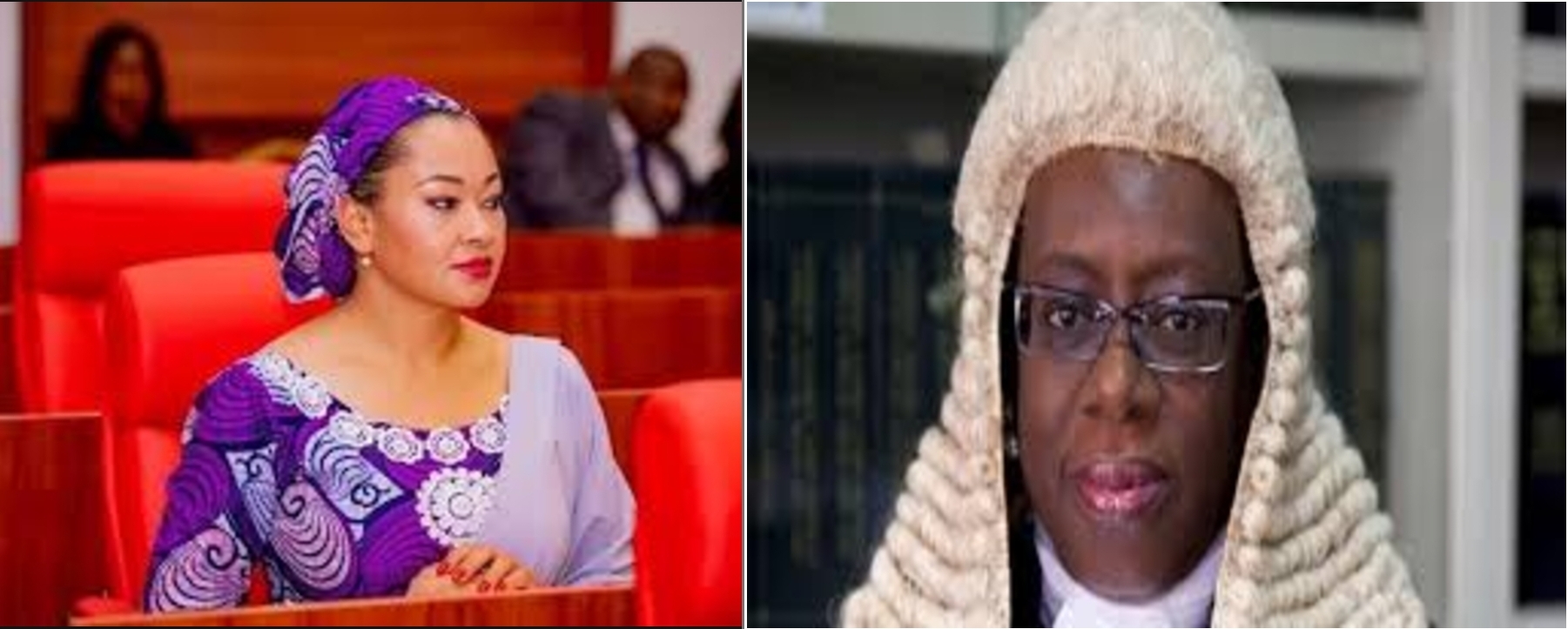
Between March and May 2025, Senator Natasha Akpoti-Uduaghan filed twelve documented petitions with Nigeria’s law enforcement agencies. These were not media antics—they were formal legal submissions detailing threats to life, cyberstalking, defamation, withdrawal of security, and an alleged assassination plot involving high-ranking officials.
And yet, astonishingly, none were acknowledged. None investigated. Not one earned even a basic reply. The silence from state institutions was total. The machinery of justice, which should be neutral and vigilant, chose passivity. It created a dangerous precedent: that a woman elected by the people can cry out twelve times, and the system will turn its face away.
However, when she publicly restated her fears in a televised interview—referring to alleged “discussions” between Senate President Godswill Akpabio and Yahaya Bello about eliminating her—the state moved swiftly. Within days, the Federal Government, through the Attorney-General, filed criminal defamation charges against her.
Her case was immediately brought to court. This swift turnaround, when viewed against the background of twelve unanswered petitions, has only deepened public skepticism. It has fueled the growing perception that the Nigerian judiciary is not only inconsistent—but possibly captured. A judiciary that acts with speed only when the accused is politically inconvenient, but sleeps when victims cry out, does not inspire confidence. It creates fear.
Twelve ignored pleas. One rapid prosecution.
This pattern, Madam Chief Justice, does not reflect institutional fairness. It reflects selective suppression. Even if you were unaware of the operational specifics, the symbolic weight now rests squarely on your judiciary. And yes, even if you did not authorize these actions directly, they are carried out under your watch. That is what the public sees. That is what history will record.
And to add to this, the FCT Chief Judge acted so quickly in pushing this case forward. But you, the Chief Justice of the entire nation, must rise above this imbalance. You must do right—not just legally, but morally.
A Letter Only After Shame—And With No Date
In an exclusive interview with journalist Adeola Fayehun, Natasha revealed a troubling development: following her lawyer’s public outcry over state silence, a long-overdue “invitation letter” was issued by the police.
But when displayed on screen, the letter bore no date. No time. No reference to prior petitions. It was empty—hastily crafted to deflect public scrutiny rather than to serve justice. It lacked the seriousness that should accompany the rule of law. It appeared not as a legal document, but a public relations afterthought.
Madam Chief Justice, this is not mere administrative error. This is symptomatic of a deeper decay—where reactive governance substitutes authentic justice. If this is what passes for due process, then silence becomes your court’s new language.
She Returns Alone—Fearing Jail, or Worse
Senator Natasha has announced that she will return from London on June 3, 2025, to face the charges against her. This is not a triumphant return—it is a cautious, fearful one. On Adeola Fayehun’s YouTube program, she spoke with visible anxiety. She expressed real fear that she could be shot—just as others have reportedly been shot in or around Nigerian courtrooms.
She said she may be granted bail. Or she may be jailed. Her voice carried the weight of someone returning not just to clear her name—but to walk into a system that has often failed the vulnerable. These were not the words of a defiant politician—but of a woman stepping forward despite knowing the risk.
In Nigeria, such fears are not baseless. They are grounded in precedent. Political trials have often ended in tragedy or abuse. Senator Natasha fears not only the possibility of unjust detention—but the very real danger to her life.
She has publicly invited the Nigerian people to witness her return—not as an act of defiance, but as a protective gesture. She stated this clearly during her Adeola interview: her safety now depends on public presence and collective witness. She is not just defending herself—she is testing whether justice still exists in the nation.
Also of grave concern is that her official police security detail has already been withdrawn. She returns to Nigeria not only vulnerable—but entirely exposed. No protection from the state. No assurance of safety. She is stepping into danger, and she is doing so alone.
Madam Chief Justice, what does it say of our judiciary when a citizen—an elected official—feels safer abroad than in her own courtroom? Will your courts protect her rights and dignity? Or will they serve as a stage for another politically charged prosecution?
Selective Justice Hurts the Judiciary and Your Name
It is now public knowledge that Akpabio, Bello, and others named in her petitions have not been invited, questioned, or investigated in any way. This imbalance tears at the fabric of legal trust.
The perception—right or wrong—is that Nigeria’s judiciary responds only to the politically convenient, not the legally obligated.
What does this say about your leadership, Madam Chief Justice? That justice flows only toward those with influence? That a woman can raise her voice twelve times and receive nothing but silence—and a summons?
This is not just an injustice to one woman—it is a signal to every Nigerian that the courts no longer serve the people, but the powerful.
Madam Chief Justice, This Is Your Moment to Intervene
The judiciary cannot afford to be seen as selective.
You may not have filed the charges. You may not have silenced the petitions. But the credibility of the entire bench is now on the line.
Call for a judicial inquiry. Demand that all parties—Akpabio, Bello, Duru—be examined. Ensure that Senator Natasha’s petitions are treated with equal seriousness.
Let the courts prove they serve all Nigerians equally—not just those with power.
A Final Plea to Your Robe, Spirit, and Office
There is still time, Madam Chief Justice. Time to be remembered for courage. Time to reclaim the moral conscience of the court. Time to restore the judiciary as the last hope of the common citizen.
Because when the courts are seen to shield the powerful and punish the vulnerable, it is not just democracy that collapses—it is the soul of a nation’s justice.
And when the soul of justice sickens, even the chief justice cannot avoid its judgment.
Choose impartiality. Choose legal balance. Choose to lead—not for power, but for posterity.
May your robe bear no stain of silence. May your court echo fairness. May your name be remembered not for indifference—but for intervention.
This writer does not know any of the individuals involved; the focus is solely on upholding democracy, truth, and justice.
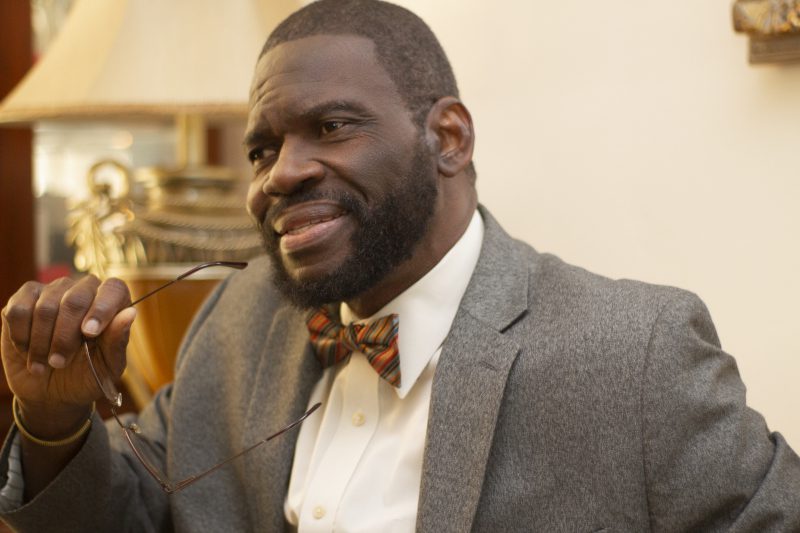
Psychologist John Egbeazien Oshodi
Professor John Egbeazien Oshodi is an American psychologist, educator, and author specializing in forensic, legal, and clinical psychology, cross-cultural psychology, police and prison sciences, and community justice. Born in Uromi, Edo State, Nigeria, he is the son of a 37-year veteran of the Nigeria Police Force—an experience that shaped his enduring commitment to justice, security, and psychological reform.
A pioneer in the field, he introduced state-of-the-art forensic psychology to Nigeria in 2011 through the National Universities Commission and Nasarawa State University, where he served as Associate Professor in the Department of Psychology. His contributions extend beyond academia through the Oshodi Foundation and the Center for Psychological and Forensic Services, advancing mental health, behavioral reform, and institutional transformation.
Professor Oshodi has held faculty positions at Florida Memorial University, Florida International University, Broward College, where he also served as Assistant Professor and Interim Associate Dean, Nova Southeastern University, and Lynn University. He is currently a contributing faculty member at Walden University and a virtual professor with Weldios University and ISCOM University.
In the United States, he serves as a government consultant in forensic-clinical psychology, offering expertise in mental health, behavioral analysis, and institutional evaluation. He is also the founder of Psychoafricalysis, a theoretical framework that integrates African sociocultural dynamics into modern psychology.
A proud Black Republican, Professor Oshodi advocates for individual empowerment, ethical leadership, and institutional integrity. His work focuses on promoting functional governance and sustainable development across Africa.

























You must be logged in to post a comment Login