
Africa
Defections, Tinubu, And The Return of Abacha Democracy -By SKC Ogbonnia
Let us even choose not to factor the common knowledge above, but common sense dictates that only an enemy of Nigeria will be singing praises of the APC regime that has plunged the country into untold hardship with no end in sight. Only a corrupt mind would be rushing to a ruling party that is leading the most criminal and unjust regime in national history.

A famous American journalist, Sydney J. Harris, once wrote that, “History repeats itself, but in such cunning disguise that we never detect the resemblance until the damage is done.”
Once upon a time Nigeria had a military Head of State, Sani Abacha, who ruled as a maximum dictator. He would eventually yield to pressure to transition the country to a democracy, but he also plotted to succeed himself as the president.
Keenly aware that he was unpopular and had no chance of winning the presidency in any free and fair election under a multiparty democracy, Abacha turned to unholy schemes. His regime staged an aggressive montage of propaganda to launder his image behind a facade of positive narratives–all suggesting a show of overwhelming public support for the military head of state to succeed himself. They portrayed him as the best leader ever and his candidacy as the second coming of the Messiah. But that was not all.
Buoyed by the false public support, General Sani Abacha used the instrument of power to coerce opposing political parties to endorse him as a sole candidate. All coasts were clear for him to enthrone a sham democracy featuring only one party and, of course, without internal or external opposition. But providence has a way with destiny, as well as with ambitions. Sani Abacha died unexpectedly. And his brand of democracy also died suddenly, or so we thought. That was in 1998!
Fast forward to 2025, history is repeating itself in a disgusting disguise. The objective fact is that the Abacha model of democracy or resemblance of it is back in our naked eyes, and the man in charge has a similar trait and background. Like Sani Abacha, President Bola Ahmed Tinubu did not gain power by popular account. While Abacha became Head of State by the way of a military coup, a majority of Nigerian voters (64.7%) rejected Tinubu in the election that he used to assume power. Like Abacha, Tinubu is widely rated as one of the most corrupt leaders in the world. Like Sani Abacha, amid a woeful record of performance, President Bola Ahmed Tinubu is employing underhand tactics, undermining democratic norms in order to win a re-election.
So far, the former Lagos governor is in full control of both the Legislature and the Judiciary. The gravest of all, however, is a grand design to emulate the Abacha model by using all manner of political intimidation to decimate the structures of the opposition parties. The objective is a one-party state or a semblance of it. This explains the wave of defections of legislators and governors to Tinubu’s ruling APC. Nothing more!!
Of course, the defecting politicians or the Tinubu enablers have continued to labour so hard to offer nothing but tantalizing reasons for abandoning the people and the parties that brought them to power. However, every reason or excuse they have offered is in conflict with history and common sense.
Interestingly, the governors who have decamped so far happen to hail from the South-East and South-South zones of the country. This is a region that ‘aligned with the center’ for 16 of the 25 years in the Fourth Republic. This is a region that has produced a President, Vice President, Senate Presidents, Deputy Senate Presidents, Deputy Speakers, Ruling Party Chairmen, and some of the other most powerful portfolios when PDP held sway. Yet, there is nothing to show for the support or the patronage. Needless to remind them that this same region includes Imo and Ebonyi states, which have been under the control of the same APC since the previous regime; yet, such a gesture did not stop Bola Ahmed Tinubu from waging a shadow war against the Igbo people of Nigeria.
Let us even choose not to factor the common knowledge above, but common sense dictates that only an enemy of Nigeria will be singing praises of the APC regime that has plunged the country into untold hardship with no end in sight. Only a corrupt mind would be rushing to a ruling party that is leading the most criminal and unjust regime in national history.
The truth of the matter is simple: Their reason for the defections is purely for selfish interests. Specifically, these defecting politicians are lily-livered leaders who lack principle and have either corrupt baggage, afraid of winning elections on their own merit or those eager to benefit from the ruling party’s corrupt ecosystem. The whistling charm is the prevailing pledge by the then National Chairman of the APC, Adams Oshiomhole, that the sins of the members of the opposition parties would be forgiven if they defect to the ruling party.
Former British Prime Minister, Sir Winston Churchill, probably had in mind the type of unfolding political crisis in Nigeria, when he noted that, “Those that fail to learn from history are doomed to repeat it”.
Bola Ahmed Tinubu ought to be able to dig deeper in history and remember that brute attempts by then ruling parties to win broad political mandate was the central reason commonly cited for the fall of both the First and Second Republics.
Recall the situation under the very Second Republic. Similar to the case of Tinubu, President Shehu Shagari (who scored only 33.7% of the votes ) failed to garner majority votes through the 1979 polls. The National Party of Nigeria (NPN), being the ruling party at the time, was desperate for a clear majority in the subsequent election of 1983. It followed the mission by boasting and threatening that it must capture the states where the regional capitals of the First Republic–namely Enugu, Kaduna, and Ibadan–were located. The NPN brushed aside the fact that those states were controlled by political parties featuring popular native presidential candidates, namely Nnamdi Azikiwe, Aminu Kano, and Obafemi Awolowolo, respectively.
With the timber and calibre of the ruling NPN behind him, Shagari threw caution to the wind and went ahead to deploy heavy duty federal might to deliver those former regional capitals through the 1983 elections. Accordingly, the election result was greeted with mass discontent and unrest. Not surprisingly, mass jubilation greeted the military coup of 1983 that overthrew the Shagari government. While military coups must no longer be an option, Tinubu can learn from recent history that the restive masses have become even more potent.
In sum, it is clear that Nigeria’s hard earned democracy is at its lowest ebb. This failure is because the overbearing influence of the Executive branch under President Tinubu has weakened institutional independence and, by consequence, lack of checks and balances, dictatorship, systemic corruption, and abuse of civil liberties. Today, Mr. Tinubu is widely seen to be above the law. He is widely seen to dictate who gets what, who wins or who loses. Sadly, instead of holding the ruling party accountable, the opposition leaders are succumbing, defecting to become a part of the state corrupt ecosystem. The posterity beckons!
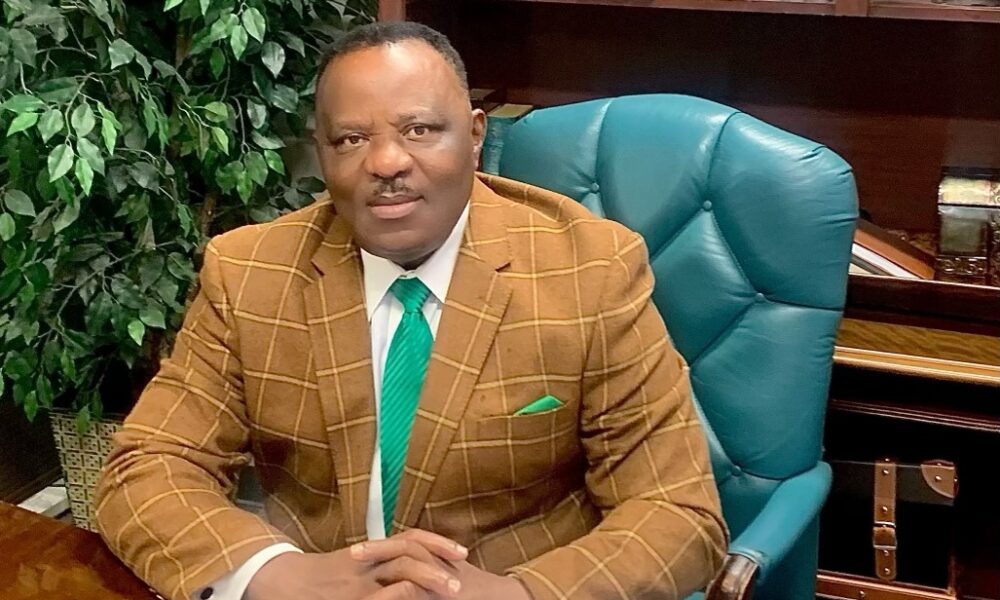
SKC Ogbonnia, a former APC Presidential Aspirant, writes from Houston, Texas.





















You must be logged in to post a comment Login