
National Issues
Egbetokun Not Responsible For Nigeria Police Act 2020 Amendment, by Adewole Kehinde
In my opinion, there is nothing wrong with extending the retirement age from 60 to 65 years and the tenure of service from 35 to 40 years. After all, on June 5, 2023, President Bola Tinubu signed into law a Constitution Alteration Act to introduce a uniform retirement age and pension rights for judicial officers.

“I am content with what I have, little be it, or much” – John Bunyan
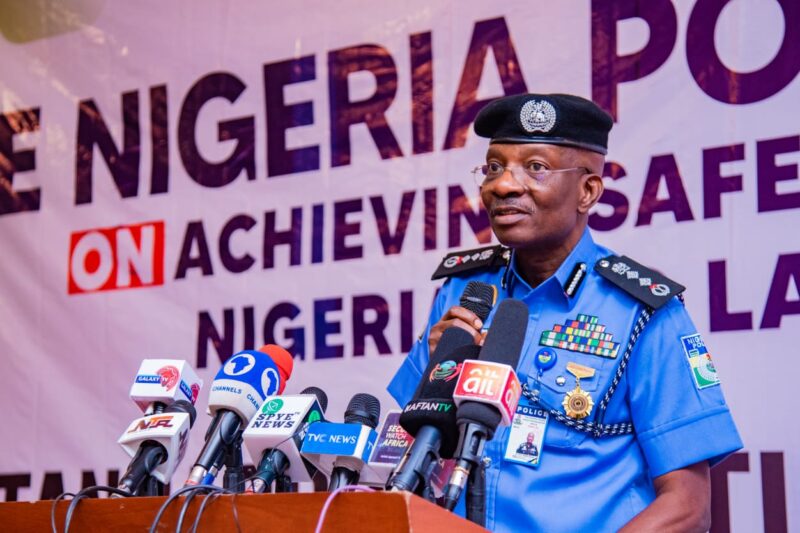
I came across a publication tagged “EXCLUSIVE” saying that Police Chief, IGP Egbetokun is pushing for a personnel tenure extension.
Considering the medium that published it, most Nigerians know that the publication is another trash waiting to be shredded as waste.
Let us go down the history lane of the Nigeria Police Act 2020 Amendment.
On Tuesday, 3rd October 2023, the House of Representatives commenced a debate on a bill that seeks to increase the age of retirement of police officers from 60 years to 65 years.
The private member bill sponsored by Hon. Gaza Gbefwi seeks to amend the Police Act, No. 2 of 2020, to provide for the engagement of compulsorily retired senior police officers as consultants to provide training and guidance to serving officers and for related matters.
The affected senior police officers are those compulsorily retired because of the appointment by the President of an Inspector General of Police.
Hon. Gbewfi proposed the insertion of a new section 7A and amendment of Section 18 of the Principal Act.
As stipulated in Clause 2 of the bill, Hon. Gbewfi proposed the insertion of a new section ‘7A’ after the existing section 7, which provides that: “As from the commencement of this Bill, where a Police Officer other than the most senior Deputy Inspector-General of Police is appointed by the President as the Inspector General of Police, all Deputy Inspectors General of Police of coordinate rank or superior rank who are made to retire mandatorily as a result of such appointment, shall be engaged by the President as strategic technical consultants for the training of officers of the force in the Police College/Academy or any other like institution.”
Clause 7(A)(2) also stated that “The President shall determine the terms and conditions of engagement of each consultant, provided that no consultant shall be engaged for a period exceeding 5 years from the date of his engagement.”
Clause 7(3) also provides that “the provision of this section does not apply to senior serving officers who were retired compulsorily as a result of a disciplinary measure, or on health grounds, or whose compulsory retirement was for any reason other than as provided in Clause 2 of this Bill.”
The sponsor of the bill also proposed an amendment to Section 18(8) of the Principal Act, by substituting for the words ’60 years’ the words ’65 years’ appearing in line 3.”
As stipulated in the Explanatory Memorandum, the purpose of this bill is to ensure that junior police officers learn from the wealth of knowledge and experiences of retired Deputy Inspectors General of Police who compulsorily retire as a result of the appointment of their junior as an Inspector General of Police.
As of the date of the private member bill sponsored by Hon. Gaza Gbefwi was being debated, the Inspector General of Police was so busy with various development initiatives aimed at improving the welfare of the Nigeria Police.
Also, on Thursday, 24th August 2023, the Committee of Retired Inspectors-General of Police advocated 65 years as retirement age and 40 years as tenure of service for police personnel.
This is part of the resolutions of the former I-Gs at the end of their two-day retreat, held at the International Institute of Tropical Agriculture (IITA) in Ibadan on Tuesday and Wednesday.
The resolutions are in the retreat’s seven-point communiqué issued on Thursday in Ibadan by retired IGP Solomon Arase, who was the Chairman of the Police Service Commission (PSC) as of then.
The other points outlined are reforms and policy matters; recruitment and deployment of police personnel; safety and welfare; strategic partnership; training and capacity development; police operations; and police operations.
According to the communiqué, there is a need for a re-evaluation of retirement age and tenure of service.
”This should be by extending the retirement age from 60 to 65 years and tenure of service from 35 to 40 years, whichever comes first.”
Those behind the write-up saying that IGP Egbetoku has submitted a memorandum in support of the Bill forgot that the bill was first sponsored in the 8th Assembly but was yet to get to the final reading before the dissolution of that Assembly.
The Police Act 2020 is well explanatory on the tenure of the Inspector General of Police, as Section 7 subsection (6) of the Police Act of 2020 stipulates that, “The person appointed to the office of the Inspector-General of Police shall hold office for four years.”
Based on the Police Act, Egbetokun’s tenure is expected to end on October 31, 2027, since that was the date the Nigeria Police Council confirmed his appointment as the substantive Inspector General of Police (IGP).
Another point to note is Section 7 subsection (5) of the Police Act of 2020 states that “The Inspector-General of Police shall only be removed from office by the President on the advice of the Police Council,” therefore IGP Egbetokun cannot be a beneficiary of this bill.
Those who are very close to the Inspector General of Police can boldly say that Egbetokun is not even more interested in holding on to office than what is stipulated in Section 7 subsection (6) of the Police Act of 2020.
I am surprised that some mischievous individuals who don’t want the progress of the Nigeria Police want the IGP not to support a bill meant for the good of police personnel.
Egbetokun is not a desperate IGP, and as of 8th July 2020, when the Senate amended the Police Act that okays four-year tenure for Inspector General of Police, he was a Commissioner of Police assigned to Kwara State.
In my opinion, there is nothing wrong with extending the retirement age from 60 to 65 years and the tenure of service from 35 to 40 years. After all, on June 5, 2023, President Bola Tinubu signed into law a Constitution Alteration Act to introduce a uniform retirement age and pension rights for judicial officers.
This alteration now pegs the unified retirement age for all judicial officers of superior courts of record at 70 years.
Before now, the retirement age for High Court Judges was 65 years, while Appeal Court and Supreme Court Justices had their retirement age as 70 years. In light of this alteration, all judicial officers appointed to the Supreme Court, Court of Appeal, Federal High Court, National Industrial Court, High Court of the Federal Capital Territory (FCT) and of a State, Sharia Court of Appeal of the FCT and of a State, as well as the Customary Court of Appeal of the FCT and of a State, are due to retire at the age of 70 years. However, they may opt to retire earlier.
Also, I recalled that after the Federal Executive Council approved the bill to extend the retirement age of teachers from 60 to 65 years in January 2021, former President Buhari transmitted the bill to the National Assembly in June of that year.
The bill, which has now become law, increased the retirement age of teachers from 60 to 65 years.
The legislation also extended the duration of service for teachers in the country from 35 to 40 years.
Section 1 of the Act stipulates that teachers in Nigeria shall compulsorily retire on the attainment of 65 years of age or 40 years of pensionable service, whichever is earlier.
Section 3 of the Act provides that the Public Service Rule or any legislation that requires a person to retire from public service at 60 years of age or after 35 years of service shall not apply to teachers in Nigeria.
Extending the retirement age of police personnel from 60 to 65 years as well as the duration of service for police personnel in the country from 35 to 40 years would reduce the cost of management of the police force, especially the cost of training and recruiting new officers.
After all, the extension of service years of police personnel is not peculiar to Nigeria alone. Countries like Australia, Brazil, Canada and the United States have increased the retirement age for their police personnel.
Nigeria police officers’ longer service will provide a distinctive viewpoint on the intricacy of contemporary policing. Police Crime Management specialists and tools are essential for 21st-century crime governance.
Adewole Kehinde is the publisher of Swift Reporters and can be reached at 08166240846, email: kennyadewole@gmail.com





























You must be logged in to post a comment Login