Africa
Fayose’s Thank You Message To Obasanjo: Uncouth, Unthinking And UnAfrican -By Isaac Asabor
For the sake of our values, if not for our politics, we can only hope this serves as a wake-up call, not just to Fayose, but also to the many who think leadership without courtesy is strength. Because, unlike power, respect is not earned through your position, but through your conduct. Fayose’s conduct in this matter was anything but respectful. It was uncouth, unthinking, and decidedly UnAfrican.

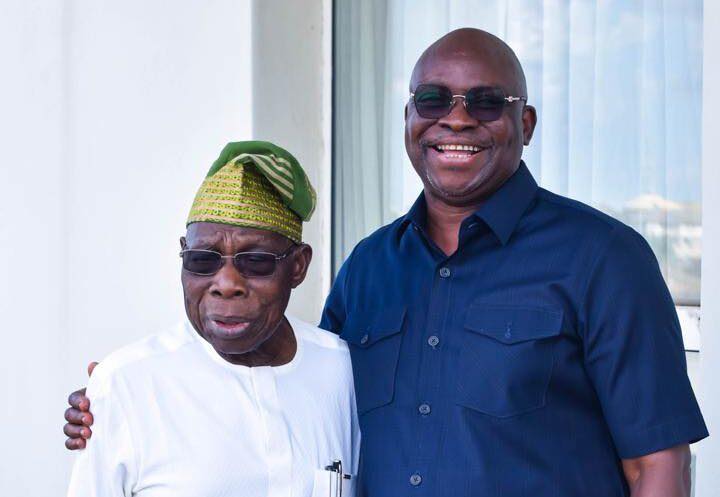
There are many ways a man can be remembered after leaving the corridors of power, and history has a habit of judging those in and out of office by the dignity, or disgrace, they attach to their actions. In the unfolding drama between former President Olusegun Obasanjo and former Ekiti State Governor Ayodele Fayose, once again Nigeria is forced to confront a troubling facet of political behavior: the collapse of courtesy and decorum among those in positions of influence.
That Fayose chose to send a “Thank You” message laced with insults and demeaning language to an elder statesman, one he deemed worthy enough to invite to celebrate his 65th birthday, is not just a breach of personal etiquette; it is a failure of character, conscience, and culture. In addition, it is deeply unAfrican.
Let us situate this within its proper context. Former President Obasanjo, at 89, attended a birthday party hosted by a man who has spent years verbally attacking him. Fayose, who has sparred repeatedly with Obasanjo in the public arena, has hurled insults with the kind of abandon that betrays a lack of self-restraint. Yet Obasanjo showed up, not for political endorsement, not for an old debtor’s reconciliation, but out of what he described as parental regard, calling Fayose “one of my political children.”
Instead of extending the reciprocal grace expected from host to guest, Fayose sent a message that will go down in infamy. In the so-called “Thank You” text shared publicly by Obasanjo’s aide, Fayose accused the former president of making “irresponsible comments” during the event. He went further, saying someone once said Obasanjo is “supposed to be kept in a zoo,” adding that he belongs there. He accused the elder statesman of suffering “heightened dementia” and threatened to expose him in due course.
This is not politics. This is not criticism. It is emotional bankruptcy masquerading as candor. Even in hostile political climates, African tradition demands basic respect to elders, especially those who have held high office and lived lengthy public lives. You do not invite a man from Abeokuta to Lagos on his own dime, shake his hand publicly, and then send him a private text comparing him to zoo inmates. That is not political boldness. That’s crassness dipped in cowardice. Fayose had the mic and the stage to say everything on his mind. He chose instead to smile, shake hands, and then engage in textual abuse.
Yet, if this exchange stopped at private messages, it would be contemptible but not newsworthy. What makes it a national misfortune is that it was made public, revealing the lack of emotional maturity that defines too much of Nigeria’s political class. The fact that Fayose, a former governor who has benefited immensely from the system, can speak this recklessly to a former president speaks volumes about the depth of our decline in leadership principles.
Obasanjo, for his part, responded with a pointed but dignified jab, thanking Fayose for revealing his true nature and promptly returning whatever money was given to facilitate his transport. Whether that gesture was grandstanding or genuine, only history and conscience will judge. What it unmistakably shows is that there is still a line of decency some are willing to observe, even when provoked.
However, the real issue is not Fayose versus Obasanjo. It is the steady normalization of bad behavior in Nigeria’s public life. It is the fact that a man can threaten an older leader with “setting records straight” and mock his health while thanking him for attending a birthday party and many will applaud that as “speaking truth to power.” Truth to power is not the same thing as speaking from a place of pettiness and pulse.
Our political culture suffers from a growing deficit of decorum. That deficit manifests in the manner our politicians address each other, how they discuss matters of state, and increasingly, how they treat the very people they claim to serve. When political actors speak like market brawlers, citizens begin to lose faith not just in them, but in the institutions, they represent.
Fayose’s words, even if triggered by past grievances, crossed a line that African culture holds sacred. We are, after all, a people who hold respect as a currency more valuable than money. A man who cannot manage his temper, even in the face of provocation, loses more than moral high ground; he loses public trust, dignity, and cultural standing.
The real tragedy is that Fayose could have made a powerful point without degradation. He could have articulated his grievance about Obasanjo’s remarks publicly and respectfully, something a seasoned politician with thousands of followers ought to know instinctively. Instead, he bungled the opportunity of a innocuous reply, turning what should have been a conversation on statesmanship into a circus of personal vilification.
What is also worthy of note is how Obasanjo’s admonition about repentance and humility at the event seems to have been wholly lost on the celebrant. A former governor at 65 should be settling into the phase of mentoring, reflective maturity, and legacy shaping. Nevertheless, his response to even mild public rebuke suggests a man still fighting old battles from a place of emotional insecurity.
We must be careful not to treat this episode as mere entertainment or political banter. Because it is symptomatic of a deeper rot, one in which respect is seen as optional, and leaders feel empowered to hurl insults at will in the name of political candor. Today it is Fayose sending zoo-level insults; tomorrow it will be the next rising star, thinking that public office is a license to speak like a street brawler.
Nigeria’s public square must grow past these embarrassing spectacles. Such behavior may trend today, but it erodes the respect and authority of all who participate in the political process. When leaders behave like this, they make a mockery of governance. They teach the next generation to be loud, not thoughtful; disrespectful, not persuasive; and destructive, not constructive.
That is not African. That is not leadership. In addition, that is not the legacy any man should want at 65. In the end, this was more than an ugly message. It was a missed opportunity for apology, maturity, and closure. Instead, Fayose’s “Thank You” note became a political grenade, thrown not with precision but with petty spite.
Every leader, especially in Africa, must remember: the way you speak to others, especially those older or more accomplished, often says more about you than them. In addition, no amount of wealth, power, or tweets can cover up the stench of bad character.
For the sake of our values, if not for our politics, we can only hope this serves as a wake-up call, not just to Fayose, but also to the many who think leadership without courtesy is strength. Because, unlike power, respect is not earned through your position, but through your conduct. Fayose’s conduct in this matter was anything but respectful. It was uncouth, unthinking, and decidedly UnAfrican.