
Breaking News
Fossil Fuel Dispute Delays COP31 Deal as Nations Continue Climate Talks Into Saturday
Climate financing has also become a major obstacle, particularly over concerns from developing countries that wealthy nations are not providing sufficient financial assistance to help them address the effects of climate change.

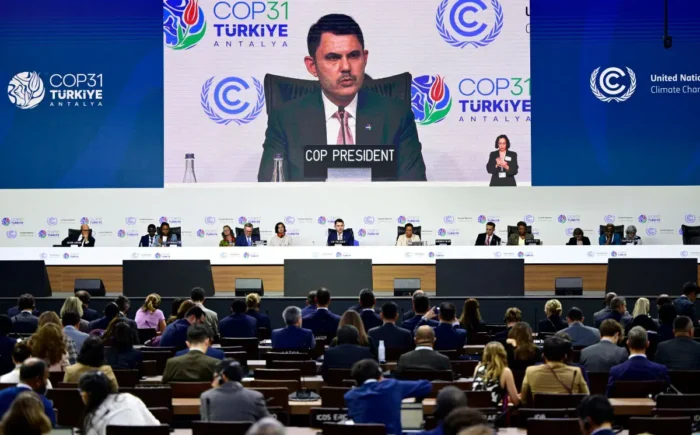
Nearly 200 countries remained divided at the COP31 climate summit in Turkey as negotiations extended into Saturday following disagreements over fossil fuels, climate financing and global warming targets.
The talks, which had been scheduled to conclude on Friday after two weeks of negotiations, continued overnight as countries struggled to agree on a final deal.
Australia, which is presiding over the negotiations, was working to prepare a third draft agreement amid growing pressure to secure a compromise before delegates departed for their respective countries.
COP31 President and Turkey’s Environment Minister, Murat Kurum, acknowledged the challenges facing negotiators, telling an assembly late Friday: “We are close to the finish line, but we are not there yet.”
His address was briefly disrupted when a protester interrupted proceedings by shouting, “You are killing the future!” The individual was subsequently escorted out of the hall.
The summit has faced considerable challenges, with expectations of a major agreement already weakened by an oil price shock and geopolitical tensions linked to the war in Iran.
The negotiations are also unfolding amid a series of climate-related disasters affecting parts of Europe, Nepal and Indonesia, while a super El Niño pattern is increasing fears of more extreme weather conditions.
Fossil fuel phase-out divides nations
One of the biggest disagreements at the summit centres on whether the final agreement should explicitly commit countries to moving away from fossil fuels.
An earlier draft released during the week proposed a faster phase-out of fossil fuels, an idea strongly opposed by major oil-producing countries such as Saudi Arabia.
However, a second draft published on Thursday removed every reference to fossil fuels, triggering fresh criticism and renewed negotiations.
The European Union condemned the revised document, saying it “risks turning this climate COP into a fossil summit”.
Twelve countries, including France, Panama and the Solomon Islands, subsequently issued a joint letter on Friday demanding that the final agreement include “a clear transition away from fossil fuels”.
Panama went further by threatening to abandon the negotiations. Its Environment Minister, Juan Carlos Navarro, has repeatedly criticised the climate talks, alleging that a “petroleum mafia” is preventing meaningful progress.
In a related development, OPEC announced on X that its Secretary-General, Haitham Al Ghais, had held discussions with Russian presidential climate envoy Ruslan Edelgeriev at the summit.
According to the oil cartel, the meeting addressed “the importance of inclusive and balanced approaches across all multilateral environmental fora”.
Australia pushes electrification target
Australia’s Climate Minister, Chris Bowen, has been leading efforts to bridge differences between negotiating countries, moving between delegations in search of common ground.
Bowen said on Friday that he was determined to continue negotiations until an agreement was reached, declaring that he would work “for as long as it takes, to get the job done”.
A key proposal in the draft agreement seeks to increase the use of electricity across the global economy, replacing technologies that rely directly on fossil fuels, including diesel vehicles and gas heating, with electric alternatives.
Turkey and Australia, the summit’s hosts, are backing the proposal as part of efforts to improve energy security and accelerate the reduction of emissions responsible for global warming.
“Electrification is the key to transitioning away from fossil fuels,” Bowen, who is chairing the negotiations, said.
The proposed target would increase electricity’s share of global final energy demand to 35 per cent by 2035.
However, the proposal has generated further disagreements because it does not specify that the additional electricity must come from renewable sources rather than coal or gas.
Consequently, some countries are pushing for the target to explicitly prioritise clean electricity.
There is also resistance to a proposal to expand carbon capture technology, with critics describing it as expensive and insufficiently proven. They argue that the technology could allow industries to continue burning fossil fuels instead of transitioning to cleaner alternatives.
Climate financing becomes another sticking point
Beyond the fossil fuel dispute, countries are also divided over the timing of the next reports from the UN’s Intergovernmental Panel on Climate Change (IPCC).
The latest draft agreement expressed “deep concern” about the imminent breach of the 1.5 degrees Celsius warming threshold but removed an earlier provision calling for temperatures to return below that limit as soon as possible this century.
Climate financing has also become a major obstacle, particularly over concerns from developing countries that wealthy nations are not providing sufficient financial assistance to help them address the effects of climate change.
The removal of a proposed $120 billion climate adaptation funding target sparked anger among developing nations.
Ghana’s Environment Minister, Zanetor Agyeman-Rawlings, expressed frustration over the situation, saying: “We didn’t come here to beg.”
The disagreement has further complicated efforts to secure a final agreement as negotiators continue working to bridge the differences among participating countries.
Africans Angle News
























You must be logged in to post a comment Login