
Entertainment
Freethought Music Festival and Intellectual Awakening in Africa, by Leo Igwe

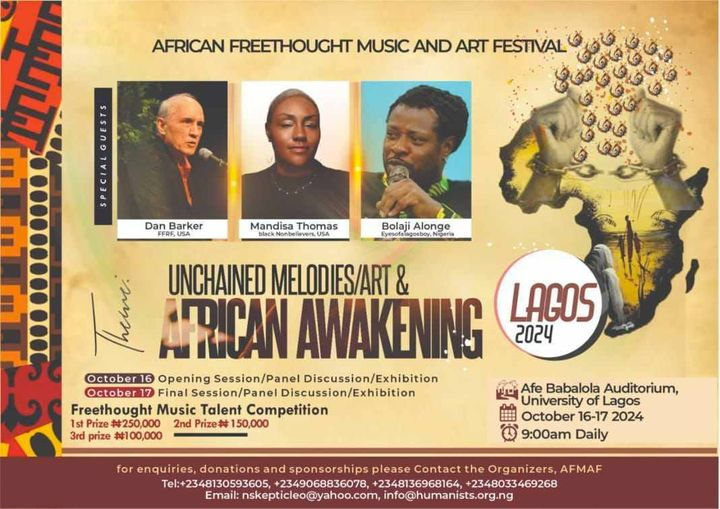
African humanists, atheists, freethinkers, secularists, and other nonreligious individuals and groups are organizing a freethought music and art festival. This event will make history because it will be the first of its kind in the region. This event is of immense significance. To better situate the importance of this program, it is pertinent to define the terms, freethought, music, and art. Freethought refers to unorthodox attitudes or beliefs including ideas, dispositions and sentiments that are independent or critical of authority, tradition, convention, or establishment. Freethought has been conceived as ideas and views that question or challenge dogmas and sacrosanct notions including religious and cultural taboos. Freethinking is characteristically dissenting and skeptical. Freethinkers are taboo breakers. Music is either vocal or instrumental sound, or both that combines to produce harmony, melody, or rhythm. Art entails expressions and applications of human creativity and imagination, including painting and dance, literature and music.
The African Freethought Music and Art Festival is an effort to highlight irreligious, godless, and irreverent musical and artistic expressions. African societies are often portrayed as religious, and known for godly, gospel songs and bands, mainly traditional, Christian, and Islamic godly and supernatural rhythms and melodies. But the freethought festival draws attention to the existence of godless gospel songs, and performances, to unchained and unorthodox melodies and rhythms. The freethought event is informed by the fact that freethought music and art constitute a part of the African culture and society. The event is an opportunity to celebrate and showcase African freethought musical talents. It aims to create a niche for freethought music, literature, dance, and painting that speak to African life situations, histories and experiences. African history has been characterized by local and international experiences of slavery, colonial oppression, and conquests including efforts to highlight and address these social ills and cultural contradictions. Freethought songs literature and performances have been useful and resourceful in addressing harmful social, cultural, traditional, and religious practices.
To emphasize freethought ideals and values, organizers are staging a music talent competition. Music students and youths have been invited to participate. The organizers have selected some songs that signpost freethought views and possibilities. The first song is Nakomitunaka which translates to “I’m asking myself”. A Congolese musician, Georges Kiamuangana Mateta, composed it. The song rebuked the catholic church that opposed President Mobutu Sese Seko’s Authenticite campaign. Nakomitunaka contains “provocative lyrics” that question christian images and representations especially why Christian iconographers depicted the saints as exclusively white, looking like Europeans, and Satan as black, looking like Africans. The song angered both the Catholic and Christian communities in the country. And they excommunicated Kiamuangana. The second song is John Lennon’s Imagine There Is No Heaven. Many Africans entertain such imaginations and could compose or improvise songs imagining there is no afterlife, or there are no gods, no demons, no angels, no witches and spirits as popularly believed.
The third is Lucky Dube’s False Prophets. Many self-acclaimed prophets, pastors, imams, and marabouts have been exploiting Africans, mining their gullibility and desperation. There have been instances where African pastors made their church members to eat grass or drink Dettol. There have been cases where in the name of prayers sheikhs and imams pour saliva into the hands of their members which they rob on their faces. This song could inspire an exposition abusive acts, hypocrisies and deceitful schemes of self acclaimed god men and women in the region. The fourth is the German folk song Die Gedanken sind Frei, which means Thoughts are free. The fifth is Fela Anikulakpo Kuti’s Amen Amen Amen, and the sixth is Femi’s Wonder Wonder Wonder. These songs have been selected to inspire, educate, and enlighten. They have been listed to compel Africans to think and rethink their beliefs and outlooks, to reflect, ponder, and, yes, wonder.
The festival concludes with a roundtable discussion on humanism and freethought in Africa. Discussants will provide insights into how artistic forms and expressions, musical compositions, improvisations, and performances could be deployed to challenge dogmas that hold Africans back and down, superstitions and traditions that darken and destroy the region.
Participants will explore ways to use music and art to realize an intellectual awakening with a global dimension.
Leo Igwe is a co organizer of the African Freethought Music and Art Festival


























You must be logged in to post a comment Login