Africa
From Farm to Fortune: How Governor Bago’s Agricultural Revolution is Redefining Niger State’s Economic Landscape -By Aliyu Baba Mohammed
The Niger State model proves that agricultural development can serve as an engine for broader economic growth while addressing pressing challenges of youth unemployment, women empowerment, and food security. By combining immediate interventions like fertilizer subsidies with long-term investments in technology, infrastructure, and human capital development, Farmer Governor Bago has created a replicable framework for agricultural transformation that other states can adapt to their specific contexts.

In the dusty corridors of Nigeria’s Middle Belt (North Central), Governor Muhammad Umaru Bago of Niger State has embarked on an ambitious agricultural transformation that could serve as a blueprint for economic revival across the nation. His comprehensive agricultural programme, launched with the fervour of a man who earned the moniker “Farmer Governor,” represents more than policy implementation; it embodies a strategic vision to position Niger State as Nigeria’s agricultural powerhouse while complementing President Bola Ahmed Tinubu’s renewed hope agenda for national food security.
The timing of Bago’s agricultural revolution could not be more critical. Nigeria faces mounting food insecurity, with inflation devastating household purchasing power and climate change threatening traditional farming patterns. Against this backdrop, Niger State’s systematic approach to agricultural development offers a compelling case study in how subnational governments can drive meaningful change. The state’s vast arable land, covering approximately 76,363 square kilometers with over 3.2 million hectares suitable for agriculture, provides the foundation for what could become Nigeria’s most successful agricultural transformation programme.
Central to the governor’s strategy is the recognition that modern agriculture requires more than good intentions; it demands coordinated investment, strategic partnerships, and innovative approaches to age-old challenges. The flag-off of the annual fertilizer sales and distribution programme last year (2024) exemplifies this understanding, moving beyond mere subsidy provision to create a comprehensive support system for farmers. By ensuring affordability through targeted subsidies while maintaining quality standards, the programme addresses the dual challenge of input accessibility and agricultural productivity that has long plagued Nigerian farming communities.
The emphasis on affordability through subsidies represents a detailed understanding of the economic realities facing Niger State farmers. Unlike blanket subsidy programmes that often benefit middle-class farmers more than smallholders, Bago’s approach prioritizes accessibility for those who need it most. The programme’s design ensures that fertilizers and other agricultural inputs reach rural communities where transportation costs and limited market access have historically created barriers to modern farming techniques. This targeted approach maximizes the impact of public investment while building the foundation for sustainable agricultural growth.
Collaboration with development partners and the private sector forms another cornerstone of the agricultural revolution, demonstrating Bago’s recognition that government resources alone cannot drive comprehensive transformation. The state’s partnership approach leverages international expertise such as Egypt, where he visited the Egyptian Embassy to boost ties in Agriculture, and other key sectors.
He said, “my visit is focused on Egypt’s expertise in modern irrigation techniques, and sustainable agriculture could greatly benefit farming communities in my state. So, we are building a strategic partnership aimed at boosting agricultural productivity.”
Bago is also leveraging private sector efficiency, and public sector reach to create a multiplier effect that extends far beyond what any single entity could achieve. These partnerships bring not only financial resources but also technical expertise, market linkages, and innovative solutions that address specific challenges within Niger State’s agricultural value chain.
The programme’s emphasis on youth and women empowerment reflects a sophisticated understanding of demographic realities and social dynamics within rural communities. With Nigeria’s population skewing young and women comprising a significant portion of the agricultural workforce, any sustainable transformation must address their specific needs and challenges. The targeted initiatives for these groups go beyond tokenism to address systemic barriers that have limited their participation in commercial agriculture, including access to credit, land rights, and technical training.
For youth farmers, who constitute approximately 60-70% of Niger State’s agricultural workforce, the programme provides pathways to commercial farming that were previously inaccessible. Through specialized training programmes, microfinance initiatives, and market linkage support, youth are transitioning from subsistence farming to commercial agriculture, increasing both household income and state agricultural output. This approach recognizes that empowering youth in agriculture creates ripple effects throughout communities, improving nutrition, education outcomes, and overall economic development.
Youth engagement in agriculture represents perhaps the most transformative aspect of the programme, challenging the perception of farming as a last resort occupation. Through technology integration, modern farming techniques, and agribusiness development support, young people are discovering agriculture as a viable career path. The programme’s youth-focused initiatives include training in precision agriculture, access to modern equipment, and support for agricultural startups, creating a new generation of agricultural entrepreneurs who view farming as a business opportunity rather than a survival strategy.
Security challenges, which have plagued agricultural communities across Nigeria’s Middle Belt, receive direct attention through coordinated efforts to ensure uninterrupted farming activities. The state government’s approach to security goes beyond traditional law enforcement to include community engagement, early warning systems, and coordination with federal security agencies, especially around Shiroro, Munya, Rafi, Magama, Mariga, Mashegu and Wushishi local government areas of the state. This comprehensive security strategy recognizes that agricultural productivity depends on farmers’ ability to access their farms safely and harvest their crops without fear of attack or displacement.
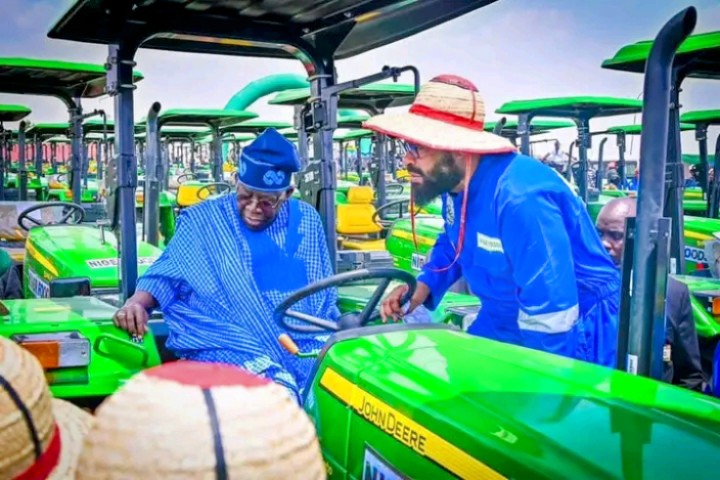
The technology integration component of the programme positions Niger State at the forefront of Nigeria’s agricultural modernization efforts; one of the reasons president Ahmed Bola Tinubu gave a special recognition to farmer governor Umaru Bago, during the occasion of the FG’s launch of the 2000 tractors this June, 2025 as part of the Renewed Hope Agricultural Mechanisation Programme.
Through partnerships with technology companies and agricultural research institutions, the state is implementing precision agriculture techniques, improved seed varieties, and modern farming equipment that dramatically increase productivity per hectare. This technological advancement not only improves yields but also attracts young people to agriculture by making farming more efficient and less labour-intensive.
The programme’s impact extends beyond agriculture to stimulate broader economic development throughout Niger State. Increased agricultural productivity creates demand for transportation, storage, processing, and marketing services, generating employment opportunities across multiple sectors. Rural communities benefit from improved infrastructure, including roads, storage facilities, and processing centers, which serve agricultural development while improving overall quality of life.
The environmental sustainability aspects of the programme demonstrate forward-thinking leadership that addresses climate change challenges while promoting agricultural productivity. Through climate-smart agriculture techniques, sustainable land management practices, and renewable energy integration, the programme builds resilience against climate variability while maintaining productivity. This approach ensures that current agricultural gains do not compromise future productivity or environmental health.
Other state governors across Nigeria should emulate Bago’s comprehensive approach to agricultural development because it demonstrates how coordinated investment, strategic partnerships, and inclusive programming can drive meaningful economic transformation. The Niger State model proves that agricultural development can serve as an engine for broader economic growth while addressing pressing challenges of youth unemployment, women empowerment, and food security. By combining immediate interventions like fertilizer subsidies with long-term investments in technology, infrastructure, and human capital development, Farmer Governor Bago has created a replicable framework for agricultural transformation that other states can adapt to their specific contexts. The programme’s emphasis on partnership, innovation, and inclusion offers a pathway for Nigeria and other African countries to achieve food security while building a more equitable and prosperous agricultural sector that supports both rural livelihoods and national economic development.
Aliyu Writes From Kaduna State, Nigeria.
He Can Be Reached Via: aliyu0380@gmail.com