Politics
Games Of Election Result Transmission -By IfeanyiChukwu Afuba
Presiding officer, Benjamin Kalu, was so predictable in his rush to accomplish a predetermined position that many members of the House of Representatives walked out from the proceedings. It did not matter to the leadership of the two Houses that the Nigerian Society of Engineers had dismissed their scaremongering on poll electronic administration. In a widely circulated advertorial, the NSE held that the Senate’s mindset on electronic delivery of results lacked scientific validity. For the avoidance of doubt, the NSE stated: ‘We declare our full support for real time elec

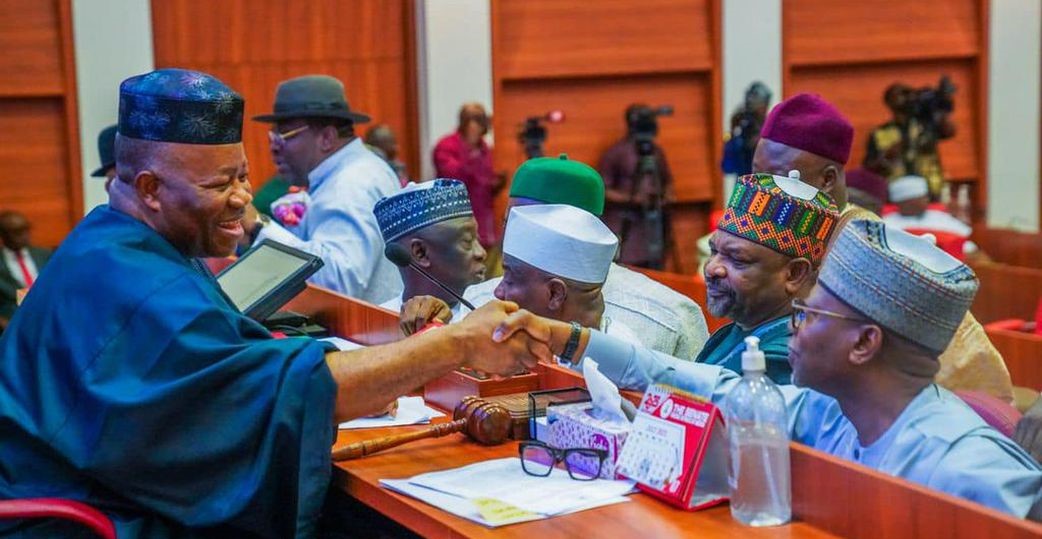
On Tuesday, April 17, 2026, the two houses of the National Assembly bulldozed through a tendentious Electoral Amendment Act. The forced passage of this contentious legislation was achieved by the wilful resolve of the leadership of the two chambers to ram through the Act. In a move reminiscent of a choreographed political script, the Senate and House of Representatives barged through rowdy sessions to stamp approval on a manipulable election format. To push ahead with what amounts to a legal recipe for hijackable election outcome, the leadership of the National Assembly snubbed progressive lawmakers, the opposition, civil society and Nigerians at large who denounced the unfolding arrangement. It’s a phyrric victory for engineers of the scheme because the move will most likely strengthen the resolve of Nigerians for a free, fair and transparent presidential election.
Fela Anikulakpo – Kuti was right. Dead right. And heroic to put it so boldly from a
citizen-centric point of view. Politics is not a game, should not be defined as a game; should not be run as a game, he inferred way back in the mid 1980s. Politics is about my life, my wellbeing. You cannot treat something that concerns my life as a game, he said in his peculiar, quaint manner of expression. But the message got through loud and clear. Fela’s reflection came against the jamboree of the just ended Second Republic. The music icon’s logic is unassailable anyday. Who will tell political actors of the Fourth Republic? Who will tell chieftains of the ruling APC?
Just as Fela’s admonition is timely, so also Jean Jacque Rousseau’s words are prophetic of the Nigerian situation. Rousseau’s philosophy that man is born free but everywhere in chains captures the power pandemic of human society. Whereas some nations have made appreciable progress in placing controls on state power, many others, including Nigeria are choking under it’s oppression. Since the cobbling of Nigeria, the exercise of political authority has been a relationship of rulers versus subjects. The colonial contraption had no illusions about lacking legitimacy. Military rule was a command and control structure. As a member of the Supreme Military Council in 1985, Ebitu Ukiwe spoke authoritatively when he said that the Buhari – led regime was not pretending to be a democracy. Alas, not even the democratic dispensations are citizen – compliant. Since 1960, Nigeria’s democracy has not been accountable to the people. And Nigeria’s parasitic political class is still up in arms to block the citizen’s leverage over political authority. This is precisely what has played out, an attempt by our chicken and chips politicians to veto the citizen’s electoral power.
Between the first and second weeks of February 2026, the Senate enacted maneuvers befitting spy masters in international espionage. When decisions on amendment to the Electoral Act were supposed to have been concluded, an ugly controversy erupted. The Senate’s amendment read that the means of result transmission was at the “discretion” of the INEC. Election officials would “transmit results in a manner prescribed by the commission.” A small group of senators observed that this was at variance with deliberations on the Bill which favoured electronic posting of polling station results. Nigerians were peeved by the direction the clause was tilted to. The outrage thrived against the section’s departure from the letter and spirit of the proposed amendment. The draft provided that “the presiding officer shall electronically transmit the results from each polling unit to the INEC result viewing portal in real time…” To this simple, straightforward demand, the Senate paper diverted to the red herring of INEC’s autonomy and “operational flexibility.”
You could not but wonder at the extent the Senate went to prioritise the option of manual processing of result – which was what the rigmarole on INEC’s judgment was all about. Why was the Senate trying to preempt INEC? Did the electoral body at any point confess inability at electoral transmission of result? By it’s very nature, such weighty matter of public interest had to be made publicly. Without records of INEC’s plea of digital incapacity, the Senate’s subtle campaign for manual
option more than raises eyebrows. An observer’s inescapable impression would be that the Senate, dominated by members of the ruling party was holding brief for INEC. It’s a measure of the Senate’s agenda on the electoral law that she took time to cite poor network coverage, cybersecurity risks, electricity technology deficiencies and risk of legal challenges as hindrances to electronic posting of polling results. For all their efforts, however, Nigerians did not believe the APC – majority Senate.
Nigerians have learnt to be on the lookout when dealing with those in top positions of government. Nigerian leaders covet power with all their mind and heart that many are prepared to execute the most demeaning stunts to cling to power. It was not long ago that Nigerians went through the Maradona years. The dribbling runs of the Argentine football star was used to describe the rulership style of a military junta. It was a governmental pattern marked by inconsistencies, policy shifts and goal reversals. Maradona himself had employed sleight of the hand, unseen by the referee, to score a World Cup goal. In similar fashion, the Ibrahim Babangida regime ran a civil rule transition with three – time change of terminal date and finally annulment of it’s own conducted election! Another round of manipulation began in 2006 with the approaching end of a constitutional tenure. Two outings as head of state and President totalling eleven years was not enough for the power ambitious. While several Constitution amendments were advertised, the target was tenure extension for the incumbent. Nigerians saw through the ruse and rejected the proposed changes. Typically, a case of good riddance to rotten rubbish.
Not surprisingly, the cunning of the Senate was decoded early enough. The alert had earlier gone out by opposition party leaders on the undue delay over the Electoral Act. Faced with the popular demand for a democratic – driven electoral law, the Senate reconvened and took up the matter once more. It resolved for electronic transmission of result, but where not possible, manual process. In real terms, there was nothing new. It was the same destination, the same earlier purpose of creating opening for manual posting of result. And it was this loophole – ridden system approved by the Senate that the House of Representatives adopted in it’s entirety. Presiding officer, Benjamin Kalu, was so predictable in his rush to accomplish a predetermined position that many members of the House of Representatives walked out from the proceedings. It did not matter to the leadership of the two Houses that the Nigerian Society of Engineers had dismissed their scaremongering on poll electronic administration. In a widely circulated advertorial, the NSE held that the Senate’s mindset on electronic delivery of results lacked scientific validity. For the avoidance of doubt, the NSE stated: ‘We declare our full support for real time electronic transmission of election results.’
What happened at the National Assembly on Tuesday this week was a play of the self – serving politics Fela cautioned against. The question that arises at this juncture is why the federal legislature does not accept credible election as a higher principle to be emphasised before any other thing? How come that every other constituency except the ruling party axis considers electronic transmission of result as the most plain, workable, safe and secure of all other options? As Senator Dino Melaye observed, even with 31 state governors, the APC is afraid of transparent elections. The ruling party may have achieved it’s interest for now. But machinery of government has no power over the people’s consciousness. Indeed, power is situational; it’s tide varies, changes. Boy David defeated giant Goliath.