
Global Issues
Gaza at a Crossroads: Trump’s Radical Proposal, the Two-State Dilemma, and the Global Struggle for Peace -By Samuel Agbelusi
A sustainable solution to the Gaza crisis necessitates addressing its root causes through political dialogue. The two-state solution, envisioning independent Israeli and Palestinian states coexisting peacefully, has been a cornerstone of international diplomatic efforts.

On Tuesday February 4 2025, President Donald Trump announced plans for a “US Ownership” over Gaza. This is coming barely 2 weeks after his inauguration as the 47th President of the United States.
The announcement was made at a news conference with Israeli Prime Minister Benjamin Netanyahu in Washington, when he said there are plans to demolish the remaining structures in Gaza and transform the territory under U.S. “ownership” as this is his plan.
According to Reuters, the news conference was organised for President Donald Trump and Israel’s prime minister, Benjamin Netanyahu, to address reporters at the White House, on his intention to take over the Gaza Strip, and the position of the US in the ongoing conflict.
President Trump reinforced during the news conference that his proposal will seek to transform the seaside enclave into a resort that would draw people from around the globe thereby displacing Palestinians who live there and resettling them elsewhere but far from the territory.
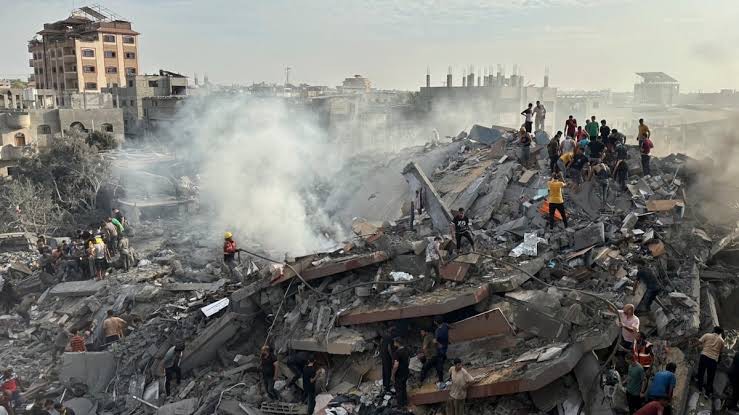
The Trump proposal is coming amid the growing concern about the post-conflict future of Gaza, where the UN has established that a series of buildings have been destroyed and people living in the territory have been displaced as a result of the ongoing crisis that has lasted for 15 months.
The Gaza Crisis
The Gaza Strip which is situated between Israel to the north and east, Egypt’s Sinai Peninsula to the south and the Mediterranean Sea to the west covers 360 square km (139 square miles), slightly more than twice the size of Washington D.C., according to the CIA World Factbook, and a little larger than the island of Malta has been a focal point of conflict and humanitarian crises for decades.
However, following the 1948 Arab-Israeli War, Gaza came under Egyptian administration, becoming a refuge for Palestinians displaced during the conflict. Historically, In the 1967 Six-Day War, Israel seized control of Gaza, initiating a prolonged military occupation. The Oslo Accords in the 1990s granted the Palestinian Authority partial autonomy over Gaza. However, after Hamas won the 2006 elections and subsequently took control in 2007, Israel and Egypt imposed a blockade, citing security concerns. This blockade has severely restricted the movement of people and goods, contributing to economic hardship and infrastructural decay.
On 7th of October 2023, where militant groups led by Hamas launched a surprise attack on Southern Israel, killing 1,195 Israelis and foreign nationals, including 815 civilians, and taking 251 hostages. With the attack, Israel invaded Gaza on 27 October leading to a 15-month conflict characterized by intense military engagements and substantial civilian casualties. The United Nations reports that approximately 69% of buildings in Gaza, including over 245,000 homes, have been damaged or destroyed, resulting in a humanitarian crisis with more than 47,000 Palestinian fatalities according to reports from New York Post.
The ongoing conflict in the Gaza Strip has led to unprecedented levels of internal displacement among its residents. As of December 31, 2024 according to the internal displacement monitoring centre, approximately 83% of Gaza’s population, equating to around 1.9 million individuals, were internally displaced due to continuous hostilities and widespread destruction of infrastructure. The displacement crisis has been exacerbated by Israeli evacuation orders, which, by May 2024, had placed 78% of the Gaza Strip under directives to evacuate. This has forced a significant portion of the population to relocate multiple times, often under perilous conditions.
The destruction of homes and civilian infrastructure has been extensive. By October 19, 2023 according to -, Israeli bombardments had destroyed 98,000 houses, accounting for one in every four homes in Gaza. This widespread devastation has left many families without shelter and has significantly contributed to the displacement crisis.
In response to the devastation, U.S. President Donald Trump proposed a controversial plan to “take over” Gaza, displace its residents, and redevelop it as the “Riviera of the Middle East.
Implications of The Proposal
In February 2025, U.S. President Donald Trump unveiled a controversial plan to assume control over the Gaza Strip, proposing the relocation of its Palestinian residents to neighboring countries such as Egypt and Jordan. The plan includes redeveloping Gaza into a prosperous area dubbed the “Riviera of the Middle East.
United Nations High Commissioner for Human Rights, Volker Türk, emphasized that this proposal will have an effect on the global law stating that the international law strictly prohibits the forced transfer or deportation of populations from occupied territories. Such actions could be interpreted as ethnic cleansing and may constitute war crimes under international statutes therefore raising ethical and legal concerns in the global community.
There are geopolitical concerns that with the US assuming control over the Gaza Strip it would place the country at the center of a complex geopolitical landscape. With the Gaza region battling with ongoing security threats, including the presence of militant groups and a history of conflict. Managing these security concerns would likely necessitate a prolonged U.S. military presence, potentially leading to further entanglement in Middle Eastern conflicts according to The Atlantic.
Also, the proposed redevelopment of the Gaza Strip into a prosperous area, envisioned as the “Riviera of the Middle East,” entails significant economic and logistical hurdles. Estimates suggest that rebuilding Gaza would require an investment between $30 billion to $80 billion according to reports.
Domestically, the proposal has led to divisions within the United States. Some democrat supporters have expressed confusion and concern over the departure from traditional foreign policy approaches while republican supporters have expressed delight to the proposal stating a strong desire that it is a generous offer for the war to have a lasting end.
Another major concern is the rejection of the proposal by the Arab countries, Egypt, for example, has long rejected the idea of housing Gaza’s population, amid growing socio-economic pressures and longstanding fears of Islamist violence and Jordan has been steadfast in its desire not to host more Palestinians, having already provided refuge for people fleeing Palestine in 1948 and 1967 according to –
Trump’s proposal risks collapsing the Gaza ceasefire and impeding the release of the remaining hostages which was agreed days before his inauguration on January 15.
Unsurprisingly, Hamas rejected the proposal right away, in part because the group knew it would be exposed without its human shields in Gaza. Hamas leaders might also question whether they should continue implementing the ceasefire if its subsequent phases and ultimate outcome are now in flux.
Analysts believed that the proposal could significantly undermine the viability of the two-state solution, a long-standing framework aimed at resolving the Israeli-Palestinian conflict by establishing independent Israeli and Palestinian states.
The Two-State Solution?
The two-state solution is a proposed framework to resolve the Israeli-Palestinian conflict by establishing two sovereign nations: Israel and Palestine.
The Gaza war has put renewed focus on a two-state solution to the Israeli-Palestinian conflict, still seen by many countries as the path to peace even though the negotiating process has been moribund for a decade.
The two-state solution was the bedrock of the U.S.-backed peace process ushered in by the 1993 Oslo Accords, signed by Yasser Arafat of the Palestine Liberation Organization (PLO) and Israeli former Prime Minister Yitzhak Rabin.
The accords led the PLO to recognise Israel’s right to exist and renounce violence and to the creation of the Palestinian Authority (PA). Palestinians hoped this would be a step towards an independent state, with East Jerusalem as the capital.
Advocates of the two-state solution have envisaged a Palestine in the Gaza Strip and West Bank linked by a corridor through Israel.
Two decades ago, details of how it might work were set out in a blueprint by former Israeli and Palestinian negotiators Known as The Geneva Accord, its principles include recognition of Jerusalem’s Jewish neighbourhoods as the Israeli capital, and recognition of its Arab neighbourhoods as the Palestinian capital, and a demilitarised Palestinian state.
With the option of a two-state solution on the horizon for a while, it would see an independent Palestinian state established alongside the existing one of Israel – giving both peoples their own territory. However, despite receiving support from former Israeli leaders, the situation has radically changed.
Early 2024, in a televised address, Prime Minister Benjamin Netanyahu said: “In any future arrangement, Israel needs security control over all territory west of the Jordan River.” This comes after several other Israeli politicians explicitly stated they no longer endorse a two-state solution.
The Way Forward
Addressing this Gaza crisis requires a holistic and comprehensive strategy that must include immediate humanitarian relief, plans for a realistic sustainable economic development, and a strong commitment to a political resolution.
The conflict has severely strained Gaza’s economic system and to alleviate immediate suffering, it is imperative to facilitate unimpeded access for humanitarian aid.
A sustainable solution to the Gaza crisis necessitates addressing its root causes through political dialogue. The two-state solution, envisioning independent Israeli and Palestinian states coexisting peacefully, has been a cornerstone of international diplomatic efforts.
However, recent developments have cast doubt on its viability. Notably, proposals involving the relocation of Gaza’s population have been met with widespread condemnation. United Nations Secretary-General António Guterres emphasized that in the search for solutions, it is essential to avoid any form of ethnic cleansing.
Lastly, the complexity of the Gaza crisis demands a coordinated international response. Multilateral organizations, governments, and non-governmental organizations must collaborate to provide humanitarian aid, support reconstruction efforts, and facilitate political dialogue to ensure a lasting end to the crisis.
With the latest proposal from the US President and the widespread criticism, there is a long process to ensure the actual outcome of ending this crisis.
The path to resolving the Gaza crisis is fraught with challenges, but a comprehensive approach that combines immediate humanitarian assistance, realistic economic development, and a renewed commitment to political resolution offers the most viable pathway to lasting peace and stability in the region.


























You must be logged in to post a comment Login