Africa
How Akpabio Turned Montesquieu’s Separation Of Powers On Its Head -By Isaac Asabor
Senator Akpabio’s recent assertion that “lawmakers were not elected to confront the executive but to partner with it” is not only misguided but dangerous to the very foundation of democratic governance. His statement reflects a chilling truth about Nigeria’s current political reality: the walls between the arms of government have crumbled, and what remains is a unitary structure masquerading as a democracy.

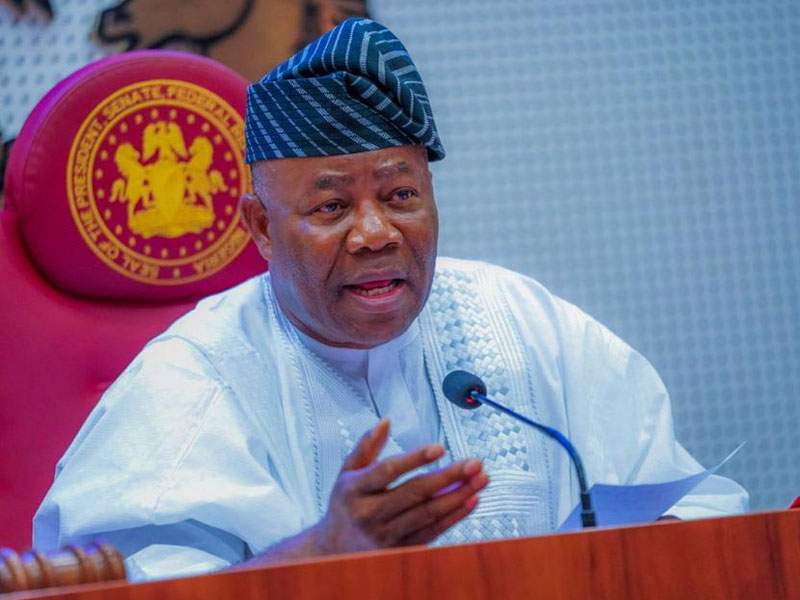
Despite being a fundamental principle of democracy, the doctrine of separation of powers appears to be under threat in Nigeria, as recent remarks by Senate President Godswill Akpabio suggest a troubling fusion of legislative and executive roles. This article explores how the National Assembly’s posture under Akpabio undermines Montesquieu’s vision, blurring the lines meant to prevent tyranny and preserve liberty.
When Charles-Louis de Secondat, Baron de La Brède et de Montesquieu, formulated the doctrine of the Separation of Powers in his seminal 1748 work, The Spirit of the Laws, it was intended as a safeguard against tyranny. By advocating for the division of government into three distinct branches, legislative, executive, and judicial, he proposed that liberty could only be preserved if each branch functioned independently and served as a check on the others.
Fast-forward to contemporary Nigeria under President Bola Ahmed Tinubu, and what we see playing out under the watch of Senate President Godswill Akpabio is the complete opposite of that ideal. The principles Montesquieu passionately laid out to prevent authoritarianism have not only been diluted, they have been brazenly turned on their head.
Senator Akpabio’s recent assertion that “lawmakers were not elected to confront the executive but to partner with it” is not only misguided but dangerous to the very foundation of democratic governance. His statement reflects a chilling truth about Nigeria’s current political reality: the walls between the arms of government have crumbled, and what remains is a unitary structure masquerading as a democracy.
Akpabio made the remarks in a documentary marking President Bola Ahmed Tinubu’s two years in office, emphasizing legislative-executive collaboration and ongoing national reforms, according to a statement on Tuesday by Presidential Media Adviser Bayo Onanuga.
“When elected into the National Assembly, whether in the Senate or the House of Representatives, your constituents will not give you boxing gloves. It’s not a boxing tournament,” Akpabio said. “You are there to work in a bipartisan manner for the interest of Nigeria.”
To understand the gravity of Akpabio’s declaration, we must first acknowledge the constitutional role of the National Assembly. Under Nigeria’s 1999 Constitution (as amended), the legislature is empowered to check the executive, not massage its ego. It is the voice of the people, and its loyalty should rest with the electorate, not with the presidency.
Yet, Akpabio’s words and actions have continuously undermined this principle. His claim that “if you spend all your energy fighting the executive, who will work for Nigeria?” is emblematic of someone who fundamentally misunderstands, or deliberately subverts, the watchdog role of the legislature. This is not about political infighting; it is about institutional oversight and accountability, which are hallmarks of any functional democracy.
In a bid to justify his camaraderie with the executive, Akpabio flaunts the fact that the current administration features a president, vice president, and first lady, all former senators. According to him, this shared pedigree has fostered “unprecedented cooperation.” But cooperation, in the context he describes, is merely subservience in disguise. It is a scenario where the legislature becomes an extension of the presidency, a rubber stamp, rather than a check and balance.
The Nigerian democracy today, particularly under the Tinubu administration, is suffering from a dangerous synchronization of powers. Nowhere is this clearer than in the following observations:
From the approval of massive loans without rigorous scrutiny to the quick passage of bills forwarded from the presidency, the National Assembly has acted more like a civil service department than an independent arm of government. Laws like the Student Loan Act and Minimum Wage Bill may be lauded by Akpabio, but they are often passed without robust public consultation or debate. The question is not whether laws are passed, but whether they are passed through a process that reflects legislative independence.
The judiciary, the supposed last hope of the common man, has become increasingly politicized. Judicial appointments are heavily influenced by the executive, and judgments on politically sensitive matters often tilt in favor of the ruling party. The separation of powers cannot exist where judges are afraid to rule against the government for fear of retribution or lack of promotion.
The core function of the National Assembly, to hold the executive accountable through oversight, has become more theatrical than substantive. Committees summon ministers and heads of agencies more for show than for genuine interrogation. Reports are swept under the carpet, and corruption probes often end without consequence.
Akpabio boasts that the Senate has rejected some of the president’s nominees, as if that alone proves independence. But rejecting a handful of appointees while approving dozens of questionable decisions does not restore credibility. It is a tactic to project a façade of impartiality while maintaining the status quo.
Montesquieu wrote: “When the legislative and executive powers are united in the same person, or in the same body of magistrates, there can be no liberty.” This is exactly what Akpabio is institutionalizing. The Nigerian Senate, under his leadership, has become a co-pilot in a plane that the executive solely navigates.
Rather than serve as a balancing force, the legislature has surrendered its identity, its dignity, and its purpose. The claim that legislators are elected to “work in a bipartisan manner” sounds noble on the surface, but in Nigeria’s context, it often means turning a blind eye to injustice, incompetence, and impunity, all in the name of unity.
The effect of this breakdown in the separation of powers is dire. Nigeria is teetering on the edge of elected authoritarianism, where elections still happen but the institutions that should guarantee fairness, accountability, and transparency have been neutralized. The legislature no longer asks tough questions. The judiciary is slow or reluctant to challenge the executive. And the executive rules almost unimpeded.
The average Nigerian citizen, reeling from economic hardship, insecurity, and poor governance, is left with nowhere to turn. When all three arms of government sing the same tune, dissent becomes a crime, and the interests of the people become secondary to the interests of the ruling elite.
What Nigeria desperately needs is not lawmakers who see themselves as partners in governance, but as protectors of the people’s trust. They must reassert their constitutional role, not for the sake of confrontation but for the preservation of democratic integrity.
Senator Akpabio’s model of legislative-executive “synergy” may win him applause in the corridors of Aso Rock, but such relationship would not in history be seen as a legacy that should be replicated. By turning Montesquieu’s principle of separation of powers on its head, he is helping to erode the very fabric of democratic governance in Nigeria.
In this precarious moment in Nigeria’s history, the question is not whether the arms of government should work together, but how they should work together without compromising their constitutional independence.
For if the legislature continues to abandon its oversight role and the judiciary its impartiality, then Nigeria will not just be a flawed democracy. It will become a democracy in name only, a sad irony for a country that once fought so hard to escape the yoke of military dictatorship.