
Africa
How Transactional Politics Is Killing Nigeria’s Democracy -By Isaac Asabor
Democracy, in its true essence, is about representation, service, and accountability. Unfortunately, transactional politics has turned it into a grotesque theatre of greed. Nigeria stands at a crossroads, continue on this path and plunge into further chaos, or reclaim the soul of our democracy through electoral integrity, civic enlightenment, and leadership by merit.

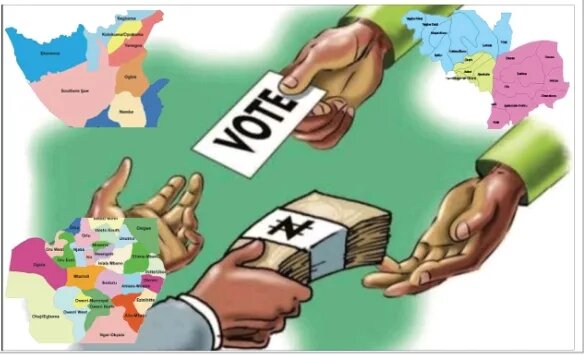
There is a kind of politics that has become deeply entrenched in Nigeria’s democratic landscape, a brand so corrosive and brazenly opportunistic that it threatens the very foundation upon which democracy stands. It is called transactional politics, a phenomenon where political loyalty, public service, and governance are traded for personal or group gains. This toxic quid pro quo arrangement has turned Nigeria’s democratic experiment into a bazaar, where votes are bought, conscience is mortgaged, and public interest is shelved.
At its core, transactional politics is a deviation from ideological politics. It does not matter what a politician stands for, what policies he or she plans to implement, or how competent he or she is. What matters is “what is in it for me?” This mindset has permeated all levels of governance and citizen engagement, from the ward level to the presidency, and from the voters to the politicians.
In Nigeria, elections have increasingly become cash-and-carry affairs. Vote buying has reached epidemic levels, with parties openly distributing food items, cash, wrappers, and mobile phones during campaigns. In the 2023 general elections, for instance, reports from across the country, including Lagos, Rivers, and Kano States, showed how party agents stood barely meters away from polling units with wads of cash, buying votes for as low as ₦1,000 and as high as ₦10,000 per voter.
The situation was so bad that the Independent National Electoral Commission (INEC) and anti-graft agencies such as the EFCC made feeble attempts to arrest some culprits. But what can be done when the same politicians funding the vote-buying are the ones appointing the heads of these institutions? It becomes a vicious circle, and the people are caught in the middle.
Let us not delude ourselves: this rot did not begin yesterday. In fact, transactional politics has been a steady cancer eating into Nigeria’s democratic fabric since the return to civilian rule in 1999. The political godfatherism of the early 2000s, from Olusola Saraki in Kwara to Lamidi Adedibu in Oyo, was essentially a form of transactional politics. These “kingmakers” handed political power to proteges with the understanding that the latter would serve their personal interests once in office.
When former President Olusegun Obasanjo fell out with his then Vice President, Atiku Abubakar, in the early 2000s, it was not about the people. It was about personal interest and control of political structures. The same scenario played out when Bola Ahmed Tinubu’s influence in Lagos politics grew to the point where no governor could emerge in the state without his blessing, a tradition that continues to this day.
Because elections are won through transactions rather than merit, those who assume office do so not with a sense of service but with a mentality of recouping investment. Politics in Nigeria has become a business where you invest billions during the campaign and expect returns through inflated contracts, bogus salaries, and kickbacks once in power.
This was evident in the scandal that rocked the Niger Delta Development Commission (NDDC) in 2020, where it was revealed that billions of naira were spent on non-existent projects, including ₦1.5 billion allegedly spent on “COVID-19 relief” for staff. When then Acting Managing Director, Prof. Kemebradikumo Pondei, fainted on live television during a National Assembly probe, it was symbolic of a system collapsing under the weight of its own greed.
Similarly, the saga in the Ministry of Humanitarian Affairs, where former Minister Sadiya Umar Farouq and her successor Betta Edu were caught in the web of financial irregularities running into billions, reflects how transactional politics has morphed from vote-buying to policy capture. Palliatives meant for the poorest Nigerians were turned into political tools and personal enrichment pipelines.
Another blight of transactional politics is how appointments are made. Competence takes the back seat. Nepotism, party loyalty, and political “Strongmen” dictate who gets what job. The appointment of ministers, heads of government agencies, ambassadors, and even university governing boards are all part of the patronage system.
Take, for example, the nomination of ministers under the Buhari administration. Several names emerged not for their technocratic pedigree but because they had “laboured for the party” during elections. This same approach is being mirrored under the Tinubu administration. How can a country move forward when public service is reduced to compensation for campaign efforts?
It is no surprise that Nigeria consistently ranks low on the Corruption Perception Index and the Human Development Index. The best hands are sidelined while loyal sycophants who barely understand their portfolios are rewarded with key positions.
Perhaps the saddest part of this entire charade is the electorate. A large percentage of Nigerians have become willing participants in this transactional mess. Years of poverty and hopelessness have reduced voting to a business transaction. “Take ₦5,000 and vote,” they say. After all, what has democracy ever brought the common man?
But the people forget, that ₦5,000 will cost them five years of darkness, poor healthcare, hunger, and insecurity. That salt, rice, and wrapper will lead to dilapidated schools, unpaid pensions, and bad roads. Until Nigerians begin to value their votes and understand the weight it carries, transactional politics will remain king.
If Nigeria must survive as a democratic nation, a radical departure from transactional politics is non-negotiable. This must begin with electoral reform that criminalizes and actively prosecutes vote-buying and political bribery. The enforcement must be impartial, no matter whose ox is gored.
Secondly, there must be a civic reawakening. Voter education must go beyond slogans and jingles. Civil society organizations, the media, and religious institutions must educate Nigerians, especially the youth, about the power of their vote and the need to resist immediate gratification for long-term gains.
Political parties must also evolve from being mere election machines to ideologically driven platforms. Candidates must debate, present policy blueprints, and be held accountable by the media and electorates.
Lastly, Nigeria must return to merit-based governance. Appointments and promotions must be based on track record, not loyalty. If the best minds are not given the room to lead, the country will continue to slide backwards.
Democracy, in its true essence, is about representation, service, and accountability. Unfortunately, transactional politics has turned it into a grotesque theatre of greed. Nigeria stands at a crossroads, continue on this path and plunge into further chaos, or reclaim the soul of our democracy through electoral integrity, civic enlightenment, and leadership by merit.
It is time Nigerians stopped selling their future for a plate of rice and a few crisp naira notes. Because at the end of the day, the real cost of transactional politics is paid in blood, poverty, and broken dreams.

























You must be logged in to post a comment Login