
Africa
If the Senate Can Ignore a Federal High Court Order, Can Fubara Do the Same to the Supreme Court? A Nation on the Edge -By John Egbeazien Oshodi
What Happens When Citizens No Longer Believe in the Courts? The judiciary’s credibility is critical in maintaining democratic order, and the perception of judicial bias could exacerbate political tensions across Nigeria. Rivers State, which is already experiencing deep political divisions, is now at the heart of an institutional crisis. The selective adherence to judicial rulings raises questions about whether Nigeria is moving toward a lawful democracy or a system of rule by political decree. Public trust in the judiciary is essential, yet the growing sentiment is that some politicians and institutions are above the law while others are held strictly accountable.

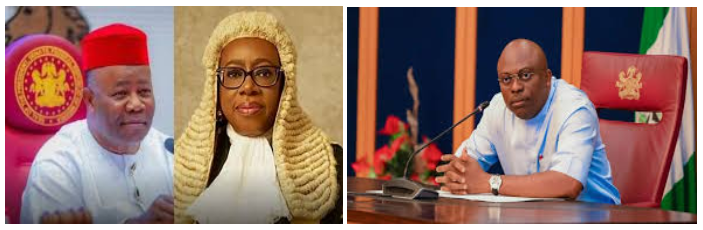
The Supreme Court’s recent ruling on the status of the 27 lawmakers loyal to former Governor Nyesom Wike has deepened public concern over Nigeria’s judiciary. The apex court ruled that there was no legal basis for Governor Siminalayi Fubara’s claim that the lawmakers defected from the Peoples Democratic Party (PDP) to the All Progressives Congress (APC). This verdict effectively restored the legislative authority of the lawmakers, further complicating Fubara’s control over the state government. However, the judgment is being widely perceived as favoring Wike’s camp, raising questions about judicial neutrality and reinforcing broader apprehensions about institutional credibility. If the courts are perceived as political tools rather than impartial arbiters, then the foundation of Nigeria’s democracy is at risk of crumbling under the weight of selective judicial obedience.
Double Standards in Obeying Court Orders
Who Decides Which Rulings Matter? If Nigeria’s Senate, under the leadership of Godswill Akpabio, can boldly disregard a Federal High Court order by suspending Senator Natasha Akpoti-Uduaghan despite a court ruling to the contrary, then how can Nigeria turn around and expect Governor Fubara to fully comply with a Supreme Court ruling he perceives as flawed? The inconsistency in judicial compliance at different levels of government creates a dangerous precedent where court orders are no longer universally binding, but instead selectively followed based on political convenience. If Fubara were to openly question or even delay compliance with the Supreme Court’s ruling, it would not be without justification, considering the growing evidence that judicial rulings in Nigeria may no longer carry the same weight they once did.
Rivers State Electoral Body Defies the Legislature:
The Rivers State Independent Electoral Commission (RSIEC) has also joined the cycle of legal defiance. Following the Supreme Court ruling, the Rivers State House of Assembly issued a 48-hour ultimatum to Governor Fubara to re-present the 2025 budget and summoned the chairman of RSIEC, Justice Adulphus Enebeli (rtd), along with commissioners, to justify financial expenditures without an appropriation law since January 2024. In an act of outright defiance, both Governor Fubara and RSIEC have rejected the ultimatum, further fueling the constitutional standoff. RSIEC issued a Pre-Action Notice, challenging the legal authority of the Assembly to issue such an ultimatum and claiming it violates Section 36 of the 1999 Constitution, which guarantees fair hearing. The refusal of RSIEC to comply now raises serious concerns about whether judicial decisions and legislative authority hold any real weight if major political actors selectively choose which rulings to follow.
Judicial Favoritism? When the Law Serves Political Interests
If the judiciary is truly independent, then its rulings should be seen as sacrosanct, regardless of the parties involved. However, when some court orders are obeyed while others are openly flouted, the entire justice system is weakened, leaving room for anarchy and eroding public confidence. The judiciary must not only be impartial but must be seen to be impartial. A judicial system that tilts toward one political faction while aggressively enforcing rulings against another risks losing credibility in the eyes of the public. If the Certified True Copy (CTC) of the Supreme Court ruling now contains elements of defection that were never part of the original litigation, then the judiciary itself is under scrutiny for possible post-ruling modifications that serve political interests rather than legal precedent.
Fubara’s Imminent Political Battle:
Governor Fubara is now in an increasingly precarious position. The Supreme Court ruling, which strengthens the authority of Wike’s lawmakers, emboldens them to further assert control over the state legislature. This ruling provides them with a legal foothold to renew impeachment threats and legislative challenges against Fubara. By narrowing his legal avenues to challenge the defected lawmakers, the ruling forces him to engage in careful political maneuvering. He must now either broaden his alliances to counterbalance Wike’s grip on the Assembly or seek a diplomatic resolution to maintain governance stability. However, given that the Senate has already openly defied a Federal High Court order, some argue that Fubara may feel justified in questioning or delaying compliance with the Supreme Court’s ruling.
The Supreme Court’s Role in Defection Cases: Has the Outcome Been Pre-Determined?
Furthermore, the Supreme Court’s involvement in defection cases has led to increased scrutiny on whether ongoing cases in lower courts have been effectively pre-determined. If the Supreme Court ruling includes preemptive decisions on defection that were not part of the case before it, it could signal that lower court rulings may already have a foregone conclusion, limiting any future legal challenges. This calls into question whether Nigeria’s judicial system is still a neutral venue for resolving disputes, or if it has become a tool for political leverage.
Erosion of Trust:
What Happens When Citizens No Longer Believe in the Courts? The judiciary’s credibility is critical in maintaining democratic order, and the perception of judicial bias could exacerbate political tensions across Nigeria. Rivers State, which is already experiencing deep political divisions, is now at the heart of an institutional crisis. The selective adherence to judicial rulings raises questions about whether Nigeria is moving toward a lawful democracy or a system of rule by political decree. Public trust in the judiciary is essential, yet the growing sentiment is that some politicians and institutions are above the law while others are held strictly accountable.
The Unraveling of Nigeria’s Democracy:
A Nation on the Precipice: In an era where political loyalty seemingly dictates legal outcomes, what happens when the people lose faith in the very institutions meant to uphold justice? If judicial orders are perceived as suggestions rather than mandates, then how does Nigeria maintain a functional democracy? With both the legislative and executive arms of government now engaged in selective compliance, the judiciary finds itself in an unprecedented crisis of legitimacy.
A Final Warning: If Court Rulings No Longer Bind, What Holds Nigeria Together?
Nigeria stands at a dangerous tipping point. The nation’s stability depends on the ability of its institutions to command respect and enforce accountability fairly and consistently. If the courts fail to uphold the principle of equal justice under the law, then democracy itself is at risk. The slow unraveling of trust in the judiciary is not just a legal or political issue—it is an existential threat to Nigeria’s ability to function as a state governed by law. If left unchecked, this erosion of trust will not only embolden further disobedience to legal authority but will set the stage for a future where governance is dictated by power rather than principles. If court rulings are no longer binding, then what remains to hold Nigeria together?

John Egbeazien Oshodi
Professor John Egbeazien Oshodi is an American psychologist, educator, author specializing in forensic clinical psychology, cross-cultural psychology, police prison science, social justice. Born in Uromi, Edo State, Nigeria, he is the son of a 37-year veteran of the Nigeria Police Force, a background that shaped his commitment to justice, security, psychological research.
A pioneer in forensic psychology, he introduced state-of-the-art forensic psychology to Nigeria in 2011 through the National Universities Commission (NUC) Nasarawa State University, where he served as an Associate Professor in the Department of Psychology. His contributions extend beyond academia into psychological health behavioral change initiatives through the Oshodi Foundation the Center for Psychological Forensic Services.
Professor Oshodi has held faculty positions at Florida Memorial University, Florida International University, Broward College, Nova Southeastern University, Lynn University. He is also a contributing faculty member in the doctoral undergraduate psychology programs at Walden University serves as a virtual professor with Weldios University Iscom University in the Benin Republic.
Beyond academia, he is a government consultant for forensic-clinical psychological services in the USA previously served as Interim Associate Dean Assistant Professor at Broward College, Florida.
He has published extensively on mental health, justice, institutional reform is the founder of the Psychoafricalysis theory, which integrates African sociocultural perspectives into psychology.
Professor Oshodi remains an influential force in advancing psychology institutional reform globally, particularly in Africa.


























You must be logged in to post a comment Login