Africa
June 12 Appeal: A Psychologist Urges Tinubu—Free Fubara for Your Conscience, Health, History, and Honor -By John Egbeazien Oshodi
This commentary is not an attack on the presidency. It is a reflection—a mirror held up to the realities many Nigerians are too afraid to speak aloud. It is an attempt to appeal to reason, to memory, to conscience. The choice facing the president is simple: reverse course, end the emergency rule, and reinstate Governor Fubara in accordance with the Constitution; or continue down a path where legality is blurred and justice is selective. The latter choice may bring short-term political gains, but it will come at the cost of long-term legitimacy. The world is watching. More importantly, history is recording.

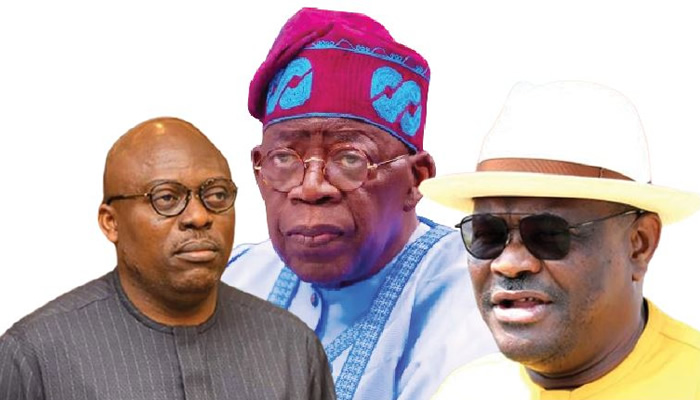
On this year’s Democracy Day, Nigeria once again reflects on the meaning of June 12—a date etched in blood and principle. It is not just a day on the calendar; it is a national pulse check. It reminds us who we once were, and who we claim to be. For President Bola Tinubu, a man whose democratic credentials were born in the fire of June 12, this is no ordinary anniversary. It is a mirror moment. And for Rivers State, and the suspended Governor Siminalayi Fubara, it is a test of how much the country still values justice over power.
As a psychologist observing the patterns of power, trauma, and public perception, this message is not offered with hostility—but with urgency: Mr. President, free Fubara—for your conscience, and for your health. Because what festers politically often festers personally. Unresolved injustice, when internalized or defended, becomes a weight. A burden. And history has shown that unresolved moral conflict at the highest levels of power eventually seeps into the body, the soul, and the nation.
The Politics Behind a Rejection
When Tony Okocha, Chairman of the APC in Rivers State, boldly declared that the party was not a “dumping ground for political sinners,” his statement stirred the waters not merely for its harsh tone but for its strategic timing. At first glance, it appeared to be a routine display of party discipline, an attempt to draw the line against opportunistic defections. But upon closer inspection, Okocha’s words revealed more than they concealed. They were not directed at some abstract idea of political immorality. They were aimed, pointedly, at Governor Siminalayi Fubara—a man currently suspended under questionable constitutional circumstances and quietly isolated by the same political forces that once endorsed him. The vehemence of the rejection suggested not a legal problem but a personal vendetta. The political machinery in Rivers is not rejecting Fubara on principle. It is disciplining him for disobedience.
Fubara, notably, has not even declared publicly that he intends to leave the Peoples Democratic Party (PDP). Any rumors of defection remain speculative. And even if he were to choose another political platform, that decision would be well within his fundamental human rights—his freedom of association and expression. He does not need Wike’s permission to exercise these liberties. Nigeria’s Constitution does not recognize political slavery.
A Governor Removed, Not by Law—but by Design
Fubara’s removal from active governance was not the result of impeachment, a vote of no confidence, or any constitutionally sanctioned process. Instead, it came through a federal declaration of emergency, followed by the appointment of a sole administrator. This was unprecedented in Nigeria’s democratic trajectory. Under Section 305 of the 1999 Constitution, the president has powers to declare a state of emergency, but such declarations do not empower the executive to suspend elected governors, nor do they transfer executive powers to an unelected appointee. The decision to sideline Fubara bypassed not just due process, but the basic structure of federal democracy. It sent a chilling message to all subnational leaders: autonomy can be suspended at will. In a country still healing from the wounds of military rule, this kind of political maneuvering is deeply unsettling.
The Silence of a President—and the Loudness of an Alliance
The legal anomaly of Fubara’s suspension might have remained a technocratic issue, were it not for the political undercurrents driving it. At the center of this arrangement is Nyesom Wike, the former governor of Rivers State and now Minister of the Federal Capital Territory. Wike, though still officially a PDP member, occupies an outsized role within the APC-led federal government. His influence is so extensive that many now refer to him, only half-jokingly, as Nigeria’s “co-president.” That a serving PDP chieftain can wield such influence in an APC government speaks to a deeper entanglement—one where loyalty to democracy is being replaced by loyalty to personal networks. The question that Nigerians are asking is not just, “Who rules Rivers?” but increasingly, “Who rules the Presidency?”
Even Wike Questions the Method
In an ironic twist, Wike himself has publicly questioned the emergency declaration that removed Fubara. But this criticism, far from being a principled stand, appears to be rooted in frustration that the emergency temporarily delayed the impeachment he and his allies were orchestrating. The original plan, it seems, was to use the state assembly—dominated by Wike loyalists—to swiftly remove Fubara. The federal emergency disrupted that timeline, granting Fubara a reprieve. Wike’s public disapproval of the emergency is not a rejection of federal overreach, but a reaction to the strategic inconvenience it caused. It reveals a troubling political pattern: the rule of law is not a foundation but a tool, deployed or discarded depending on who holds power.
The Resignation That Spoke Volumes
Aliyu Audu, the now-former Senior Special Assistant on Public Affairs to President Tinubu, resigned in a move that many see as both symbolic and substantive. In his resignation, Audu did not merely cite policy differences or administrative frustrations. He cited the erosion of democratic values, specifically pointing to the president’s alliance with Wike as a dangerous compromise. Audu’s departure was a rare act of political integrity in a system that often rewards silence. His words echoed the growing discomfort among many Nigerians who feel that the country’s democratic foundations are being chipped away not by open authoritarianism, but by the slow, quiet seepage of unchecked alliances. When an insider walks away and says, “this is not what we promised the people,” it should not be ignored.
The Weight of June 12
As Democracy Day approaches, the symbolism of June 12 grows heavier. This day is not a mere holiday; it is a moral landmark in Nigeria’s political calendar. It honors the memory of those who fought and died for electoral integrity, transparency, and the sovereignty of the people’s vote. President Tinubu, once a leading voice in that struggle, now stands at a moral crossroad. His silence on the situation in Rivers State is becoming louder than any words he may offer in his June 12 address. The people are watching to see whether the man who once resisted tyranny will now condone it—whether the hero of one democratic era has become the custodian of another’s decay.
A Caution Without Condemnation
This commentary is not an attack on the presidency. It is a reflection—a mirror held up to the realities many Nigerians are too afraid to speak aloud. It is an attempt to appeal to reason, to memory, to conscience. The choice facing the president is simple: reverse course, end the emergency rule, and reinstate Governor Fubara in accordance with the Constitution; or continue down a path where legality is blurred and justice is selective. The latter choice may bring short-term political gains, but it will come at the cost of long-term legitimacy. The world is watching. More importantly, history is recording.
The Next Chapter Is Yours to Write
Mr. President, your mandate is from the people—not from any single man, not from any past transaction, and certainly not from fear. Even if the rumors are true—that certain alliances were made, that political debts are being repaid—the Constitution you swore to uphold cannot be rewritten in the name of loyalty. Leadership requires hard decisions. It demands courage to break free from influence, no matter how deeply rooted. The moment has come to decide whether you will be remembered as a transitional figure or as a transformational leader. Restore Fubara. Restore the voice of Rivers people. Let June 12 be a day of correction, not just commemoration. Let democracy, once again, speak louder than power.
This writer does not know any of the individuals involved; the focus is solely on upholding democracy, truth, and justice.
Professor John Egbeazien Oshodi is an American psychologist, educator, and author specializing in forensic, legal, and clinical psychology, cross-cultural psychology, police and prison sciences, and community justice. Born in Uromi, Edo State, Nigeria, he is the son of a 37-year veteran of the Nigeria Police Force—an experience that shaped his enduring commitment to justice, security, and psychological reform.
A pioneer in the field, he introduced state-of-the-art forensic psychology to Nigeria in 2011 through the National Universities Commission and Nasarawa State University, where he served as Associate Professor in the Department of Psychology. His contributions extend beyond academia through the Oshodi Foundation and the Center for Psychological and Forensic Services, advancing mental health, behavioral reform, and institutional transformation.
Professor Oshodi has held faculty positions at Florida Memorial University, Florida International University, Broward College, where he also served as Assistant Professor and Interim Associate Dean, Nova Southeastern University, and Lynn University. He is currently a contributing faculty member at Walden University and a virtual professor with Weldios University and ISCOM University.
In the United States, he serves as a government consultant in forensic-clinical psychology, offering expertise in mental health, behavioral analysis, and institutional evaluation. He is also the founder of Psychoafricalysis, a theoretical framework that integrates African sociocultural dynamics into modern psychology.
A proud Black Republican, Professor Oshodi advocates for individual empowerment, ethical leadership, and institutional integrity. His work focuses on promoting functional governance and sustainable development across Africa.