
National Issues
Nigeria’s Hunger Games: The Tale of Two Tables in Tinubu’s Government, by Isaac Asabor

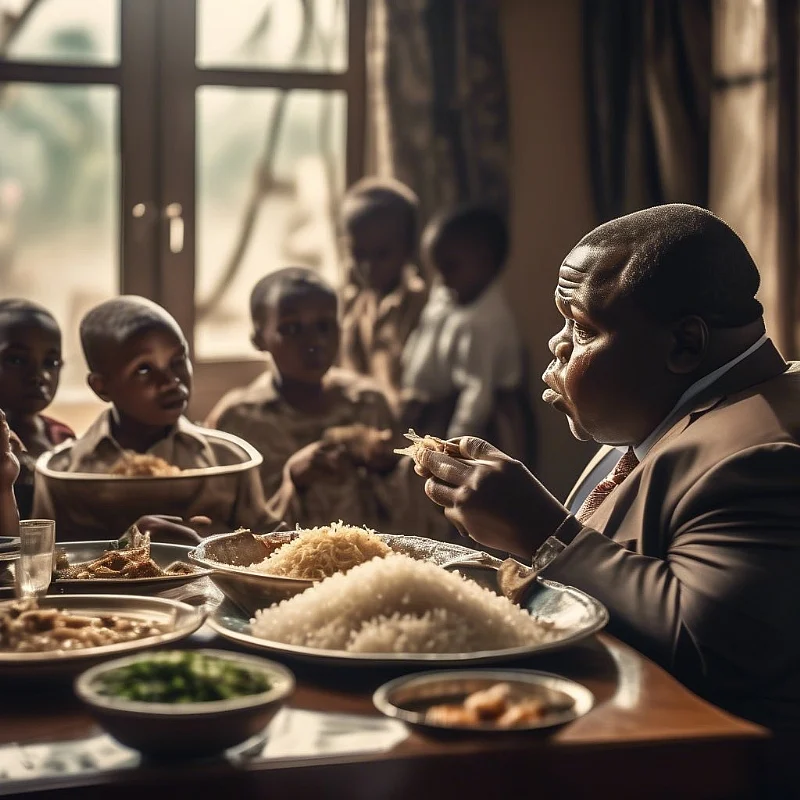
In a small town many years ago, there was a man named Baba Agatha, a hardworking trailer driver who was always on the road. Baba Agatha had two wives. The first wife, whom he had divorced, left behind three children. These children became the responsibility of Baba Agatha’s second wife, Mama Agatha, whenever he was away. Despite the substantial feeding allowance Baba Agatha left behind, he always returned home to find his three children from the first wife looking famished. The reason for this became clear over time: Mama Agatha was feeding her own biological children well, while depriving her stepchildren of the food they needed.
This tragic story mirrors the current situation in Nigeria. The Tinubu government, like Baba Agatha, has borrowed large sums of money, loans from the World Bank and China meant to nourish the nation. But just as Mama Agatha prioritized her own children, it seems the government is feeding only its own, leaving the majority of Nigerians to go hungry.
Everywhere you look, the signs of malnutrition are clear. The cost of living has skyrocketed, unemployment remains high, and basic necessities are increasingly out of reach for the average citizen. The loans, meant to stabilize the economy and provide relief, appear to be filling the pockets of those in power, while the rest of the population struggles to survive.
The analogy is stark: just as Baba Agatha’s children from the first wife were left to starve despite the available resources, the Nigerian people are being starved of the benefits they should be receiving from these massive loans. The funds, meant to improve infrastructure, create jobs, and provide social services, seem to be feeding only those in government and their close associates. Meanwhile, the rest of the nation is left to fend for itself, with little hope of relief in sight.
As Nigerians, we must ask ourselves: How long will we allow this cycle to continue? How long will we watch as those in power grow fat off the resources meant for all? The story of Baba Agatha’s household is a cautionary tale, a reminder that when resources are not equitably distributed, it is the most vulnerable who suffer the most.
It is time for the Nigerian government to address the needs of all its citizens, not just those within its inner circle. The loans from the World Bank and China should be used to uplift the entire nation, not just a select few. If this does not change, the hunger that plagues our country will only grow, and the gap between the haves and have-nots will continue to widen.
Like Baba Agatha, we must return home to find our children well-fed and thriving, not hungry and hopeless. It is a responsibility we owe to the future of our nation.
At this juncture, it is germane to confess that this was inspired to express this view upon reading a request dated August 10, 2024 which the leadership of Socio-Economic Rights and Accountability Project (SERAP) wrote President Tinubu, urging him to use his good offices and leadership position to direct the Attorney General of the Federation and Minister of Justice Mr.LateefFagbemi, SAN, and appropriate anti-corruption agencies to promptly and thoroughly investigate the spending of $1.5 billion World Bank loan to Nigeria’s 36 states and Abuja for poverty reduction and social protection in the states.
In the letter, SERAP emphatically requested that suspected perpetrators of corruption and mismanagement should face prosecution as appropriate, if there is sufficient admissible evidence, and any proceeds of corruption should be fully recovered.
It also urges Mr. President to direct Mr.Fagbemi and appropriate anti-corruption agencies to promptly, thoroughly, transparently and effectively investigate the alleged mismanagement of the Chinese loans of USD$3.121 billion obtained by the Federal Government, and in the same vein urges him to instruct the Economic and Financial Crimes Commission (EFCC) and Independent Corrupt Practices and Other Related Offences Commission (ICPC) to jointly track and monitor the spending of the $1.5 billion World Bank loan to Nigeria’s 36 states and Abuja for social protection and COVID-19 response.
Unarguably explaining the rationale for making the request, SERAP in its letter stated thus: “According to our information, the World Bank on 15 December 2020 approved $1.5 billion loan for Nigeria’s 36 states and Abuja for social protection and strengthened state-level COVID-19 response. The loan aims to help the states build a resilient recovery post-COVID19 and to reduce poverty.
“Specifically, the loan aims to increase access to basic education, quality water and sanitation services; improve primary healthcare; and increase the coverage and effectiveness of social assistance programs, promote women’s empowerment and reduce maternal and child mortality across the states.
“The $1.5 billion World Bank loan is for two projects. The first is Nigeria Covid-19 Action Recovery and Economic Stimulus – Program for Results (Nigeria CARES) which aims to help increase access to social transfers and basic services, as well as provide grants to poor and vulnerable households. This is financed through an International Development Association (IDA) credit of $750 million.
“The second is the State Fiscal Transparency, Accountability and Sustainability Program for Results (SFTAS), which aims to help increase the efficiency in spending, strengthen revenue mobilization, and enhance accountability and transparency in public resource management to further strengthen state-level COVID-19 response. The project is financed through an International Development Association (IDA) credit of $750 million.
“According to the Debt Management Office, the total borrowing by Nigeria from China was USD$3.121 billion, as at March 31, 2020. The USD3.121 billion loans are for 11 projects including the Nigerian Railway Modernization Project (Idu-Kaduna section); Abuja Light Rail Project, Nigerian Four Airport Terminals Expansion Project (Abuja, Kano, Lagos and Port Harcourt), Nigerian Railway Modernization Project (Lagos-Ibadan section) and Rehabilitation and Upgrading of Abuja – Keffi- Makurdi Road Project.
“According to the Debt Management Office, Nigeria’s total public debt stock, including external and domestic debts, increased by ₦24.33 trillion in three months alone, from ₦97.34 trillion ($108.23 billion) in December 2023 to ₦121.67 trillion ($91.46 billion) as of March 31, 2024. The debt represents external and domestic loans obtained by the Federal Government, the 36 state governments and the Federal Capital Territory (FCT)”.
To further buttress the reason for making the request, SERAP says it is concerned about reports that the World Bank loan to the 36 states and Abuja and the $3 billion obtained by the Federal Government may have been mismanaged or diverted or spent for un-authorized purposes, and in any case remain unaccounted for.






















You must be logged in to post a comment Login