Africa
Our Hospitals, Our Health Workers, and Us -By Abdulkadir Salaudeen
He is not alone; may the Almighty have mercy on all Nigerians who died in our hospitals due to government negligence of the health sector. Which sector hasn’t the government neglected? The only thriving sector that continues to gain government’s attention and care is the political sector, and only few Nigerians are politicians to benefit. May we not die miserably.

Health is said to be wealth. This is an undisputable aphorism. Only a healthy but ignorant person who has never experienced illness would dispute this saying — I doubt if such ignorant exists anywhere. Though the depth of our knowledge may differ, everyone basically knows the importance of good health.
That said, governments globally, whether responsible or irresponsible, pay utmost attention to their citizens’ health. Unfortunately, Nigerian government is one of the few exceptions. The saying “A healthy nation is a wealthy nation” is the driving philosophy behind prioritizing people’s health, even for corrupt and irresponsible governments.
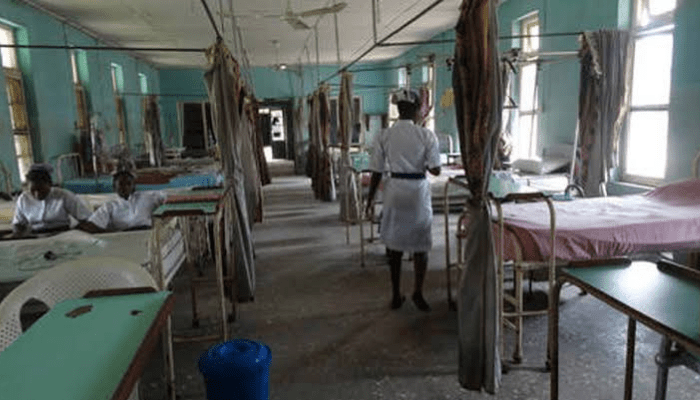
Hospitals are designated to care for the sick. A hospital’s ability to effectively discharge this basic function is one index for measuring a country’s healthiness. Using this approach, Nigeria is a sick country. The citizens are sick. The hospitals that should care for the sick are in a coma.
Doctors, nurses, and other health workers work under pressure as they struggle to provide healthcare to patients. They, too, as health providers, suffer job-related fatigue because they are overworked and overwhelmed by the disproportionately large number of patients they attend to daily.
In a press statement issued on Nigeria’s 65th Independence anniversary three months ago, the Nigerian Association of Resident Doctors NARD decried the country’s poor doctor-to-patient ratio of 1:9,083 (that is, 1 doctor per 9,083 people). The association described it as far from global best practice. According to a political appointee, the Minister of State for Health and Social Welfare, Iziaq Salako, one doctor currently attends to about 3,500 patients in Nigeria. Whichever ratio we are inclined to believe between NARD’s and the Minister’s, the situation is ugly and terrible compared to the global average. The global average reportedly sits near 1.7 doctors per 1,000 people.
In advanced countries, the ratio of doctors to patients is typically between 3 to 6 doctors per 1,000 people. Take for instance, countries like Cuba (9.54 per 1,000), Monaco (8.61 per 1,000), and Belgium (6.53 per 1,000) have some of the highest doctor densities globally. Nigeria has one of the lowest despite being a continental giant.
In addition, NARD’s statement reads: “Furthermore, Nigerian resident doctors work an average of 106.5 hours per week, with surgical residents enduring over 122.7 hours weekly. This translates to an average of four to five days of 24-hour call duty per week.” Yet, their take home, despite being overworked, hardly take them home.
Many have resorted to working in as many hospitals as possible to make ends meet. This, in most cases, is at the detriment of patients. But do we blame them? No! It is a display of the natural instinct of survival. They must survive first to help a dying patient survive. They must rescue themselves and their families first in an attempt to rescue dying patients in our hospitals. Our medical doctors are victims themselves — victims of a system that stretches them beyond their limits. That is why some medical doctors have died on duty due to stress and endless lack of rest.
As important as our doctors and nurses are in providing healthcare in our hospitals, they constitute only about 15% of the workforce. There are other health workers like pharmacists, medical laboratory scientists, physiotherapists, radiographers, dietitians, health information managers, engineers, administrative staff, and other support staff. These health workers, who make up about 85% of the workforce, have been on strike since November 14, 2025. They are called the Joint Health Sector Unions (JOHESU). The industrial action embarked upon by this health union has grounded activities in virtually all federal government hospitals across the country that provide only skeletal service.
There are serious limitations to what doctors and nurses can do without these workers. Why are they on strike? As usual, their salaries cannot sustain them. And because it is now a crime to demand a salary increment, the Federal Government has enforced the “No Work, No Pay” policy, stopping salaries of striking members.
This policy, if the government is not aware, lacks the potency to stop workers from embarking on strike. Workers’ conditions and plights have greatly deteriorated to the extend that salary stoppage will not make them budge an inch. Why? The salary is too miserable, so much so that it makes very little difference between being paid and not being paid.
As a result of this strike which is over two months, many have lost loved ones. If there are influential people who could talk to our rulers, they should do so to halt the death toll in our hospitals. I have asked several times on this page and I will ask again: where is the money saved from the removal of the oil subsidy? I have not gotten any reasonable response.
Our hospitals, which should have massively benefited from the touted oil subsidy savings, are nothing to write home about. There is no sophisticated equipment to match modern progress in medical facilities in our hospitals. Where you find some of this equipment, it is either there is no regular power supply to keep them working or there is a shortage of manpower to operate them, or their operators (JOHESU) are on strike.
I went to Aminu Kano Teaching Hospital last October when I could not chew with my 32 due to severe toothache. After a thorough examination, I was asked to book an appointment for a later date, which was the second week of December. I have been going to the hospital since then, and till now nothing has been done because those in charge of my medical record are on strike.
Two months ago, my one-year-old daughter had serious breathing difficulty and she could not be breastfed. It was discovered that her oxygen level was very low. That became a serious problem to address in the hospitals. We took her to five different hospitals before we got it addressed.
Was it even really addressed? Before we got to the fifth hospital, her oxygen level had normalized due to some counselling we got from some kind and caring health workers, and which we meticulously followed. Our health workers are not intrinsically poor in service delivery (they are really doing great), but our hospitals are bad places to visit. To some, they are graveyards. Generally, experiences in our hospitals are nasty.
Many went to our hospitals but came out in body bags for lack of facilities as basic as bed space. I lost a good friend and neighbor this week. He suffered from an ailment that can be easily managed, only if he could be admitted. But our hospitals, including teaching and specialist hospitals, lack beds to admit patients. He was taken to five different hospitals, but it was the same story. No bed space. In one where a bed was available, they could not manage his health.
On his way to the sixth hospital in another state where we thought there could be bed space, he gave up the ghost. Despite being a Muslim who must believe he was destined to die when he died, I still strongly believe that, aside from destiny, we lost him due to lack of bed space in our hospitals.
We fondly call him Malam Iliya. A very hardworking, trustworthy, and responsible friend and father. Though of little means, he is very contented — a contentment laced with integrity. May Allah take care of the family he left behind, forgive him, and grant him Paradise.
He is not alone; may the Almighty have mercy on all Nigerians who died in our hospitals due to government negligence of the health sector. Which sector hasn’t the government neglected? The only thriving sector that continues to gain government’s attention and care is the political sector, and only few Nigerians are politicians to benefit. May we not die miserably.
Our rulers in Abuja should do the needful. Our hospitals cannot continue to hemorrhage. Government should urgently and earnestly address the demands of JOHESU before death gradually depletes the country’s human resources.
Abdulkadir Salaudeen
salahuddeenabdulkadir@gmail.com