
Global Issues
Pathways and Perspectives Toward Forging Media Cooperation between Russia and Africa -By Kestér Kenn Klomegâh
Professor Mohammad Bashir Ali, Kaduna State University (Nigeria), leading the Nigerian delegation to the Forum, discussed at length, the traditional role of media in promoting economic and entrepreneurial cooperation between Russia and Africa. Despite the multiple challenges posed by the complex international environment in both Africa and Russia, there is enormous potential for opportunity in this area. He concluded that greater consolidation in the media sphere is essential.

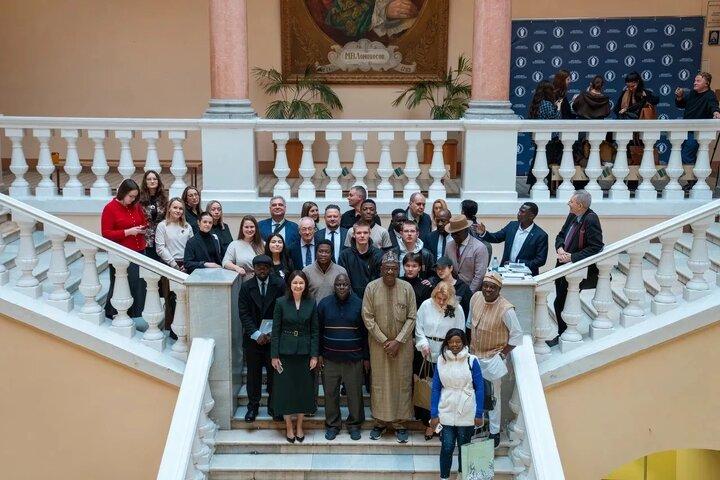
Under the auspices of the Faculty of Journalism of Lomonosov Moscow State University, the Russian-African Club, in late April, held its IV International Forum of Journalists from Russia and Africa, which marked another historical milestone. According to an established annual tradition, discussions were focused aspects of the media, its structure, current performance, information contents, and challenges as well as future visions.
Organized by the Russian-African Club of Lomonosov Moscow State University, in collaboration with the Faculty of Journalism and the Faculty of Global Studies at Moscow State University, the shared common purpose was also to critically review whether the media, both in Africa and in the Russian Federation, has played its role in strengthening bilateral relations, and promoted the important goals set out during the first and second Russia-Africa summits.
Why Media Matters
As largely expected, there were indepth discussions. There were also controversies over the dynamics of media performance, with prominent participating experts raising narratives and criticisms, in the context of the forum’s theme: “Mass Media of Russia and Africa: The Role in Strengthening Friendship and Solidarity among the Peoples of the World.”
Elena Vartanova, dean of the Faculty of Journalism at Moscow State University, vice-president of the Russian-African Club, pointed to the fact that the media has to build diverse partnerships between Russia and Africa, further emphasized the importance of intercultural dialogue in creating a unified information space amid the complex global transformations of the modern world.
Yaroslav Skvortsov, dean of the Faculty of International Journalism at MGIMO, spoke about his recent unique trip to South Africa, noting that South Africa and the continent as a whole remain a “media blind spot” for Russian media, just as Russia receives very little coverage for African audiences. The expert emphasized the need for serious, thoughtful, and in-depth reporting work in this area. The necessity to explore more opportunities in building strong ties, deepening the understanding of geopolitical developments, while fostering dialogue among the continent’s public.
Underlining Reasons
The media performance gap between Russia and Africa stems from overwhelming dominance of Western media outlets, a little of direct African reporting in Russia (including a lack of accredited African journalists), and limited institutional investment. These are some of the reasons highlighted during the discussions by an African studies journalist and columnist for the ITAR-TASS Analytical Center, Oleg Osipov, Timur Shafir, Secretary of the Union of Journalists of Russia and Head of the International Department of the Union of Journalists of Russia, and Louis Gowend, chairman of the Commission for Relations with African Diaspora and the Media of the Russian-African Club of Moscow State University, and president of the African Business Club.
Oleg Osipov, unreservedly, expressed concern about information deficit in Russian and African journalism, emphasized the urgent need to expand the network of Russian correspondent offices across the African continent, as well as getting a few experienced African media practitioners to Russia. This is especially important in today’s reality, as geopolitics heightens in the world.
Geliya Filatkina, associate professor at the Faculty of Journalism, Lomonosov Moscow State University, pointed to the main challenges in developing the media sphere in Africa are the uneven distribution of access to the internet, digital resources, radio, and the press. She says the dominance of state-owned media, largely controlled by the West, is a factor hindering the development of free journalism, coupled with an acute shortage of qualified personnel.
Assessing current global trends, Russia needs to expand its presence in all spheres, and the media space is a crucial component of this process, the Russian expert believes. But for Timur Shafir, the thoughts were on the fact that it was especially important now to find common grounds in the mutual perceptions of the peoples and cultures of Russia and Africa through media communication. In addition, he further emphasized that the media landscape is currently undergoing significant transformations, with technologies, audiences, and means of communication changing. Therefore, journalism is currently an area of particular responsibility and professional integrity, and direct dialogue between journalists in Russia and Africa has become crucial now.
Search for New Approach
The IV International Forum of Journalists from Russia and Africa, was considered as the new dawn, turning a new chapter with suggestion and paving the path for improving media performance in both regions. The participants offered a deafening applause to this position. The speakers expressed confidence that the Forum will serve as a starting point for many new joint initiatives.
According to Louis Gowend, the RusAfroMedia media platform—an information resource, which was created by the Moscow State University RA Club in 2022, for instance has to undergo serious facelifting, by strengthening cooperation and to improve the image of Russia-Africa cooperation. This platform provides all the conditions for a free and frank exchange of opinions, relevant useful information, and the promotion of initiatives in all areas of cooperation between Russia and Africa. The speaker expressed concern over the fact that Russian journalists are much less active on the RusAfroMedia platform than their African counterparts and urged those present to make greater use of this resource.
In his contribution to the discussions, Alexander Berdnikov, executive secretary of the Russian-African Club and chairman of the Commission on Public Security and Public Diplomacy of the Council for Nationalities Affairs under the Moscow city government, distinctively noted that, at a time when new development trends are unfolding in the world, journalism and the entire media sphere are literally becoming a battlefield for information wars and special operations.
The speaker reminded that the Forum, being held ahead of the Third Russia-Africa Summit scheduled for October 2026, indicates how crucial for participants to develop solutions and initiatives for cooperation in journalism between Russia and Africa, and which will form the basis for practical recommendations in preparation for the forthcoming African leaders’ Summit.
Preserving Traditional Practice
Lyubov Sakhno, head of the Protocol and African Section of the TASS International Relations Department, represented Russia’s oldest news agency and spoke about ITAR-TASS’s consistent efforts to provide African media with foreign-language news feeds. But then, Russian media expansion faces limited budget constraints. According to her, over 400 media outlets in Africa use these resources. She also discussed the organization’s media forum, which traditionally takes place on the sidelines of the Russia-Africa Summit.
Sergey Grachev, deputy director of the Media Research and Analysis Directorate at Rossiya Segodnya International News Agency and a lecturer at the Faculty of Journalism at Lomonosov Moscow State University, agreed with his colleagues that today we are facing unprecedented pressure from Western media. African media, most often, depends on Western sources, which Russian officials argue creates a “vacuum” filled by biased or hostile information. Despite this, Russian media projects in Africa continue to develop, presenting analytical models of Sputnik’s presence on social media, where it broadcasts in 33 foreign languages.
Editor-in-chief of the African Initiative news agency, Buinta Bembeeva, noted in her discussions that Africa has become noticeably, and more prominent in Russian news in recent years. The speaker discussed the African Initiative’s experience in Africa. The agency is noticeably represented in many African countries through cooperation agreements with local media outlets. The agency also collaborates with bloggers and organizes a journalism school for young African journalists. This close, on-the-ground, direct collaboration with African media outlets is key to achieving full-scale journalistic activity.
Contributions from Nigerian Academics
Professor Babatunde Joseph, Kaduna State University, spoke about using strengthened strategic communications to strengthen partnerships and unite the cultures of African countries. He agreed with his Russian colleagues on the need to expand the presence of Russian news agencies in Africa and African media in Russia. The expert cited the example of a well-known British radio station that broadcasts in five languages in Nigeria alone: Hausa, Yoruba, Igbo, Pidgin English (called “Najin” there), and plain English. “This is a successful strategy,” the professor was forced to note.
Professor Mohammad Bashir Ali, Kaduna State University (Nigeria), leading the Nigerian delegation to the Forum, discussed at length, the traditional role of media in promoting economic and entrepreneurial cooperation between Russia and Africa. Despite the multiple challenges posed by the complex international environment in both Africa and Russia, there is enormous potential for opportunity in this area. He concluded that greater consolidation in the media sphere is essential.
Professors Yushau Ibrahim Ango and Ayodele Babatunde, both from Kaduna State University, presented a working paper entitled “African Creative Industries and Media Systems in the Context of Digitalization,” analyzing the impact of digital media on entrepreneurship in the Nigerian economy. The paper, however, concluded that reliance on digital platforms introduces new vulnerabilities, including algorithmic unpredictability, into the economy. This paper contributed to entrepreneurship and media research by theorizing digital platforms as entrepreneurial infrastructure, which has implications for policy, platform governance, and understanding how media shapes economic life in the African context.
Concluding Remarks
Hafiz Basi, chairman of the Youth Projects Commission of the Russian-African Club, seriously echoed the opinion in closing remarks, stating that it is time to change outdated stereotypes that portray Russia and Africa through Soviet political clichés. “We need journalism that brings people together, not further distances,” Hafiz Basi emphasized. He also noted that the lack of accredited African journalists in Russia remains a pressing issue. Meanwhile, African media outlets write about Russia primarily in political terms, failing to reveal the true depth of Russian culture and the soul of the Russian people. In his opinion, the Russia-Africa Journalists Forum, once more, demonstrated its importance, which discusses the most pressing issues, prospects, and strategies for strengthening media cooperation between Russia and Africa. This is in reality, important during the time of rapid geopolitical changes, in response to the aggressive rhetoric of Western countries and their satellites, public diplomacy, soft power, and peacekeeping journalism which are becoming increasingly relevant careful analysis and take effective measures in building a solid foundation for Russian-African dialogue.






















You must be logged in to post a comment Login