Breaking News
PDP vs ADC: Two Opposition Visions Emerge Ahead of Nigeria’s 2027 Election
The PDP and ADC are battling for opposition relevance ahead of 2027, presenting different visions on political structure, electoral credibility and voter confidence.

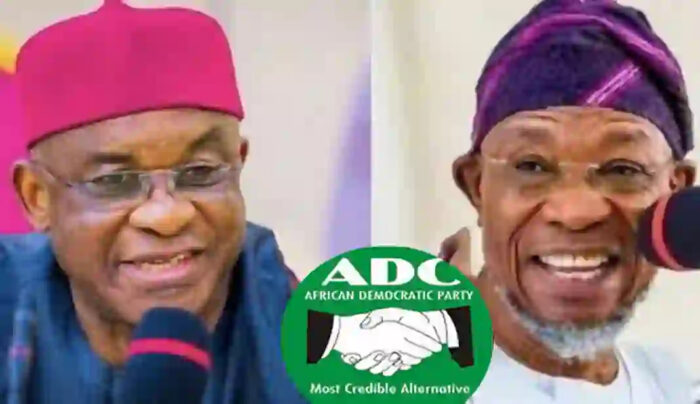
The Peoples Democratic Party (PDP) and the African Democratic Congress (ADC) are beginning to stake out different positions in the emerging contest for opposition relevance ahead of Nigeria’s 2027 general elections.
That contrast became evident in their separate recent engagements with the US-linked International Republican Institute (IRI), whose delegation is assessing Nigeria’s political and electoral environment ahead of the next general election.
While PDP National Chairman Abdulrahman Mohammed used his meeting with the IRI team to emphasise the party’s nationwide structure and readiness, ADC National Chairman David Mark focused on the need for a peaceful, credible and transparent electoral process.
The messages may have been delivered at different times, but together they highlight a deeper question confronting Nigeria’s opposition: what will matter most in 2027 — political structure or electoral credibility?
PDP presents itself as ready
When the IRI delegation visited the PDP national headquarters at Wadata House, Abuja, Mohammed stressed the party’s organisational reach.
According to him, the PDP has structures across Nigeria’s 36 states, the Federal Capital Territory and all 774 local government areas.
“But I want to assure you that the PDP is fully ready for the election,” he said.
The statement was also a political declaration that the PDP remains a significant national force capable of mounting a countrywide electoral challenge.
Mohammed further cited the recent Osun governorship election, particularly the participation of voters, as evidence that Nigerians remain willing to engage with the electoral process.
“You can attest with the outcome of the election,” he told the IRI delegation, referring to the turnout and determination of Osun voters.
The PDP’s argument is therefore straightforward: it possesses the structures, reach and political machinery required to compete nationally.
Mark puts electoral conditions at the centre
Two days later, the IRI delegation met with ADC National Chairman David Mark.
The former Senate President approached the conversation from a different angle.
Rather than focusing mainly on organisational reach, Mark concentrated on the rules and conditions of the electoral contest.
He called for peaceful elections, freedom of choice, institutional neutrality and safeguards against manipulation.
“Elections should not be treated as war or a do-or-die affair,” Mark said.
According to him, citizens must be able to select their leaders without violence, intimidation, manipulation or the misuse of state institutions.
For Mark and the ADC, the credibility of the 2027 election is “non-negotiable”.
That position gives the ADC a different identity within the opposition space. The party is not simply presenting itself as another vehicle for challenging the ruling party; it is also seeking to frame opposition politics around the integrity of the electoral process.
Same Osun election, different lessons
The recently concluded Osun governorship election provides an interesting backdrop to the contrasting positions.
Mohammed sees the election largely as evidence of voter participation and determination.
Mark, however, points to the security concerns surrounding the election, including reports that no fewer than 30 people were killed in connection with the poll.
His concern is that elections must not become contests in which political actors pursue victory regardless of the consequences.
The difference is subtle but important.
The PDP’s narrative is centred on citizens turning out to vote and the organisational capacity needed to harness that participation.
The ADC’s narrative is centred on ensuring that citizens can make those choices in an environment free from fear, violence and manipulation.
Thus, the same Osun election is being used to support two different arguments about the future of opposition politics.
IRI assesses the environment
The International Republican Institute is listening to both sides but has not chosen between them.
IRI African Regional Director Jenai Cox said the organisation was meeting political parties and other stakeholders to understand the pre-election environment, party preparations and issues that could require attention ahead of 2027.
The mission also observed the Osun election and visited Ekiti.
Among those on the delegation were IRI President Dan Twining and former US Assistant Secretary of State for African Affairs Jendayi Frazier.
Cox said the organisation would present preliminary findings and recommendations after reviewing its meetings and observations.
There was no endorsement of either the PDP’s or ADC’s interpretation.
But the fact that both opposition parties have presented their positions to the same international election assessment team gives the meetings added political weight.
A contest beyond party structures
The emerging rivalry between the PDP and ADC reflects a broader struggle over the direction of Nigeria’s opposition politics.
The PDP is seeking to establish that it remains the dominant established opposition structure, with the national reach and machinery required to challenge for power.
The ADC, meanwhile, is positioning itself around electoral credibility, peaceful competition and institutional integrity.
Neither argument exists in isolation.
A successful opposition challenge in 2027 will require political organisation, alliances and voter mobilisation. But it will also depend on the credibility of the electoral process and public confidence in the rules governing the contest.
That leaves a bigger question for the opposition space: which platform can persuade Nigerians that it has both the machinery to compete and the credibility to lead?
The separate IRI meetings suggest that the battle for 2027 is already moving beyond the question of who can defeat the ruling party.
It is increasingly becoming a contest over who can define the meaning of opposition, who can command national relevance and whose political narrative will resonate most strongly with Nigerian voters.
The major electoral confrontation is still months away, but the struggle for structures, alliances, credibility and opposition leadership has already started.
Africans Angle News