
Forgotten Dairies
Political Adulthood: Why Africa Must Create Its Countries -By Ozuomba Egwuonwu
The modern idea of country is relatively recent in human history. A major turning point came with the Peace of Westphalia, which ended the Thirty Years’ War in Europe. While historians debate how decisive it was, Westphalia became associated with the principle that each state possesses sovereignty over its own territory and domestic affairs. This laid much of the intellectual foundation for the modern country or state system.

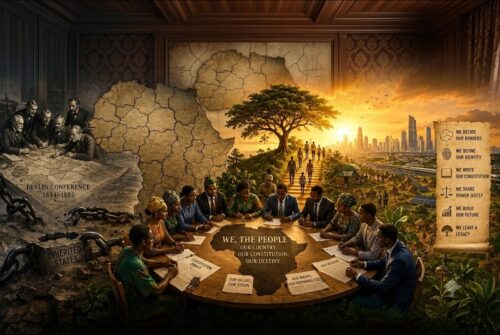
Perhaps history denied Africa one of civilization’s most important political experiences. According to G. W. F. Hegel, “The State is the march of God in the world.”
If the State is humanity’s highest political creation, then creating one is among civilization’s highest maturing political experience.
The experience of consciously creating modern states or countries- not nations, for Africa had nations and knew kingdoms, empires, city-states, and tribal confederations long before Europe knew many of its own-those political communities however, revolved around rulers or dynasties rather than the consent of a defined citizenry and modern day concept of states or countries.
The modern idea of country is relatively recent in human history. A major turning point came with the Peace of Westphalia, which ended the Thirty Years’ War in Europe. While historians debate how decisive it was, Westphalia became associated with the principle that each state possesses sovereignty over its own territory and domestic affairs. This laid much of the intellectual foundation for the modern country or state system.
Thus from the seventeenth century onward, Europe in particular, witnessed repeated waves of country creation:
- Kingdoms merged or fragmented.
- Principalities united.
- Republics emerged.
- Empires collapsed.
- Borders were renegotiated through diplomacy, constitutional settlements and sometimes wars.
By the nineteenth century, nationalism transformed political legitimacy. The question was no longer merely who ruled, but which people constituted the political community.
The twentieth century accelerated this process. The collapse of multinational empires after the First World War, the defeat of fascism after the Second World War, decolonization, and the end of the Cold War all generated new countries.
Thus, it is an accepted fact that modern history never stopped creating countries and contrary to popular imagination, the political map of the modern world has never been fixed. Countries have continually been created (every successful country was most likely,once a consummate argument around a table ), dissolved, merged, reconstituted as peoples have sought new constitutional arrangements.
Throughout these transformations, Europeans mostly -through revolutions, treaties, federations, negotiated separations, and constitutional conventions, were the principal architects and creators of most European and even non European countries. So post Westphalia and before 1900 Europe created between 25 to 30 Countries. Between 1900 and 1990 they created additional 10 to 15 countries and 16 to 18 countries post cold war (1991 onwards) within Europe alone . These figures are approximate because several states (such as Poland, Lithuania, Latvia, and Estonia) disappeared for periods and later re-emerged, rather than being wholly “new.”
In essence, Europe had already spent more than 300 years repeatedly creating, dissolving, merging, negotiating, and redesigning countries and ultimately lending credence to the fact that “History does not merely reward those who govern well. It rewards those courageous enough to decide how they shall be governed.” .
Out of about 54 African countries creation by contrast, only Ethiopia, and to a limited extent, Liberia and South Sudan had Africa actively participating, largely accepting the colonially created maps under the doctrine-later endorsed by the Organization of African Unity, which favored maintaining inherited borders, ostensibly, to avoid conflict (I will suspect, intellectual conflict the more)…
So what Africa largely have are inherited, not self created countries.
And successful countries won’t be mere geographical expressions.
They would be mostly a deliberate political invention.
Somebody or group, acutely concerned and burdened with a deep sense of historical and generational responsibility, must decide where its boundaries should lie.
Somebody or group must determine which peoples freely choose to live together, negotiate competing histories, identities, fears and aspirations.
Somebody must assess and answer the difficult question:
“Why should we become one country?”
That conversation is the true birth of most successful countries-
“We the People… do ordain and establish this Constitution.”- Opening words of the United States Constitution… Those five words alone and in themselves, begins the essence of enduring and viable country creation-not resources, not imagined goodwill, certainly not inheritance, but deliberate authorship.
Modern African countries were, in large measure, born before Africans themselves could collectively participate in that foundational conversation.
Many of today’s borders emerged from colonial arrangements, especially following the Berlin Conference. At independence, African leaders generally inherited these internationally recognized states rather than designing them from first principles.
Perhaps that historical interruption still echoes through contemporary governance.
One cannot entirely escape the suspicion that Africans have spent decades unable to administer countries they never truly created.
The distinction matters enormously.
There is a profound difference between governing an inherited political structure and creating one.
Creation demands eternal responsibility, as highlighted by Cicero- “Freedom is participation in power.”
It forces difficult conversations that administration alone can postpone indefinitely.
Creating a country would require answering questions that no bureaucracy can solve afterwards:
Who belongs?
Who governs?
How is power shared?
What injustices require correction?
What symbols unite us?
What constitutional safeguards are indispensable?
How can different peoples coexist with dignity?
Until these questions are consciously confronted, politics risks becoming perpetual crisis management.
Perhaps this explains why debates over federalism, restructuring, resource control, constitutional reform, minority rights and self-determination repeatedly return across Africa.
These debates may not merely concern governance.
They may reflect an unbegun responsible creation.
This is why Africa should not fear discussing the creation, peaceful reconfiguration, merger or even separation of countries where peoples freely and democratically determine that new constitutional arrangements would better secure justice, stability and human flourishing.
“A nation is a daily plebiscite.”
If Renan was right about nations, perhaps countries’ creation and recreation themselves are enduring constitutional conversations.
Names such as Ambazonia and Biafra inevitably arise in these conversations-not because any particular outcome is predetermined or necessarily desirable, but because they symbolize the broader principle that the political map should not be immune from peaceful democratic reconsideration.
History offers many examples of states that have divided, united or been reconstituted through political processes. The question should not be whether borders are sacred, but whether any proposed change commands broad legitimacy, protects rights and promotes lasting peace and progress.
A civilization comes of age when it accepts to question whether its political architecture still serves its people.
Indeed, refusing to ask may be more dangerous than asking.
Perhaps Africa’s greatest political challenge is therefore not simply improving governance.
It is the beginning and completion of the act of mindful political country creation.
For only a people who have consciously debated, negotiated, accepted and continually renewed the terms of their common existence can fully claim ownership of their country.
Only then do expressions such as “founding fathers,” “nation-building,” “constitutional patriotism,” and “the national interest” cease to be borrowed vocabulary.
They become lived realities.
The highest achievement of political maturity is not preserving inherited maps at all costs.
It is possessing the confidence, wisdom and civic discipline to redesign political communities peacefully whenever justice, liberty and the common good genuinely require it.
Perhaps Africa’s coming of age will not be marked merely by economic growth.
It will be marked by the day Africans collectively recognize that countries, like constitutions, are not only inherited but also human creations and that Africans are enough.
And what human beings can inherit through the agency of another human, they may also, like those human patrons, peacefully recreate through confident human reasoning, ultimately aligning with the thesis that the best way to predict the future would be to create it.
Ozuomba Egwuonwu






















You must be logged in to post a comment Login