Africa
Publishing a Court Order, Punished Like a Criminal: Welcome Back, Mr. President -By Professor John Egbeazien Oshodi
If there is to be any redemption from this shame, let it begin now — with a transparent investigation, with real accountability, with presidential courage to condemn state violence even when it is unpleasant to your allies. Let this return from Europe mark not just another itinerary item but a turning point: an insistence that Nigerian institutions will no longer tolerate the privatization of public force. If not, the welcome home will have been for an image only — while the country the world worries about grows steadily darker.

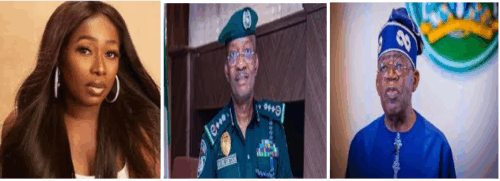
President Bola Ahmed Tinubu returned to Abuja from a working vacation in Europe in the last few hours, greeted by aides and cameras and the ritual of state pomp. Yet while the presidential plane touched down and protocol resumed, another, quieter scene of state violence played out inside the Inspector-General’s office — the story of a Nigerian journalist who was hunted, humiliated, and locked away for three days for publishing a court injunction. The two images — the pageantry of power and the private cruelty of coercive policing — cannot be separated. The latter is the ledger by which the world judges the former
Azuka Ogujiuba, founder of Media Room Hub, is not accused of inventing stories or peddling falsehoods. According to her account, she published a court judgement — a public document — on her Instagram page, as nearly twenty other media houses did. Yet she was summoned to the IGP’s office on August 6, questioned by officers Moses Jolugbo and Ifeoma Ogoli, then ambushed days later in a manner that witnesses described as indistinguishable from a kidnapping. She says they pointed guns at her, seized her phone, dragged her from a professional setting, and ultimately locked her in a cell inside the IGP office for three days without food, legal access, or family contact. This is not administrative roughness; it is state-enabled humiliation.
If this can happen inside the IGP’s office, under the watch of the nation’s top police command, it reveals a rot far deeper than a single act of misconduct. Kayode Egbetokun is the Inspector-General of Police appointed to restore discipline, professionalism, and public trust in a force long scarred by militarized culture and impunity. Yet Ogujiuba’s account suggests either catastrophic failure of oversight or willful tolerance of private vendettas dressed up as policing. Leadership cannot plead ignorance when the abuse happens in the leader’s own rooms. The optics — and the moral responsibility — are incontestable.
This case is not an isolated “bad apple.” It sits in a pattern: reporters threatened for doing their job, citizens intimidated for speaking truth to power, court transparency punished when it embarrasses the well-connected. When the state begins to treat its own courts and its own journalists as the enemy, the fragile architecture of democracy frays. A court order is not a crime; publication of a court order is not a provocation. Yet the response here was force, secrecy, and deprivation. The message to every newsroom is crystalline: publish at your peril.
Consider the human cost. Beyond bruises and stolen phones is the slow violence of fear. Ogujiuba describes sleepless nights, an enduring trauma that will shape her relationship with the state and with her profession. This is how institutional cruelty reproduces itself: one violated journalist becomes a dozen self-censoring ones; one terrified community becomes a reluctant citizenry. Trauma accumulates in bodies and institutions alike — a national psychic injury that undermines trust, discourages civic engagement, and normalizes silence. The economy loses more than headlines when people fear the penalty for speaking: it loses confidence, investment, and the civic capital essential to any stable polity.
To the president who has just crossed borders and returned under the applause of representatives and political ministers: your international diplomacy sells a version of Nigeria meant for investors and summit halls. That version is incomplete. The world watches not only the podiums but the prisons, not only the handshakes but the phone calls that follow an inconvenient headline. A nation that arrests a publisher for circulating a court ruling will never be fully trusted on rule of law, human rights, or press freedom. The global worry about “today’s Nigeria” is not a foreign preoccupation: it is a consequence of actions taken, or tolerated, at home.
There are institutional answers, and moral ones. The IGP must open a transparent, independent inquiry that is not managed by the same chain of command that birthed the complaint. The officers credibly implicated — if investigations corroborate the Journalists’ account — should face unambiguous accountability: suspension, prosecution where warranted, and public reporting of findings. The Presidency must make clear — in act not only in words — that the press is not an enemy. A genuine, public apology to Azuka Ogujiuba, followed by concrete reforms to ensure police respect for court processes and the rights of journalists, would be a start. Anything less will be read as complicity.
But the answers are not only bureaucratic. They are ethical. They require the President to model a different relationship between power and truth: to defend the press when it is unpopular to do so; to demand that instruments of the state safeguard, not terrorize, the citizenry; to refuse the politics of private injury served through public force. Leadership is not merely the wearing of rank or traveling to foreign capitals — it is the steadying of institutions at home so they do not become instruments of personal vengeance. The world judges nations by how they treat their weakest claimants to justice — and by how they protect those who hold power to account.
We must also name the wider cultural disease: impunity is addictive. When a few officers are allowed to weaponize police procedure for private gripes, they teach other officers that the uniform is a license. When the judiciary’s public records become matters of intimidation rather than civic knowledge, our legal culture retreats from transparency into shadow. When journalists are punished for publishing what courts publish, the very mechanisms that make democracy possible — public record, scrutiny, and accountability — wither. This is the slow, painful death that bureaucracy and complacency can deliver to a republic.
Finally, to Azuka Ogujiuba and every journalist who keeps showing up despite the threats: your courage is a public good. The wounds you bear are not private; they are a national debt owed to truth. To the citizens watching this unfold: do not let the spectacle of state travel distract you from the work of demanding justice at home. The fanfare that welcomes a returning president rings hollow if it drowns out the cries from cells within the IGP’s compound. Democracy is not only ceremony; it is protection for the smallest speech.
If there is to be any redemption from this shame, let it begin now — with a transparent investigation, with real accountability, with presidential courage to condemn state violence even when it is unpleasant to your allies. Let this return from Europe mark not just another itinerary item but a turning point: an insistence that Nigerian institutions will no longer tolerate the privatization of public force. If not, the welcome home will have been for an image only — while the country the world worries about grows steadily darker.
And Mr. President, let’s not pretend: the Nigeria Police is institutionally dead. One overstretched, confused, stressed, and pretending system cannot secure 220 million people. Everyone knows politicians keep it this way — to weaponize the force during elections, to intimidate opponents, and to protect their own seats. So, are you waiting until after the next polls to give the go-ahead for state policing? Or are you simply afraid of loosening your grip? Either way, the truth is simple: Nigeria must start state policing — no matter the worry, no matter the fear.
I also hope you invite the abused journalist, Azuka Ogujiuba, to hear directly from her. Of course, they will twist the story before it gets to you — but remember, Mr. President, it is your presidency they are soiling and twisting when such abuses are carried out in your name.