
Africa
Rejected By The PDP, Unwanted By The APC: Where Does Wike Really Stand? -By Isaac Asabor
In the end, Wike’s predicament is a cautionary tale: political rascality and recklessness do not pay. They only delay the moment when a man with immense power discovers that he has finally stood himself alone.

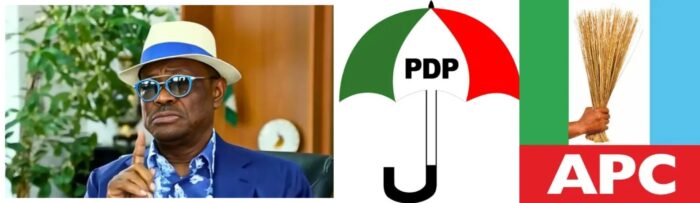
Nyesom Wike’s political dilemma is no longer a matter of interpretation, factional spin, or partisan propaganda. It has become an established fact, stated plainly by the two parties that dominate Nigeria’s political landscape. The Peoples Democratic Party (PDP) says he has been expelled. The All Progressives Congress (APC) says he is not a member and has no business interfering in its affairs. When both sides speak with this level of clarity, ambiguity collapses. What remains is a stark and unsettling question: where exactly does Wike stand? The honest answer is that he stands outside the institutional boundaries of party politics altogether.
From the PDP, the verdict has been delivered without equivocation. Emmanuel Ogidi, the party’s South-South Chairman, reaffirmed that Wike’s expulsion, along with that of other prominent figures, remains valid and enforceable. This decision was not taken by a ward executive or a disgruntled faction operating in isolation. It was ratified at the PDP’s national convention in Ibadan, the party’s highest authority. Certificates of expulsion were reportedly issued. In the internal logic of party politics, that is as conclusive as it gets.
Wike’s public insistence that he remains a PDP member is therefore beside the point. Political parties are not sustained by personal declarations or media performances. They are institutions governed by rules, processes, and collective decisions. Once a national convention expels a member for anti-party activities, that member’s claim to continued belonging loses all institutional meaning. What remains is noise, loud, persistent, but hollow.
Even more damaging is Wike’s posture toward the PDP since that expulsion. He has not behaved like a reformer fighting from within or a loyalist nursing grievances. He has acted like a conqueror who believes the party exists to be subdued. He ridicules its leadership, bankrolls rival factions, deepens its internal crises, and speaks of it with open contempt. Yet he still wants to dictate outcomes, intimidate actors, and shape its future. That is not engagement. It is political occupation without consent.
As it is, going by trending news across Nigeria’s media space, the PDP has shown Wike the exit, while the APC has firmly locked the door against him. And in this case, there is no denying the fact that the rejection of his membership in either of the political parties has been unusually blunt. Bala Ibrahim, the APC’s National Director of Information, made it clear that Wike is not a member of the party and has no right to meddle in its internal affairs. He did not suggest ambiguity. He did not leave room for interpretation. He stated it as fact.
More telling was the tone. Wike was described as a busybody, someone interfering in matters that do not concern him. He was warned that his “wings will be cut” if he continues on that path. Parties do not issue such warnings to insiders. They reserve them for outsiders who mistake access for authority and proximity for legitimacy.
This clarification exposes one of the most misleading assumptions in Nigerian politics: that holding office in a ruling government automatically confers party membership. It does not. Ministers are political appointees, but parties are voluntary associations with defined rules. Supporting a president is not the same as belonging to the party that produced that president. As the APC itself has emphasized, Wike works with President Bola Tinubu, not with the APC as an institution.
Until Wike formally aligns himself with the APC, and is accepted through its recognized structures, he remains what the party says he is: an outsider with no standing.
Taken together, the implications are unavoidable. The PDP has expelled him. The APC has rejected him. That alone confirms the central argument: Wike belongs to neither party. But the situation goes even further.
Wike now occupies a political space so unstable that even the smallest political formations would hesitate to associate with him. Nigeria is awash with micro-parties, caucuses, pressure groups, and political “movements,” many of them no larger than a house fellowship. Yet even these fellowship-sized platforms typically demand one basic thing from their members: clarity of allegiance and respect for collective rules. Wike offers neither.
He does not join; he hovers. He does not submit; he dominates. He does not negotiate; he intimidates. He enters political spaces not to build institutions but to bend them around his personality. Even the most informal political associations would struggle to accommodate someone who insists on control without commitment and influence without accountability.
His defenders argue that Nigerian politics is transactional, not ideological, and that his ability to operate across divides is evidence of tactical brilliance. That argument is seductive but ultimately destructive. Even transactional systems need boundaries. Even power politics requires rules. When influence is completely detached from membership, discipline, and accountability, politics ceases to be institutional and becomes predatory.
As a minister, Wike is expected to be part of a collective governing project driven by the APC’s electoral mandate. Ministers are not freelancers. They are political actors entrusted with implementing a party’s vision. When a minister publicly distances himself from that party, mocks its internal processes, and still seeks to exercise authority within it, the very idea of collective governance is undermined.
At the same time, Wike’s continued interference in PDP affairs, despite formal expulsion, weakens opposition politics. He wants the PDP diminished but obedient, fragmented but fearful. He seeks to influence it without belonging to it and dominate it without being accountable to it. That is not strategy. It is sabotage.
The deeper and more uncomfortable question is representation. Who does Wike actually represent today? It is no longer clearly Rivers State, where his electoral mandate has expired and his authority is bitterly contested. It is not the PDP, which has formally expelled him. It is not the APC, which has publicly disowned him. What remains is Wike himself, his ambitions, his grudges, and a personal network sustained by fear, patronage, and proximity to presidential power.
That is not a political constituency. It is a personal empire. And personal empires, history shows, are inherently unstable.
Political omnipresence is not permanence. Being loud is not the same as belonging. Being feared is not the same as being legitimate. When institutions eventually reassert themselves, and they always do, those who float above party structures often discover that they have nowhere solid to land.
This is where the final lesson lies. Nigerian politics may tolerate excess, but it does not reward recklessness forever. Political rascality may deliver short-term leverage, but it corrodes long-term relevance. Recklessness may intimidate opponents, but it alienates institutions. And in a party-based system, however imperfect, power without belonging is a dead end.
The PDP has said no. The APC has said no. Even the smallest political fellowship would hesitate to say yes.
In the end, Wike’s predicament is a cautionary tale: political rascality and recklessness do not pay. They only delay the moment when a man with immense power discovers that he has finally stood himself alone.


















You must be logged in to post a comment Login