Forgotten Dairies
Reshaping Governor Soludo’s Perception of Abatete from Cultism and Gangsterism to Innovation and Human Capital Development -By Chisom Juanita Mefor
Today, I choose to believe that the next generation of Abatete will be remembered not for the violence they inherited, but for the institutions they rebuilt, the opportunities they created, and the excellence they pursued. Let our young people become known for innovation instead of intimidation, for enterprise instead of extortion. If Ogidi gave the world Chinua Achebe, there is no reason Abatete cannot become known for raising a generation of builders, thinkers, innovators, entrepreneurs, public servants, and leaders whose lives honour the legacy of those who came before them and inspire those yet to come.

Some monuments are built to remember the dead. Others are built to remind the living who they ought to become. That was the enduring message I took away from Governor Charles Soludo’s unveiling of Chinua Achebe’s statue at Ugwunwasike Roundabout in Ogidi. It was a fitting tribute to one of Africa’s greatest literary minds, a man whose life proved that a small town in Anambra could raise a son whose words would shape conversations across continents and generations. Long after Achebe’s passing, the people of Ogidi chose to immortalise not merely the man, but the values he came to represent: excellence, courage, intellect, and an unwavering commitment to telling our stories.
Yet, in the shadow of that monument, another story was told.
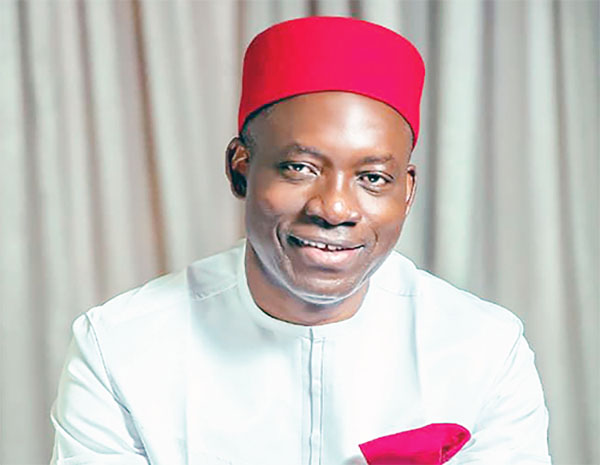
As Governor Soludo reflected on the state of security in Anambra, he challenged the younger generation to reject cultism and criminality. In the course of his remarks, he mentioned that some of the communities most associated with the problem are in Idemili North: Abatete, Nkpor, Umuoji, Ogidi, and Obosi. As someone from Abatete, hearing my hometown mentioned in that context was quite sobering. It was this part of the Governor’s speech that lingered with me long after the applause had faded.
But it is the statue of Okoli Otie at the Eke Agu Roundabout in Abatete that I cannot stop thinking about.
According to Abatete’s oral tradition and historical accounts, Okoli Otie had three sons. His first son, Ezeogu, inherited his father’s obi and the surrounding settlements that became what we know as Abatete today. His second son, Oji (whom some historical accounts refer to as Ora), became the progenitor of Umuoji. His third son, Ideke (also referred to in some accounts as Dimudeke), became the ancestor of Nkpor.
I found the contrast impossible to ignore. One statue had just been unveiled to honour Chinua Achebe, a son whose life became synonymous with excellence. Yet, in the same speech, the three communities that descended from the same ancestral father, Okoli Otie, were mentioned in connection with cultism and criminality.
Where exactly did we get it wrong? How did our family tree become a crime statistic? How did the collective Abatete-Umuoji-Nkpor inheritance, built on Omanne, on brotherhood, kinship, and shared ancestry, slowly become a burden of stigma? If our ancestral father, Okoli Otie, were standing beneath his own statue today, would this be the legacy he hoped his sons would leave behind?
Governor Soludo did not make that statement in isolation. Governors do not casually associate specific communities with cultism and criminality before the public. Such remarks suggest these communities feature prominently in the state’s security conversations, whether through crime trends, law enforcement intelligence, or other information available to government, a concern serious enough that it had to be spoken aloud. Rather than dismissing his words as an overgeneralization or responding with outrage, I believe we owe ourselves a more difficult conversation. What has happened within our communities that made such a statement possible in the first place?
It is difficult to reconcile the philosophy of Omanne with the reality of cultism. One teaches us that we are bound together by blood. The other teaches our young people to pledge themselves to allegiances that often turn brother against brother. The tragedy is that our ancestors designed institutions like Omanne to help brothers remember one another. Yet somehow, somewhere along the way, we built new ones that taught brothers to forget one another and, in some cases, to turn on one another.
The hope is that legacies are not fixed. Every generation has the opportunity to redefine what its community is known for. A community should never be imprisoned by the worst thing it is known for. Just as reputations are built over generations, they can also be reshaped by generations willing to choose a different path.
That is the opportunity before Abatete, Umuoji, Nkpor, and indeed every community whose story deserves a better ending.
But hope is not a strategy, we owe it to ourselves, and to our father, Okoli Otie, to say plainly what redefining that legacy would actually require.
The first thing we must do is simple to say but difficult to sustain: we must name it and shame it. Consistently. Not occasionally. And by “it,” we mean more than cultism alone: the violence that shelters beside it, the gangsterism we sometimes romanticize, and the idleness that quietly feeds them both. Cultism cannot be a conversation we reserve for funerals, or for the day another young man’s name becomes a headline we never wanted to read. It should be a standing item at every August Meeting, every youth gathering, every women’s meeting, every Town Union sitting, and every meeting of our traditional institutions until our silence is no longer mistaken for our acceptance.
The second is that we must begin to know our own again. There was a time when communities knew their children. They knew who was in school, who was learning a trade, who lived with a distant relative who had just gained admission, who had started a business, and who simply needed someone to believe in them. A simple community human capital census would help us identify our strengths, our gaps, and where opportunities should be directed. We can use this avenue to reach the young people who are unemployed, those who need scholarships, or those quietly building businesses with little or no support. We cannot build the future of young people we do not know.
The third is that opportunity must be brought home, not simply announced from a distance. We do not need to reinvent the wheel. The opportunities already exist; our responsibility is to make sure Abatete benefits from them to the fullest. Programmes such as the Anambra State’s One Youth, Two Skills, 1 Million Anambra Digital Tribe, and the Anambra Startup Incubation Programme are genuine pathways to employment and enterprise. But an opportunity announced at the state level does not automatically become an opportunity lived at the ward level. Our community leaders must be intentional about bringing these programmes home through local partnerships, community training centres, and structured pathways that connect learning to livelihoods. A young person who acquires a skill but cannot access tools, customers, mentorship, or startup capital has not been given a real alternative. At best, they have been handed a certificate. At worst, they return to the same circumstances they left behind.
The fourth is the hardest, because it asks us to be honest rather than merely righteous. We condemn cultism, and rightly so, but we rarely ask what it is actually offering the young men who join it: protection, money, status, identity, a place to belong. In many ways, cultism is a brotherhood built on fear rather than kinship, on allegiance rather than ancestry, a counterfeit of the very thing Omanne was designed to be. We will not defeat a counterfeit by condemning it alone. We must build something more compelling than it offers: brotherhood without violence, a culture that celebrates excellence rather than fear, and real pathways to opportunity and identity.
The fifth is the hardest question of all, one we rarely ask: what happens to the ones already inside? Every institution needs an exit strategy, and ours has none. If a young man wants out, who receives him? Who protects him from retaliation? Who helps him find work? Who mentors him back into the community he left? Redemption must be institutional, not accidental, or we will keep losing men we could have brought home. None of this is a programme a governor can hand down to us. It begins in the compound, in the family meeting, in the conversation we choose to have honestly rather than the one that is easier to avoid.
Last year December 28 2025, Governor Soludo returned to Abatete to commission a two-kilometre road built by one of our illustrious sons, Dr. Victor Iloegbunam, delivered through the Public-Private-Community Partnership model the state has championed for community-driven development. That, too, is Abatete. Our town has produced men and women whose lives have been defined by enterprise, scholarship, public service, philanthropy, and an unwavering commitment to the common good.
That is the Abatete I know.
Yes, we must confront cultism with honesty. We must name it, challenge it, and outgrow it. But we must never allow it to become the single story of our people.
Today, I choose to believe that the next generation of Abatete will be remembered not for the violence they inherited, but for the institutions they rebuilt, the opportunities they created, and the excellence they pursued. Let our young people become known for innovation instead of intimidation, for enterprise instead of extortion. If Ogidi gave the world Chinua Achebe, there is no reason Abatete cannot become known for raising a generation of builders, thinkers, innovators, entrepreneurs, public servants, and leaders whose lives honour the legacy of those who came before them and inspire those yet to come.
The work begins with us.
Long live Abatete. Long live Anambra State. Long live the Federal Republic of Nigeria!