
Global Issues
Russia-Guinea-Bissau Raising Strategic Partnership -By Kestér Kenn Klomegâh
Some local Russian media pulled discussions and analysis, tied up with the attempts to support Guinea-Bissau leader Umaro Sissoco Embalo to win the elections, (i) first to sustain large-scale partnership in security issues in West Africa, and second for continuity of Russia-Guinea Bissauan relationship, and (ii) second to capital on political stability in exploring of natural resources, construction of infrastructure facilities, as well as development of agriculture and fisheries.

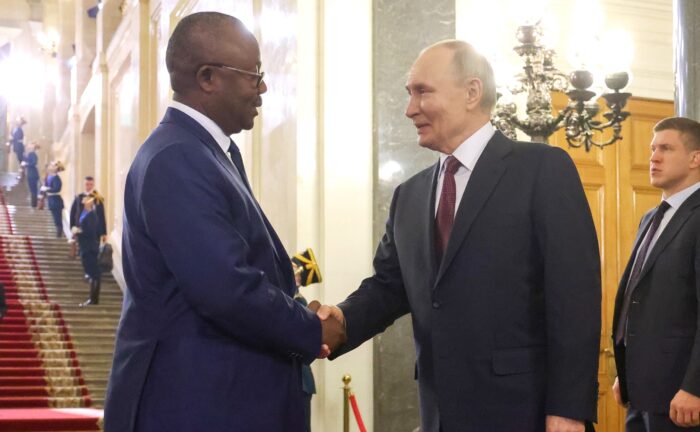
With high anticipation for increased partnership between Russia and Guinea-Bissau that has never been stronger since Soviet’s collapse. But the the anticipated change, to be facilitated by implementing bilateral agreements provides a brimming hope and possibility. Russian President Vladimir Putin definitively re-asserted and underscored a comprehensive bilateral collaboration, in a speech, at highly-guarded Kremlin meeting held on February 26, with President of the Republic of Guinea-Bissau, Umaro Sissoco Embalo, who was in Russia on an official state working visit, and that was the fourth time to Moscow.
On 9th May 2024, Guinea Bissau leader Embalo was one of the special guests to the May Day celebrations at the Red Square and later as part of the team to discuss peace initiatives with the Kremlin. That May Day celebrations, Putin stressed that “Africa is now building up capacity and aspires to emerging as an effective powerhouse in a multipolar world with its unique identity by making confident strides in nurturing a genuine sense of political and economic sovereignty.”
During the first Quarter 2025, Central African Republic (CAR), Faustin-Archange Touadéra, in mid-January, which analysts, however, speculated that permanent Russian military base was planned for CAR. An agreement on military-technical cooperation with the Russian Federation includes supply of specified military weapons and equipment, training of personnel in Russia’s military institutions as well as building military base in the country in exchange of having complete access to natural resources. There are estimated 2,500 Russian instructors working there, according to local Russian media reports. That Central African Republic (CAR), Faustin-Archange Touadéra was followed by Guinea-Bissau leader Umaro Sissoco Embalo.
Within a few minutes of arrival at the guest reception hall, an artfully security guards escorted, reminiscent of Soviet times, the consultations began with a restricted format meeting between the two leaders, with Deputy Prime Minister Alexander Novak, Presidential Aide Yury Ushakov and Deputy Foreign Minister Alexander Pankin attending the meeting on the Russian side.
Putin, reminded first that Russian-Guinea-Bissauan diplomatic relations has marked more than 50 years of its establishment, and further underscored significant successes and achievements during the past few years, concretely after the first Russia-Africa Summit in 2019. Putin emphasised that last year, trade between Russia and Africa continued to grow, increasing by 10 percent. However, trade and economic ties between two countries undoubtedly require careful attention from both sides, so that these ties could gain additional momentum.
Russia and Guinea-Bissau have previously signed various agreements to bolster trade, economic cooperation and military-technical sphere, and beyond that created working groups on developing and subsequent implementation of programmes and projects particularly in Guinea-Bissau. “There is strong potential and promising opportunities in these areas, as many Russian companies are showing increasing interest in working in the Guinea-Bissauan market,” according to Putin.
Reports indicate that over 70 percent of Guinea-Bissau’s servicemen and civilian officials were trained in the Soviet Union. This explains the necessity for the level of close interaction and cooperation with Russia. Educational and cultural ties are expanding. Putin primarily referred to the growing interest among young people in getting an education in Russia. This applies to military education and training as much as civilian programmes. Traditionally, the military of Guinea-Bissau get their degrees from Russian military academies. Moreover, Russia has increased the quota for Guinea-Bissauan friends for the current year, 2025/26.
President of the Republic of Guinea-Bissau, Umaro Sissoco Embalo, began negotiation talks with the Russians, and of course, that was the realpolitik logic to review relations, by expressing high gratitude for contributions to the establishment of their nationhood made back in the Soviet Union era, and since gaining political independence, during post-Soviet times when Russia has continued to make significant admirable contributions to the current economic development. This pointed to the unerasable fact that the Guinea-Bissauan and Russian peoples are reliable partners and endearingly ready to promote the bilateral ties of friendship and to strengthen further economic cooperation.
Meanwhile, the most cogent truth about the previous official visits undertaken by Umaro Sissoco Embalo, included the first (2019) and second (2023) Russia-Africa Summits, respectively in southern city of Sochi and cultural capital, St. Petersburg. Umaro Sissoco Embalo showed extra-caution in imploring potential Russian investors, with tectonic interest not only Guinea-Bissau but also generally with African countries, to ‘walk the talk’ referring to several agreements that have not been implemented over the years. From the first Russia-Africa Summit, a total of 92 agreements were signed with African countries, and that was followed by tonnes agreements during St. Petersburg’s summit in July 2023.
In the context of changing geopolitical balance, at least, it is important to understand the real situation on the ground. Russia has to focus concretely, back away from mere rhetorics, on partnership based on local African realities, take into practical account Africa’s sustainable development goals and to prioritise African Union’s Agenda 2063. It is important that the declarations just remain on paper, but lead to real actions and projects, with visible results.
Back in October 2022, Umaro Sissoco Embalo, as President of Guinea-Bissau and Chairman of the Economic Community of West African States (ECOWAS), during that Kremlin meeting, Putin emphasized Russia’s contribution in promoting security not only in Guinea-Bissau but also throughout West Africa. With population approximately 1.8 million people, Guinea-Bissau faces challenges of ensuring security and more than two-thirds lives below the poverty line. Guinea-Bissau, like many African states, has had political problems. Embalo has held the presidential post in Guinea-Bissau since January 2020, and will soon hold the next elections. Putin unreservedly promised Russia’s assistance and strongly urged the Guinea-Bissauans, during the forthcoming elections, to support Umaru Sissoco Embalo and to continue the admirable work started as President. Acknowledged the good relations that have developed between Russia and Guinea-Bissau, in these recent years, largely associated with name of Umaru Sissoco Embalo.
Some local Russian media pulled discussions and analysis, tied up with the attempts to support Guinea-Bissau leader Umaro Sissoco Embalo to win the elections, (i) first to sustain large-scale partnership in security issues in West Africa, and second for continuity of Russia-Guinea Bissauan relationship, and (ii) second to capital on political stability in exploring of natural resources, construction of infrastructure facilities, as well as development of agriculture and fisheries.
Notwithstanding Russia’s several promises and pledges, African countries are bound to wake up to a common understanding of the true meaning of their colonial past for the present, and determine their own future existence. And in fact, the leaders and the elites have to engage in development decision-making processes, and at the same time have to play their roles as autonomous actors instead of being pawns in context of global geopolitics.
Sharing borders with Guinea (to southeast), Gambia and Senegal (to the north), Guinea-Bissau attained its independence in September 1973. Guinea-Bissau follows a non-aligned foreign policy and seeks friendly and cooperative relations with a wide variety of states and organizations. Besides, Eсonomic Community of West African States (ECOWAS), Guinea-Bissau is a member of the African Union (AU) and the United Nations.


























You must be logged in to post a comment Login