
Africa
Seeing Defection In Nigerian Politics As A Dance Of Greed, Not Ideology -By Isaac Asabor
We must break this cycle, because a democracy where politicians jump ship at will is not a democracy. It’s a bazaar. And in a bazaar, the highest bidder wins, not the most principled leader. That is the tragedy of Nigeria’s political evolution.

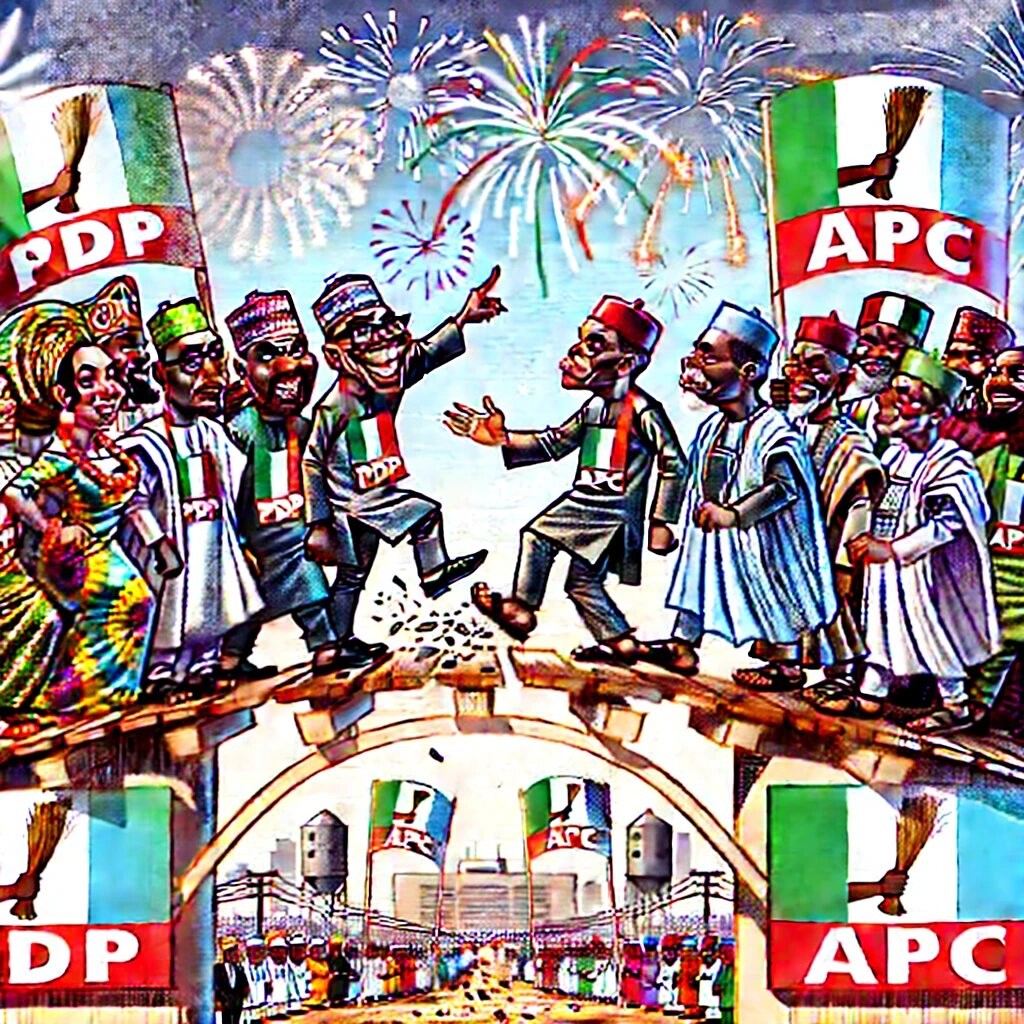
In saner political climes, party defection is typically a rare event, one driven by a clash of ideas, conscience, or a principled stance on governance. Politicians in developed democracies often cross the aisle because they disagree with their party’s policy direction or seek a better platform to serve their constituents based on deeply held ideological beliefs. But in Nigeria, defection has become a career strategy, an open market for the highest bidder, and a shameful display of selfish ambition. The principles of party loyalty, ideological commitment, or even the dignity of public service have been thrown out the window. Instead, what we see is a political class whose only guiding star is personal gain.
The recent defections of top Delta State politicians, including former governor Ifeanyi Okowa and current governor Sheriff Oborevwori from the Peoples Democratic Party (PDP) to the All Progressives Congress (APC), are glaring examples of this opportunistic culture. Their movement to a party they once demonized is not rooted in any philosophical or ideological reawakening; it is a clear-cut survival move in anticipation of federal patronage. Okowa was Atiku Abubakar’s running mate in the last presidential election and vociferously opposed the APC. Today, he is dining with the same political forces he warned Nigerians about. What changed? Nothing but the coordinates of power.
Let us not sugarcoat it, defection in Nigeria is about power, access to state resources, and political protection. These defections are not random acts. They are well-calculated maneuvers timed around elections, tribunal judgments, or impending probes. It is not about the people; it is about the politician. Okowa’s defection, for instance, comes just as the PDP continues to reel from internal crises and waning relevance at the national level. Joining the ruling party is an insurance policy, not a new beginning in governance philosophy.
Even more ironic is the case of Governor Oborevwori, Okowa’s political godson, who rode to power on the back of PDP structures. Now, under Okowa’s influence, he too has jumped ship. How does one explain that the same political structure that delivered electoral victory under the PDP is now suddenly unsuitable for governance? This is not about governance. It is about staying on the good side of Abuja.
Let us go back a bit in history. The 2014 gale of defections remains one of the most defining moments in Nigeria’s political journey. It started with five PDP governors, Aliyu Wamakko (Sokoto), Rabiu Kwankwaso (Kano), Murtala Nyako (Adamawa), Rotimi Amaechi (Rivers), and Abdulfatah Ahmed (Kwara), jumping ship to the then opposition APC. They claimed PDP had derailed and become undemocratic. Many Nigerians believed them at the time, thinking they were indeed men of conscience. But what followed was a familiar pattern, appointments, contracts, and political protection. Those who moved to APC became instant beneficiaries of federal power and resources. When the tide turned against the APC in their states, many returned to PDP or moved elsewhere.
In another classic episode, the then Senate President, Bukola Saraki, defected back to PDP in 2018 after falling out with President Buhari. He cited democratic suppression and lack of internal democracy. But many Nigerians saw through it. Saraki’s moves were less about democracy and more about shielding himself from the political witch hunt that had begun following his emergence as Senate President against the wishes of the APC leadership.
Yahaya Bello, the immediate former governor of Kogi State, though not a defector himself, has also benefited from a culture of sycophancy where loyalty is not to ideology but to whoever holds the power baton. Politicians like Femi Fani-Kayode and Musiliu Obanikoro, who were once virulent critics of the APC, are now proud card-carrying members, praising the same administration they labeled dictatorial. What changed? Certainly not ideology.
The truth is that Nigeria’s political class has no ideology. In fact, political parties in Nigeria are often indistinguishable in terms of manifestos, policy thrusts, or national vision. What we have are political associations built around personalities and power blocs, not ideals. So, defection is not a shock; it is a continuation of the same agenda under a different party name.
Compare this to the political behavior in the United Kingdom or the United States. When British MPs like Anna Soubry and Chuka Umunna left the Conservative and Labour parties respectively to form the Independent Group (later Change UK), it was due to irreconcilable policy disagreements over Brexit. In the United States, Bernie Sanders is known for his progressive ideology, running as an independent while aligning with Democrats for strategic reasons, yet remaining firmly rooted in his social democratic values. Defection, in such cases, is principled, even if controversial.
In Nigeria, however, ideology is alien. There is no left or right, no conservative or progressive. Everyone is a capitalist at heart and a socialist in campaign rhetoric. When they need the people’s votes, they promise heaven and earth. Once in power, the electorate becomes an afterthought. The party system has become a vessel for personal ambition, not public service.
This cancer of opportunistic defection weakens democracy. First, it erodes party discipline and makes nonsense of the ballot. When people vote for a candidate under one party, only to see him defect weeks or months later, it feels like betrayal. It destabilizes the political ecosystem and confuses the electorate. Secondly, it renders opposition parties ineffective. When key leaders of opposition parties defect, especially to the ruling party, it destroys the checks and balances needed in a democracy.
The courts have failed to help the situation. Instead of establishing a constitutional barrier against this shameless culture, the judiciary has often legitimized it. While the Supreme Court has, in isolated cases, ruled that votes belong to political parties and not individuals, the enforcement of such rulings remains weak and inconsistent. What we need is an electoral reform that makes defection consequential, perhaps a mandatory forfeiture of elective office when a politician crosses over mid-term, unless the party itself splits.
The onus is also on Nigerians. We must begin to interrogate our political leaders more critically. Defectors should be held accountable, not celebrated. Citizens must reject this political prostitution by voting against defectors, no matter the platform. The media must also play its role in shaping narratives. Instead of romanticizing defections as “political masterstrokes,” we should call them out for what they are, betrayals.
Ultimately, until Nigeria builds a system where parties are driven by ideas, where politicians are held accountable to ideological commitments, and where defection carries real political cost, the vicious cycle will continue. And every time a politician defects, it won’t be a movement for the people, but a march of personal ambition.
We must break this cycle, because a democracy where politicians jump ship at will is not a democracy. It’s a bazaar. And in a bazaar, the highest bidder wins, not the most principled leader. That is the tragedy of Nigeria’s political evolution.


























You must be logged in to post a comment Login