Africa
Senator Natasha Akpoti-Uduaghan: A Battle Against Misogyny and Gender Traitors -By Florence Ozor
At the very least, we demand a thorough investigation into the allegations. Surely, this is not too much to ask. Should Senator Akpabio not be eager to prove her wrong? A person with a reputation to protect would not shy away from accountability. One would expect urgency in clearing one’s name against such serious allegations, rather than prioritizing a breach of house rules over claims of sexual harassment against the third most powerful figure in a nation of over 200 million people.

The Allegation
A heated debate on misogyny has taken centre stage in Nigeria, tarnishing the reputation of the Senate led by Senate President Senator Godswill Akpabio, following allegations of sexual harassment by Senator Natasha Akpoti-Uduaghan (Kogi Central), alleging that her protest over seat reallocation was met with bias and discrimination after she rejected his advances. Her petition demanded an investigation into the matter.
The Senate President referred her seat protest to the Committee on Ethics, Privileges, and Public Petitions headed by Senator Neda Imasuen (Edo South). However, the committee prioritised the seat issue over the sexual harassment allegation, recommending her suspension. In a swift and controversial move, the Senate—comprising 109 senators, only four of whom are women—voted to suspend Akpoti-Uduaghan for six months, stripping her of all rights as a senator. The Senate’s response has sparked outrage and raised questions about gender equality and justice in Nigeria’s highest legislative chamber.

The Illegality of the Suspension
The suspension of Senator Akpoti-Uduaghan raises serious legal and constitutional questions. Nigerian law is clear: a senator can be removed only through a court order arising from an election petition, a recall process, resignation, the expiration of their tenure, or death.
Judicial precedents, such as the cases of Alli Ndume vs Senate (2017) and Ovie Omo-Agege vs Senate (2019), have established that Senate suspensions exceeding 14 days are unconstitutional and nullified by the courts. In both cases, the courts ordered reinstatement and the payment of their outstanding salaries and allowances.
The Senate’s conceited decision to suspend Akpoti-Uduaghan for six months is unlawful. It has acted ultra vires (beyond its legal authority), disregarded judicial precedence and court order, violated her rights, and set a dangerous precedent that undermines the rule of law. The Senate’s actions are a reminder of the systemic issues that plague Nigeria’s political institutions. Power is often wielded without accountability, and men act stronger than institutions. This situation is not sustainable.

The Battle Against Misogyny: The Systemic Nature of Male Impunity
One of the most glaring truths of this saga is how men, regardless of their station in life, often escape accountability for their actions. Senator Akpabio’s alleged misconduct and the Senate’s decision to suspend Akpoti-Uduaghan instead of investigating her claims are emblematic of a broader, more pervasive pattern: men who abuse their power—or their privilege—rarely face consequences, while women who dare to speak out are punished, silenced, or discredited.
In the wake of her allegations, smear campaigns have emerged, aiming to shame her and doubt her credibility. One particular rumour claims she has six children fathered by six different men. Even if she had sixty children fathered by sixty-one men, it would not matter. Her private life is irrelevant to the allegations, which must be investigated transparently and publicly. Women must choose to be unashamed; this is our first defence against misogyny.
This case is a stark reminder of the battle against misogyny, where men who enjoy immunity from bad behaviour—legitimised by patriarchy—are quick to be morality police against women who dare to speak out. This double standard is not just a reflection of individual biases; it is an institutionalised issue. Akpoti-Uduaghan’s case is a microcosm of a much larger problem. Our society has shielded badly-behaved men and normalised sexual harassment, their actions rationalised as “boys being boys” or “just a joke.” Meanwhile, women who challenge this status quo are labelled as difficult, emotional, or worse. Where does it end?
Misogyny is deeply rooted in our society. Until we implement systemic changes, men will continue to evade accountability while women suffer the consequences. This is a call to action for all of us to demand accountability—not just for the sake of Akpoti-Uduaghan, but to ensure that no one is above the law or beneath its protection.

The Battle Against Gender Traitors
The controversy has exposed not only the misogyny within the Senate and among the male population but also the troubling role of women who perpetuate patriarchal norms. Social media commentary is filled with women defending men and the highhandedness in this case. Four female senators, in particular, have come under scrutiny for their dismissive and damaging responses to Akpoti-Uduaghan’s allegations.
1: Senator Ireti Kingibe: As the Chairperson of Women Affairs, Kingibe’s response was deeply disappointing and unintelligent. In an interview, she repeatedly infantilised Akpoti-Uduaghan, referring to her as “her daughter” despite being her colleague of equal standing. Her infantilisation isn’t maternal; it’s patronising and shameful. Deference to older people is not a fiat for disrespect.
Her condescension and dismissal of Akpoti-Uduaghan’s valid concerns as a mere seat dispute reveal a glaring lack of sense and camaraderie. It was perplexing how she, who had benefitted from women’s voices of solidarity in her battles with men, one of whom is the Senate President, could so effortlessly undermine a fellow woman’s struggle, who stood by her in the house. Her silence, she claimed, was golden, but in reality, it was cowardly and a betrayal of the very women she was supposed to represent.

Senator Ireti Kingibe of Labour Party
2: Senator Biodun Olujimi: In a tone-deaf, victim-blaming interview, Olujimi’s statement that the Senate is a place for the “elderly, not the young,” reeks of elitism and gatekeeping essentially infantilising adults. It implies that age alone qualifies one to endure harassment.
Her claim that Senator Akpabio’s behaviour is harmless because “he jokes a lot” and is “fond of making little fun out of everything” is not just dismissive; but a dangerous narrative that trivializes the power dynamics at play. Worse still, her advice to Akpoti-Uduaghan to “take the case out of court” while cautioning women not to be “emotionally unstable” is a slap in the face to every woman who has ever been silenced or gaslit. Demanding accountability is not emotional instability; it is courage. True strength isn’t enduring abuse with a smile; it’s about dismantling the structures that allow it. Her interview felt like a reprimand for “allowing oneself” to be abused. Sad.

Senator Biodun Olujimi
3: Senator Florence Ita-Giwa’s comments in an interview were a disgraceful perpetuation of victim-blaming. She argued that being “strong enough to contest an election” somehow immunises women from sexual harassment—a deeply flawed, absurd, and insulting assertion. Data consistently shows that no amount of power, beauty, status, age, fame, wealth, modesty or even biological vulnerability has ever served as immunity from harassment for women. So, what exactly is she about?
Her suggestion that accusing a man of harassment is a “sign of weakness” is a deceitful narrative that silences victims and protects perpetrators, perpetuating the toxic idea that victims are to blame for their abuse. To imply that women in positions of power are somehow beyond harassment—that they are “not college girls” and should “not give room for it”—is to willfully ignore the pervasive nature of misogyny and the courage it takes to speak out against it. Harassment is not about weakness; it’s about power dynamics, and no level of strength or experience can erase the systemic abuse women endure. Her words are a mirror reflecting the entrenched misogyny we still face—my goodness, the road to progress is indeed long and arduous.

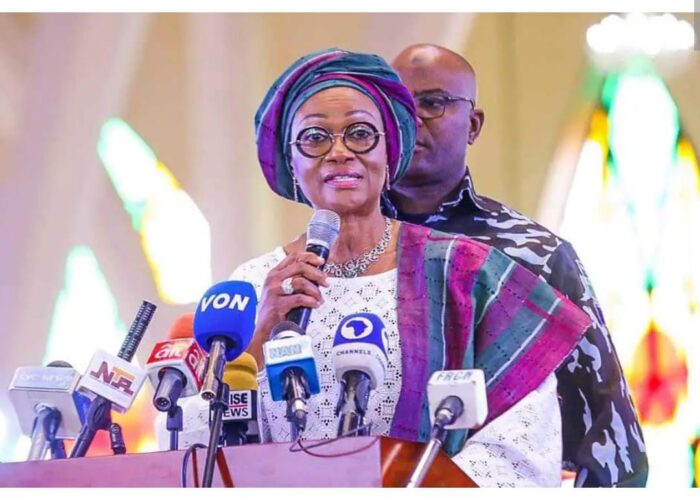
4: Senator Oluremi Tinubu (Nigeria’s First Lady): Tinubu’s remarks were particularly hypocritical. She asserted, “The Senate is doing what is needed,” calling it a “mature chamber” where such issues as sexual harassment shouldn’t arise. She advised women to “raise yourself high” and “shut down” inappropriate behaviour before it starts. This advice rings hollow, given her own experience in the Senate, where she faced blatant misogyny from Senator Dino Melaye in 2017.
I am genuinely curious to know how “high” Senator Tinubu held herself when Senator Melaye shamelessly threatened to impregnate her on the floor of the so-called “mature chamber.” Or how he got further to degrade her by mocking her age and menopausal status rather than “shutting it down before it started”. This incident starkly exposes the hypocrisy of her recent remarks. If an experienced senator like Tinubu couldn’t prevent such overt misogyny and disrespect in the Senate, how can she expect other women to simply “rise above” and avoid harassment? Her failure to address the systemic nature of harassment and her insistence on placing the burden on women to “shut it down” is a betrayal of the very women she claims to uplift.
True leadership requires acknowledging the problem and fighting for rounded change, not gaslighting victims with empty platitudes. Her comments are a reminder that even those who have faced harassment can become complicit in silencing others when it suits their narrative.
We Are All Victims Waiting to Happen
The phrase “We are all victims waiting to happen” cuts to the heart of this saga. It is a chilling reminder that misogyny is not an isolated issue—it is a systemic fire that spares no one. I first used this phrase during the peak of the #BringBackOurGirls movement, I listened to the chilling accounts of terror gripping the North-East, particularly Maiduguri. Back then, the government and much of the public treated the crisis as a distant tragedy, someone else’s problem. I remarked that we are all victims waiting to happen. Over time, abductions became commonplace beyond the north-east.
Women who side with patriarchy, undermining other women for personal gain or out of internalized misogyny—are victims-in-waiting, as the rest of us. The system they uphold has no loyalty to them, their complicity will not shield them from the very systems they enable no matter how fiercely they defend the status quo.
They silence, dismiss, or attack women who dare to speak out, thinking their alignment with patriarchal norms will grant them safety, respect, or power. But they are tragically mistaken. The misogyny they perpetuate does not discriminate. By siding with the oppressor, they may delay their victimhood, but they cannot escape it. They can never be one of the boys.

The only way to break free from this cycle is through solidarity. The choice is clear: stand together or fall one by one. Ultimately, misogyny is a fire that consumes everyone in its path— it spares no one unless we choose to fight it together. Be a Gender Champion, not a Gender Traitor.
Conclusion: Solidarity: A Call to Action
The saga of Senator Natasha Akpoti-Uduaghan presents a pivotal opportunity to shift how we perceive, prosecute, and protect against gender-based violence. For women and men of good conscience, the path forward lies in amplifying voices and consolidating efforts, not betrayal or silence.
At the very least, we demand a thorough investigation into the allegations. Surely, this is not too much to ask. Should Senator Akpabio not be eager to prove her wrong? A person with a reputation to protect would not shy away from accountability. One would expect urgency in clearing one’s name against such serious allegations, rather than prioritising a breach of house rules over claims of sexual harassment against the third-most-powerful figure in a nation of over 200 million people.
Accountability is not a threat—it is the cornerstone of justice and democracy.
@FlorenceOzor