National Issues
Tear Gas, Protests And The Politics Of Exaggeration -By Kelvin Adegbenga
The Nigeria Police Force, like all public institutions, is not above criticism and should always be held accountable where misconduct occurs. However, criticism must be grounded in facts, evidence, and fairness. When activism abandons those principles, it risks becoming propaganda rather than advocacy.

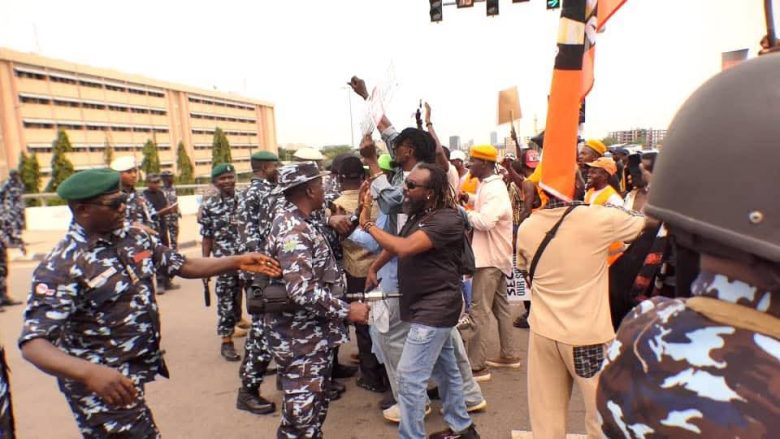
The statement issued by the Take-It-Back (TIB) Movement following the Democracy Day protest is a disappointing example of how political activism can sometimes descend into sensationalism rather than factual engagement.
Across the world, law enforcement agencies are tasked with the difficult responsibility of balancing citizens’ constitutional rights to peaceful assembly with the need to maintain public order and safety. One of the most commonly used crowd-control measures globally is tear gas. It remains a legal and widely recognized riot-control tool employed by domestic police and security agencies in numerous democratic countries.
For this reason, attempts to portray the Nigeria Police Force’s use of tear gas during the June 12 protest as evidence of brutality require careful scrutiny rather than emotional reactions. Public commentary should be based on verifiable facts and evidence, not assumptions.
Claims that activist and African Action Congress (AAC) presidential candidate, Omoyele Sowore, was specifically targeted are not supported by publicly available evidence. Videos circulating on social media show a group of protesters around him during the incident. The footage available to the public does not conclusively establish that he was singled out for treatment different from that experienced by other demonstrators present at the scene.
Equally noteworthy is the reaction from members of the public on social media platforms where the videos were shared. Many commenters questioned the narrative being promoted by Sowore’s supporters and suggested that the incident was being dramatized for political and media attention. While social media comments should never be treated as definitive evidence, they nevertheless demonstrate that public opinion is far from unanimous regarding the claims of police brutality.
Democracy Day is a significant occasion in Nigeria’s political history. It commemorates the restoration of democratic governance and honors the sacrifices made by countless Nigerians who fought for the right to freely choose their leaders. The day should inspire constructive civic engagement and reflection on democratic values.
Like every citizen, Sowore and his supporters have the constitutional right to express their views and participate in lawful political activities. However, political disagreement does not automatically transform every police intervention into an act of oppression. In a democracy, both the right to protest and the responsibility of security agencies to maintain public order must coexist.
It is also worth noting that Nigeria is already in another election cycle, and Sowore has once again emerged as a presidential candidate of the African Action Congress. As a politician seeking public office, he is entitled to campaign vigorously and present his vision to Nigerians. However, political contests are ultimately decided through persuasion, organization, and votes—not through the manufacture of controversy.
What is particularly troubling about the TIB Movement’s statement is its readiness to reach sweeping conclusions without presenting compelling evidence. Public discourse benefits when organizations verify facts before making serious accusations against institutions or individuals. Reckless allegations may generate headlines, but they do little to strengthen democratic accountability.
The Nigeria Police Force, like all public institutions, is not above criticism and should always be held accountable where misconduct occurs. However, criticism must be grounded in facts, evidence, and fairness. When activism abandons those principles, it risks becoming propaganda rather than advocacy.
Nigeria’s democracy is strengthened not by inflammatory rhetoric but by responsible citizenship, factual reporting, and respect for due process. Those values should guide all participants in the public space, whether they wear police uniforms, carry protest placards, or seek elective office.
Kelvin Adegbenga writes from Wuse 2, Abuja. Email: kelvinadegbenga@yahoo.com X: @kelvinadegbenga