
Africa
Tears for Democracy: The Betrayal of Mojisola Meranda and the Spirit of a Nation -By John Egbeazien Oshodi
Let it be known that Meranda did not cry out of fear. She did not cry because she lacked the strength to lead. She cried because she understands the cost of fighting for democracy in a country where democracy is constantly under attack.

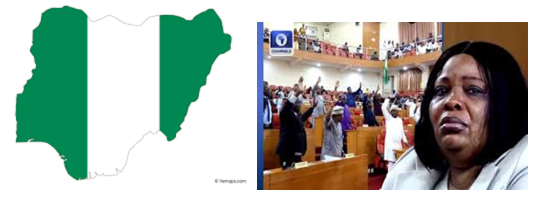
She did not cry for pity. She cried for democracy.
Mojisola Meranda, the first female Speaker of the Lagos State House of Assembly, did not ask for this battle. She did not seek war, nor did she provoke confrontation. She stepped into leadership only after the former Speaker, Mudashiru Obasa, was impeached, removed by lawmakers through a constitutional process. She stepped in to serve, to restore order, to ensure that democracy prevailed. But democracy, in Nigeria, is never given freely—it must always be fought for.
She sat in that chamber, her eyes filled with tears, not because she was weak, not because she was afraid, but because she had seen what happens when power-hungry men refuse to let go. She had seen the desperation of those who cannot accept change, those who still believe they can manipulate the system, those who would rather burn institutions to the ground than see them function without their control.
Obasa, who has since gone to court to challenge his removal, still looms in the background of this crisis. Many believe he is not just fighting in the courtroom—he is fighting in the shadows. His hands, they say, are apparently on the DSS invasion, working with external forces in a last, desperate attempt to reclaim what he lost. But in the end, they all failed.
They failed because democracy is stronger than their greed.
They failed because intimidation is no match for the will of the people.
They failed because no matter how many forces they deploy, democracy cannot be locked out.
DSS, You Got a Letter—For Security, Not Intrusion and Disruption
DSS, let’s be clear—you got a letter. Yes, a request was made. But it was for security, not interruption. For protection, not domination. Yet, once again, instead of upholding your duty, you became the very threat you were called to prevent.
You were invited to secure the Assembly. Instead, you locked its doors.
You were called to ensure stability. Instead, you brought chaos.
You were meant to protect Speaker Mojisola Meranda. Instead, she had to survive you.
The whole world saw it. The DSS did not stand by the rule of law. The people did.
In that moment of crisis, when the Speaker’s office was sealed, when lawmakers were denied access to their own chamber, when democracy itself was being strangled before our eyes, it was not DSS that defended her—it was the people.
Legislative staff pushed back. Policemen attached to the Assembly rejected the illegal siege. The will of democracy itself broke through the locked doors.
And in the end, Meranda survived it all.
Not because of you, DSS.
Not because of your weapons.
Not because of your presence.
She survived because the people refused to let democracy fall.
A Moment of Betrayal and Tears for Nigeria
On Monday, as DSS operatives stormed the Lagos Assembly, sealing the Speaker’s office, barricading lawmakers, shutting down access to the chamber, and violating every principle of institutional respect, democracy fought back. But even as victory came, the pain remained.
She sat in that chamber, trying to begin plenary, but her heart was heavy. The weight of injustice sat upon her shoulders. The betrayal of institutions meant to uphold the law was suffocating. The walls of the Assembly, built to protect democracy, had been defiled by reckless power plays. And as she looked around, she broke down in tears.
This was not just about her.
This was not just about Lagos.
This was about Nigeria.
Because if the Speaker of the Lagos Assembly, an elected leader, can be reduced to tears by the weight of political interference, what hope is there for the ordinary Nigerian?
If security forces can be used so openly, so brazenly, against democracy, what does that say about the state of governance in Nigeria?
The shame of what happened at the Lagos Assembly does not belong to Meranda. It belongs to those who orchestrated this madness.
It belongs to the dark forces who still believe Nigeria belongs to them.
It belongs to those who sit behind closed doors, pulling strings, using security agencies as their private army, thinking that they can rewrite history with force.
And yet, no matter how much they try, democracy will always fight back.
She Did Not Cry for Herself—She Cried for Democracy
Let it be known that Meranda did not cry out of fear. She did not cry because she lacked the strength to lead. She cried because she understands the cost of fighting for democracy in a country where democracy is constantly under attack.
She cried because she knows the weight of history is on her shoulders.
She cried because she understands the responsibility of leadership, the burden of standing firm even when the entire system seems determined to break you.
And despite her tears, she did not step down. She did not surrender. She stayed.
That is courage. That is resilience. That is leadership.
The Newspapers May Try, But Truth Cannot Be Buried
For those who still believe that compromised newspapers can rewrite the truth, for those media houses carefully crafting narratives to protect the dark forces behind this crisis—you are wasting your time.
Because the truth always comes out.
Because the world has already seen it.
Because this is the digital age, and history is recorded in real-time.
And because Nigeria must hear. Africa must hear. The world must hear.
She Chose to Step Back—But She Must Return
At the end of the session, Meranda made a painful decision: “We will be out indefinitely.”
That was not her.
That was not what she wanted.
That was not why she took on the responsibility of leadership.
She just wanted to serve. She just wanted to help. She just wanted to save democracy.
But democracy cannot afford to wait. The people cannot be left without leadership. The fight must continue.
A Call to Meranda: Democracy Must Go On
As a psychologist, I urge Speaker Mojisola Meranda to resume plenary soon—if not physically, then virtually. If they seek to shut the doors, then open new ones. If they block the halls, then take the Assembly to the people.
Let democracy breathe.
Let the voices of the people be heard.
Because this fight is bigger than one woman, bigger than one chamber, bigger than one crisis.
This is a fight for democracy itself.
And we will not forget.

John Egbeazien Oshodi
Oshodi Open Door, also known as Oshodi Open Door Public Training (OOPDT, pronounced opidt), is a public awareness initiative promoting transparency, accountability, and integrity in Africa through educational articles and resources at jos5930458@aol.com, and offers specialized Timely Response Solutions (TRS) training at minimal or no cost.
John Egbeazien Oshodi is an American psychologist, educator, and author. Born in Uromi, Edo State, Nigeria, he is the son of a 37-year veteran of the Nigeria Police Force. Professor Oshodi is an expert in cross-cultural psychology, forensic/clinical psychology, police and prison science, and social justice.
He has made significant contributions to forensic psychology, introducing it to Nigeria in 2011 through the National Universities Commission (NUC) and Nasarawa State University. Professor Oshodi has taught at several institutions, including Florida Memorial University, Florida International University, and Nova Southeastern University.
Currently, he serves as a government consultant for forensic-clinical psychological services in the USA and practices as a clinical and forensic psychologist. He also holds virtual faculty roles at Walden University and other institutions. Professor Oshodi has authored numerous publications and founded the Psychoafricalysis theory in psychology.
























You must be logged in to post a comment Login