Africa
The Unburied Dead: Benue and a Country’s Tyranny of Stagnation -By Ozuomba Egwuonwu
In the world before modern nation-states, conflict- as brutal as it was , bore with it the weight of purposeful finality. Tribes clashed. Some were assimilated, others annihilated, many adapted. Tribute was demanded by victors; baseline was sought by the defeated. When war came, it came with a purpose: to change the structure of life, to reshape borders of belonging and authority, and to force a new way of living, even if that meant destruction, it heralded some sort of new stability and peace.

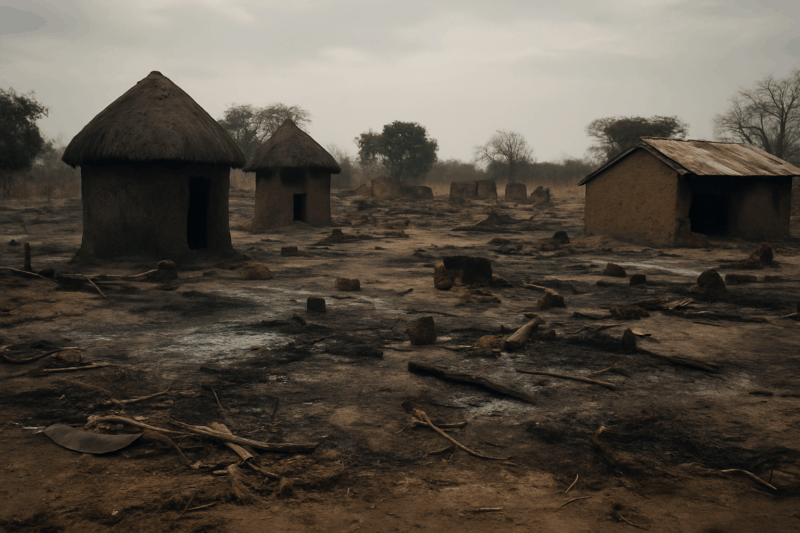
“When a nation blocks truth, peace, and war alike — only the dead speak loudest.”
There is something crueler than war. It is unending violence -slow, scattered, sporadic, yet consistent, staining the earth with blood without ever forcing humanity to evolve, decide, or adapt.
In Benue, Nigeria, this is the peculiar kind of violence that reigns: not the decisive conquest of a victor nor the full resistance of a people, but a limbo of death, displacement, and despair.
And at the heart of this limbo is not the Fulani herdsman, nor the Tiv farmer, nor even the AK-47, but the Nigerian government- a mutant so present that it obstructs nature’s resolution, and yet so absent that it allows unnatural inhumanity to fester, decaying everything within its sphere of ebullition .
In the world before modern nation-states, conflict- as brutal as it was , bore with it the weight of purposeful finality. Tribes clashed. Some were assimilated, others annihilated, many adapted. Tribute was demanded by victors; baseline was sought by the defeated. When war came, it came with a purpose: to change the structure of life, to reshape borders of belonging and authority, and to force a new way of living, even if that meant destruction, it heralded some sort of new stability and peace.
As John F. Kennedy once said “Peace is … a process, gradually changing opinions, slowly eroding old barriers, quietly building new structures.”
The defeated mourned or assimilated, the victors ruled, and life -however changed ,went on. In brutal simplicity, ancient wars often cleared the ground for a new, painful but stable order. Peace was the aftermath of horror-but it was, at least, an aftermath. In contrast, the Benue crisis offers neither horror intense enough to resolve, nor peace deep enough to heal. Here, people are being killed without being conquered, attacked without being defended, and displaced without being resettled. There is no arc to the violence, no decisive turn. Only a repetitive putrescent.
In the pre-modern framework, the current Benue crisis would have demanded a resolution: either the attackers prevail and impose a new order, or the defenders unite, resist, and repel- thereby resetting the terms of existence in a clear and painful, yet resolved, manner. The earth groans, but then heals. The people mourn, but then rebuild. The balance of life is upset, and then restored.
Benue continues to bleed because the Nigerian government is just enough of a state to block natural resolution, yet not enough of a state to herald just and humane stability.
The government declares borders, laws, and citizenship, denying the right of communities to fully defend themselves, to raise militias, to form alliances, or to mount offensive resistance.
It is not that the government is wicked because it has done nothing. The greater wickedness is that its very presence ensures that nothing truly happens. The people cannot retaliate. The state restrains them. The attackers are not prosecuted, deterred in any way. The state excuses them. The cycle continues, because the structure that could resolve it- either by full security or allowing natural justice, does neither. And in its divine silence, It restrains the hand of those who would protect themselves and yet does not lift its own to protect them, placating the public with hollow committees and empty promises. Neither Leviathan nor vacuum, it is the worst of both, monopolizing the right to violence, but refusing to exercise it for justice.
Benue has not been abandoned. That would be merciful. Benue has been trapped in an unresolving loop, not because there is no state, but because there is just enough of a state to ruin the possibility of decisive human adaptation.
The Nigerian government has perfected a terrible duality: it is just strong enough to suppress self-determination, yet too weak to ensure safety or justice.
As Thomas Hobbes warned in Leviathan:
“Covenants, without the sword, are but words.”
Nigeria made quick promises to Benue, to all its citizens – of safety, justice, dignity; made for a constitution, for elections, and slogans- but restricts the sword of justice. Of protection. Of order. It criminalized tribal self-defense, delegitimized secession, outlawed autonomy-but failed utterly in the one justification for those restrictions: to ensure the security of life.
So, when the Benue farmer is butchered, he is not permitted to fight back, and not protected from future attacks. The government has removed the tribal spear, and then left the village door open.
This paradox is not limited to Benue. It is Nigeria’s governing DNA. It explains why Boko Haram can terrorize the North-East for over two decades without resolution. Why oil theft persists in the Niger Delta. Why bandits rule highways from Zamfara to Kogi. Why corruption is permanent. And why, despite its “no victor no vanquished” mantra and the famous 3Rs, the civil war remains, for all practical purposes, unresolved- half a century later.
The tragedy of Benue and the struggle for Biafra are not the same, but they share a common enemy: a state that neither governs nor allows governance.
The Igbo people’s cry for Biafra is not just a political ambition; it is a reaction to persistent existential frustration- a hunger for resolution. In a state where the East’s roads remain impassable, its ports economically strangled, and its people repeatedly targeted or politically excluded, the dream of Biafra becomes a philosophical rejection of eternal disequilibrium and dis-equity.
As Kwame Nkrumah said:
“The forces that unite us are intrinsic and greater than the superimposed influences that keep us apart.”
But Nigeria, as presently constructed, clings to being a superimposed influence. The colonial invention that must be upheld by force and convenience, not by trust or shared destiny. And so Biafra, like Benue, reminds us that when a people are not allowed to win, not allowed to lose, not allowed to leave, and not allowed to live, the ligatures of fusion turns a festering fetid, putrefying the whole amalgamation.
So, the the Nigerian state is failing not just Benue and Biafra, but everyone. It has failed to:
Provide basic security.
Uphold economic fairness.
Deliver infrastructural development.
Manage diversity with dignity.
Enforce justice against the powerful.
Create a national identity stronger than ethnic mistrust.
It is why Yoruba self-determination movements will re-emerge stronger in succeeding dispensations. Why Northern elders speak of “restructuring” with desperation. Why young Nigerians migrate en masse. And why many now openly say what once was whispered: “Nigeria is a scam…”
What all of these indicate is not hatred for peace- but a deep yearning for resolution, in any form that honors dignity. People are tired of bleeding without burial, waiting without change, and voting without power.
A massacre is terrible. A genocide is horrifying. But worse is their repetition without consequence. To be killed once is tragedy. To live always under the shadow of death without resolution is a psycho torture that neither allows the soul to resist nor to grieve fully.
In 2018, Benue wept. In 2021, it bled. In 2024, 2025 the blood still flows. Children grow up not in war, but in fear of the next sudden attack. There is no dignity in this condition — only slow erasure. No total defeat, no total victory, no reintegration, no repair. Just waiting.
To live in chaos is to suffer. But to live in eternal near-chaos, in a world where violence is always nearby but never dealt with, where injustice is routine but never punished- is to suffer without hope. And that is what Nigeria offers today.
According to Jean-Paul Sartre, “When the rich make war, it’s the poor who die.”
In Nigeria, the rich do not even need to make war. Their failure to govern is killing off the poor- all the Benue and all the Nigerian poor.
Benue’s agony has become a mirror of what Nigeria has become: a place where nothing is allowed to be resolved-not by law, not by war, not by negotiation.
The way forward is stark: Nigeria must choose. Its institutions must either become asset for a true federal state where every region has the means and right to protect itself and prosper, or it must make way for an orderly dissolution or restructuring into smaller nations with the right to self-determination.
But it must not continue as it is-a graveyard of half-promises, half-governance, and half-peace.
As Sun Tzu once said, “There is no instance of a nation benefiting from prolonged warfare.”
And there is no instance of a people benefiting from unending bedlam either. The only gain from the current arrangement is for those who profit from confusion -corrupt politicians, arms dealers, and foreign parasitic interests.
Benue is dying. Nigeria is decaying. Not because Nigerians are broken -but because the Nigerian state is a cage designed by unsensitized outsiders, must be maintained by desensitized insiders, and failing all.
To continue this half a life is to choose spiritual decay. Nigeria must act- or allow others to act for themselves.
It must find a way to allow the cycle of history to do what it always has: bring the pain that resets humanity, or the clarity that restores it.
But to do nothing, to continue blocking even the possibility of ordered finality is the cruelest tyranny of all.

Continue Reading