
Africa
The Unraveling Covenant: How the Persecution of Nnamdi Kanu Exposes Nigeria’s Systemic Injustice Against the Igbos -By Jeff Okoroafor
The magistrate court in Kuje remands Prince Emmanuel Kanu & Barrister Aloy Ejimakor for protesting Nnamdi Kanu’s illegal detention. This op-ed analyzes how President Tinubu’s government is defying court orders & criminalizing dissent, exposing deep-seated injustice against the Igbo people and a blatant disregard for the Nigerian constitution.

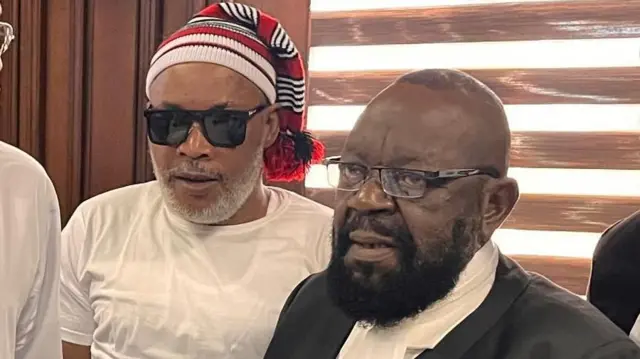
The recent image is not just a news headline; it is a perfect, damning snapshot of the Nigerian state’s relationship with the Igbo people. Prince Emmanuel Kanu, the brother of the detained leader of the Indigenous People of Biafra (IPOB), and his lawyer, Barrister Aloy Ejimakor, have been remanded in Kuje Correctional Centre. Their crime? Participating in a protest demanding the release of their brother and client, Nnamdi Kanu—a right explicitly guaranteed by Section 40 of the Nigerian Constitution.
This act is not an isolated incident of heavy-handed policing. It is the logical culmination of a deliberate, systemic, and multi-branch conspiracy to strip a people of their rights, silence their dissent, and defy the very rule of law that holds a nation together. Under President Bola Tinubu, this injustice has not only continued but accelerated, cementing his legacy as a leader who rules by fiat, not by law.
To understand the profundity of this injustice, one must return to the case of Nnamdi Kanu himself. In 2017, Kanu was granted bail by a court of competent jurisdiction. The state, in a display of sheer impunity, flouted this order. His home was allegedly invaded by the military in a controversial operation, leading him to flee for his life. Upon his extraordinary rendition from Kenya in 2021—an act internationally condemned as a violent abduction and a gross violation of international law—the stage was set for a legal reckoning.
That reckoning came on October 13, 2022, when the Court of Appeal, in a landmark judgment, struck out all charges against Nnamdi Kanu. The court did not merely grant him bail; it unequivocally stated that the government’s actions—the “brazen illegality” of his rendition—had ripped the very fabric of the legal process, making a fair trial impossible. It ordered his unconditional release.
The then-government of Muhammadu Buhari, in an act of contempt that should have sparked a constitutional crisis, ignored this ruling. It kept Kanu in detention, inventing a novel and dangerous doctrine of “national security” that places the executive above the judiciary.
Enter Bola Tinubu. A man who built his political persona on the struggle for democracy during the military era, one would have expected a champion of the rule of law. Instead, his administration has doubled down on this lawlessness. Rather than complying with a clear court order, his government has pursued desperate and frivolous appeals all the way to the Supreme Court, not in pursuit of justice, but in pursuit of perpetual detention. This is the hallmark of a tyrant: the belief that the state’s might makes it right, and that court orders are mere suggestions to be obeyed only when convenient.
The remand of Barrister Aloy Ejimakor is a watershed moment in the erosion of legal and democratic norms. A lawyer’s sacred duty is to provide a robust defense for their client. By arresting and jailing Kanu’s lead counsel for the “crime” of protesting his client’s illegal detention, the state sends a chilling message to the entire legal community: Defend this man at your peril.
This is a tactic straight from the playbook of the world’s most repressive regimes. It is designed to isolate a dissident, frighten his advocates, and ensure that his cause dies in the silence of a deserted courtroom. Similarly, jailing a client’s family member for advocating for his release is a form of collective punishment, a brutal tactic intended to break the spirit of the detainee and intimidate his support base.
The charges of “inciting disturbance” and “breach of public peace” for a protest are the flimsiest of pretexts. Since when did the right to protest, a cornerstone of any democracy, become contingent on the government’s approval of the cause? The traffic allegedly obstructed is temporary; the denial of a court order is a permanent obstruction of justice.
President Tinubu will, indeed, go down in history, but not as the democrat he once purported to be. His legacy is being forged in the steel of the Department of State Services (DSS) dungeon where Nnamdi Kanu is held, and in the Kuje cell that now houses his brother and lawyer.
His administration’s actions regarding the Kanu case are of a piece with a broader pattern of disregard for the rule of law and a cloud of corruption:
1. The Chicago State University Scandal: The certified records from the U.S. District Court Northern District of Illinois present a staggering portrait of alleged forgery and perjury. A president whose academic credentials are shrouded in such controversy lacks the moral authority to preach about the sanctity of national integrity.
2. The Poverty Mandate: Tinubu assumed office and immediately enacted policies—the removal of the fuel subsidy and the floating of the Naira—without a clear social compact or legislative cushion. The result has been catastrophic hyper-inflation and unprecedented hardship, demonstrating a callous disregard for the welfare of the very citizens he swore to protect. Governing by edict in matters that deeply affect the populace is economic tyranny.
3. The Lagos Blueprint: Tinubu’s political history is inextricably linked to allegations of a fiefdom in Lagos, where the lines between public treasury and private interest have been persistently blurred. Governing Nigeria with the same tactics of patronage and control only nationalizes a system many have long criticized as corrupt.
By continuing the illegal detention of Nnamdi Kanu and now escalating it to the persecution of his family and counsel, Tinubu is proving that his governance model is not based on legal or ethical principles, but on the raw calculus of power. He believes that by crushing the most potent symbol of Igbo grievance, he can silence an entire people.
The plight of the Igbo in Nigeria is not merely about Nnamdi Kanu. He is a symptom of a festering wound—the wound of the civil war, of abandoned properties, of state-sponsored marginalization in federal appointments and infrastructure, and of the persistent rhetoric that treats Igbo ambition for equity as a crime.
A nation that refuses to obey its own courts has ceased to be a democracy. A government that jails lawyers and family members for peaceful protest has become a persecutor. The conspiracy Kanunta Kanu alleged—involving the executive that disobeys courts, the legislature that remains a silent accomplice, and the judiciary whose orders are treated with contempt—is not a theory. It is a lived reality for millions.
The remand of Prince Emmanuel and Barrister Ejimakor is not just an attack on one family or one legal team. It is an attack on the Constitution, on the legal profession, and on the fundamental rights of every Nigerian who believes in justice. History’s judgment will be severe. It will record that when faced with a choice between upholding the law and perpetuating a toxic majoritarian impunity, Bola Ahmed Tinubu chose the path of the tyrant, and in doing so, deepened the very fissures he claims he wants to heal.

Jeff Okoroafor
Jeff Okoroafor is a social accountability advocate and a political commentator focused on governance, accountability, and social justice in West Africa.


























You must be logged in to post a comment Login