
Africa
The Wike–Navy Officer Encounter: A Test of Power, Protocol, and Professionalism -By Abdulazeez Toheeb Olawale
Experts suggest that the government should use the episode as an opportunity to review inter-agency communication and re-establish clear boundaries of authority between political office holders and security operatives.

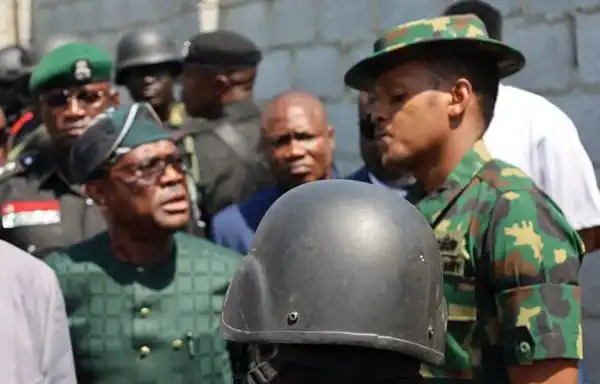
Abuja, Nigeria — The recent confrontation between Nigeria’s Minister of the Federal Capital Territory (FCT), Nyesom Wike, and a young naval officer, Lt. A. M. Yerima, has ignited national debate over authority, professionalism, and the fragile balance between civil and military institutions in Nigeria’s democracy.
The incident, which occurred on Tuesday, November 11, 2025, at Gaduwa District in Abuja, was captured in a viral video showing Minister Wike questioning the officer’s presence at a construction site reportedly linked to a former Chief of Naval Staff. Standing firm, the officer calmly responded, “I am not a fool, sir. I am acting on orders.”
That brief exchange — barely a minute long — has since spiraled into one of the most discussed civic moments in recent times, symbolizing both Nigeria’s institutional tension and the citizens’ yearning for accountability and mutual respect in public service.
Mixed Reactions Across the Nation
The fallout was immediate. Public opinion split sharply, reflecting Nigeria’s broader struggle between military discipline and civil supremacy.
The Coalition of Military Veterans condemned the minister’s tone, describing his remarks as “insulting and uncalled for.” They demanded a public apology and urged the federal government to defend security officers carrying out legitimate duties.
In contrast, some political commentators — including APC chieftain Joe Igbokwe — defended the minister, arguing that civil authority must always take precedence and that the officer should have de-escalated the confrontation rather than exchange words.
Meanwhile, Minister of Defence, Mohammed Badaru, publicly commended Lt. Yerima’s composure, stating that the government would protect officers acting under lawful orders. “The Nigerian military operates under clear directives, and no officer should be harassed while performing his duty,” the minister reportedly said.
A Reflection of Institutional Friction
This encounter has sparked a broader national conversation on civil–military relations — a recurring theme in Nigeria’s post-democratic era.
Analysts argue that while civilian authority remains supreme under the constitution, uniformed personnel are often caught in politically sensitive operations, especially in Abuja, where military presence intersects with administrative control.
Dr. Habiba Lawal, a security governance expert, notes that the Wike–Yerima exchange underscores a long-standing gap in communication between political authorities and security operatives. “We often see power being exercised without coordination,” she said. “When roles overlap, friction is inevitable. What matters is how institutions manage such conflicts.”
Observers also warn that repeated confrontations of this nature could damage public trust in governance structures, especially when both civil and military actors appear at odds in public.
Public Reaction: A Mirror of Frustration
For many Nigerians, the viral video carried more than just a power struggle — it symbolized the state of governance and respect for duty in a nation struggling to define its standards.
Social media users overwhelmingly praised Lt. Yerima for his calmness and composure, describing him as “the face of quiet courage” and “a true officer of the law.” Others accused Wike of overstepping his boundaries, seeing his reaction as reflective of Nigeria’s wider leadership arrogance.
Yet, there were also voices cautioning against romanticizing insubordination, emphasizing that the uniformed services must remain under civilian oversight.
Lessons and Implications
As investigations into the incident continue, the confrontation has become a case study in the intersection between power, respect, and professionalism.
Experts suggest that the government should use the episode as an opportunity to review inter-agency communication and re-establish clear boundaries of authority between political office holders and security operatives.
More importantly, it calls for restraint and maturity on all sides — an acknowledgment that Nigeria’s democracy thrives only when both civil and uniformed institutions operate in harmony, guided by mutual respect and the rule of law.
In the end, the Wike–Yerima exchange may have been brief, but its echoes reach far beyond a tense encounter at Gaduwa. It has become a symbol — a reminder that in the service of the nation, dignity, discipline, and dialogue must coexist.
Abdulazeez Toheeb Olawale is a young Nigerian writer and advocate for positive change, using journalism as a tool to amplify truth and hope.





















You must be logged in to post a comment Login